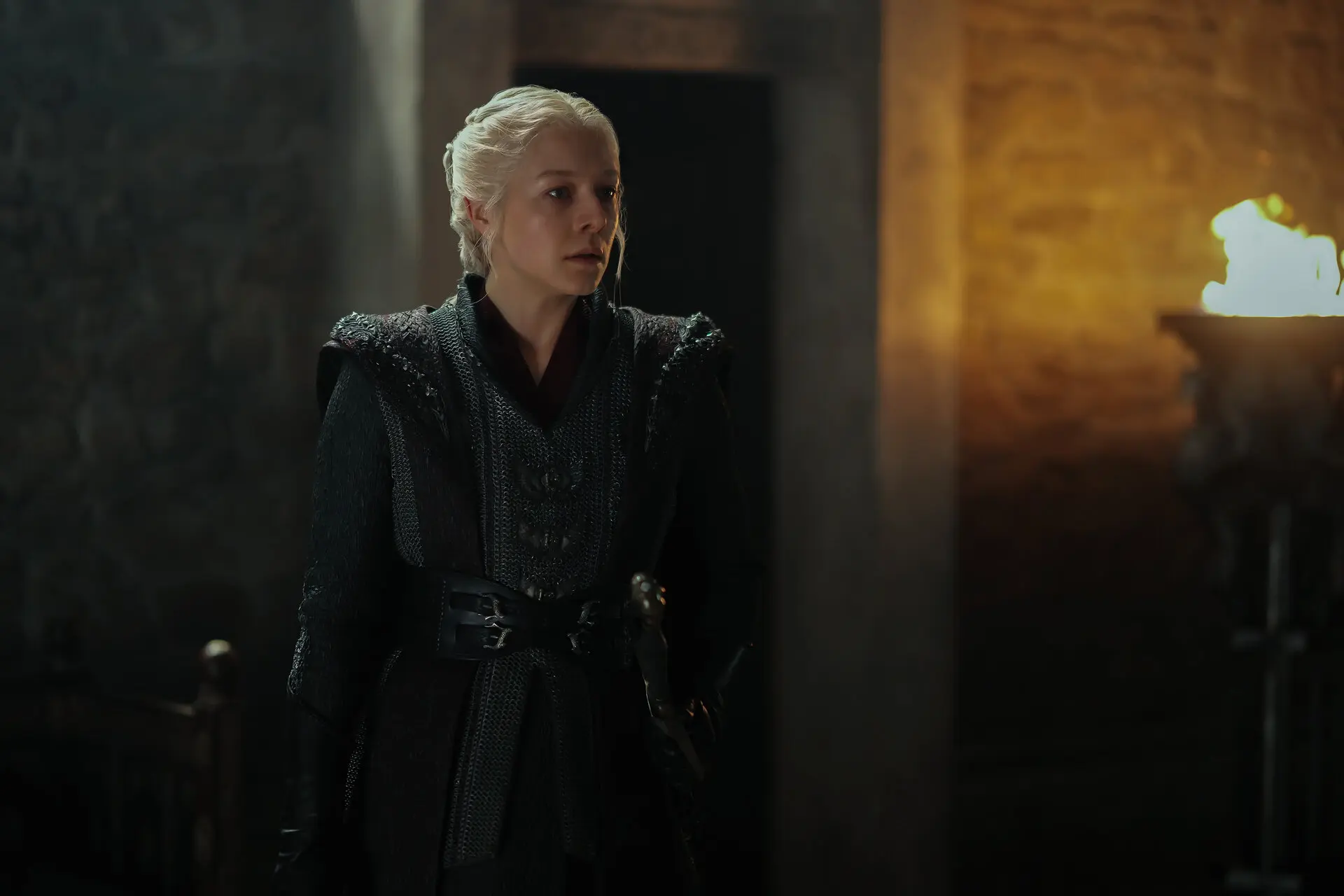























Ser Criston Cole does not die the way a knight in his own legend is supposed to die. There is no decisive duel, no final act of nobility, no scene in which the camera allows him to become heroic. Arrows simply tear through him in an ambush — quickly, brutally and almost casually. For a man who spent his life searching for meaning in honor, war and service, it is close to a perfect ending.
In House of the Dragon, Criston’s death is not even the central event of the episode. That is precisely why it works. The man who helped crown Aegon II, became Hand of the King, shaped the Greens’ politics and played a major role in the civil war disappears in the middle of the story. The world does not stop to mourn him.
For Fabien Frankel, that ending was close to ideal. The actor did not want Criston’s death to become a reward — a grand dramatic set piece that would allow viewers to feel fully satisfied. Cole had to leave suddenly, denied exactly the kind of glory he once imagined for himself.
As Daycom sees it, that is the key to the entire character. Cole begins as a man who believes in a relatively simple order: knightly honor, love, loyalty, service. Once he enters the world of the Targaryens, where personal desire cannot be separated from power, he gradually turns those virtues into sources of destruction.
Early in House of the Dragon, Criston almost resembles a romantic hero. A man of modest birth who rises through skill with a sword, he becomes a member of the Kingsguard and grows close to Rhaenyra Targaryen. Their relationship appears, briefly, to offer him a way out of Westeros’s rigid social hierarchy.
Rhaenyra’s refusal to abandon everything for him becomes the fracture point. Cole cannot accept that their relationship meant something different to her than it did to him. Personal humiliation hardens into resentment, and resentment gradually becomes political loyalty to her enemies.
With Alicent Hightower, he finds a new form of service. Their relationship is more complicated than a conventional romance: desire, guilt, religious morality and mutual loneliness all blur together. In the end, Criston becomes one of the people who place her son on the throne.
That is how the Kingmaker is born.
But the title that sounds like the summit of his life is really the beginning of his decline. Aegon’s coronation does not restore order. It unleashes a war in which elegant ideas about duty, honor and loyalty quickly become meaningless.
Season 2 destroys Criston’s remaining faith in politics. He sees dragons not as symbols of royal grandeur, but as weapons capable of reducing armies to ash. Men can debate legitimacy, devise strategies and speak solemnly about valor, but a dragon passes overhead and all of it becomes dust.
After that, Cole turns almost nihilistic. His old belief in glory disappears. His Riverlands campaign in Season 3 no longer carries the spirit of conquest. It becomes an exhausted march by a man who roughly understands where he is going and no longer bothers pretending that victory waits at the end.
Paradoxically, this is when he appears almost free.
Frankel’s interpretation of Criston rests on a simple idea: he never truly understood politics. He may not even have been a great general. The one thing Cole always knew how to do without hesitation was be a soldier.
The royal court made him into someone constantly forced to lie to himself. He loved where love was politically dangerous. He spoke of honor while breaking his own vows. He condemned the morality of others while living under the weight of his own guilt. He wanted order and helped create civil war.
On the battlefield, those contradictions disappear. There is no need to explain himself. There is an enemy, a sword, rain, cold and the possibility that tomorrow will never arrive.
That is why the bleakest part of his story also becomes one of the calmest. Once Cole understands that the campaign has effectively become a march toward death, the knowledge does not destroy him. It liberates him.
A man who no longer expects a future stops trying to invent one.
That stands in sharp contrast to the Criston of the early seasons. He was always imagining another life: escaping with Rhaenyra, preserving the purity of his Kingsguard honor, serving Alicent, seeing the Greens triumph. His tragedy emerged from the gap between those fantasies and the world as it actually was.
By the end, the fantasies are gone.
Only Alicent remains.
Before his final campaign, Cole imagines her singing of his death and wraps her favor around the hilt of his sword. After everything that has happened, she is still the person occupying his thoughts as the end approaches.
That reveals something important about the hidden architecture of the character. Criston has no family in the life we know: no wife, children, siblings or parents to return to. His emotional world has gradually narrowed until it contains one person.
For him, Alicent is more than a lover. She becomes the final proof that beneath decades of violence, guilt and political hatred, something in his life was still real.
A scene filmed for Season 2 made that idea even clearer. Criston went to Alicent’s chambers and broke down in her arms. It did not survive the final edit, but for Frankel it became a crucial internal moment — the point at which Cole effectively admits that much of the chaos around him is the result of his own choices.
That makes his death more interesting than simple punishment for an antagonist.
Criston is easy to hate. He is cruel, hypocritical, vindictive and repeatedly projects his own guilt onto others. Yet House of the Dragon never reduces him entirely to caricature. Beneath the political fanaticism remains a man who made one bad decision, then another, and gradually built an entire life out of them.
That is why his ending is deliberately antiheroic. The show does not allow him to correct his mistakes through one final noble act. It gives him no great duel in which he can prove that somewhere inside he is still the true knight he once imagined himself to be.
He is not even allowed to die beautifully.
And that is exactly why the death feels right.
Westeros does not issue moral receipts. A major role in starting a war does not guarantee a major scene at the end of it. A man can help make a king, become his Hand and alter the fate of a realm — then die in the mud beneath arrows fired by people whose names he never knew.
For Criston Cole, that is almost the final release from the illusion that followed him all his life: the belief that suffering must eventually acquire a beautiful meaning.
It does not.
On the battlefield, where he finally felt most like himself, Cole receives what he had been moving toward for years.
Not glory. Not forgiveness. Not redemption.
Just an ending.