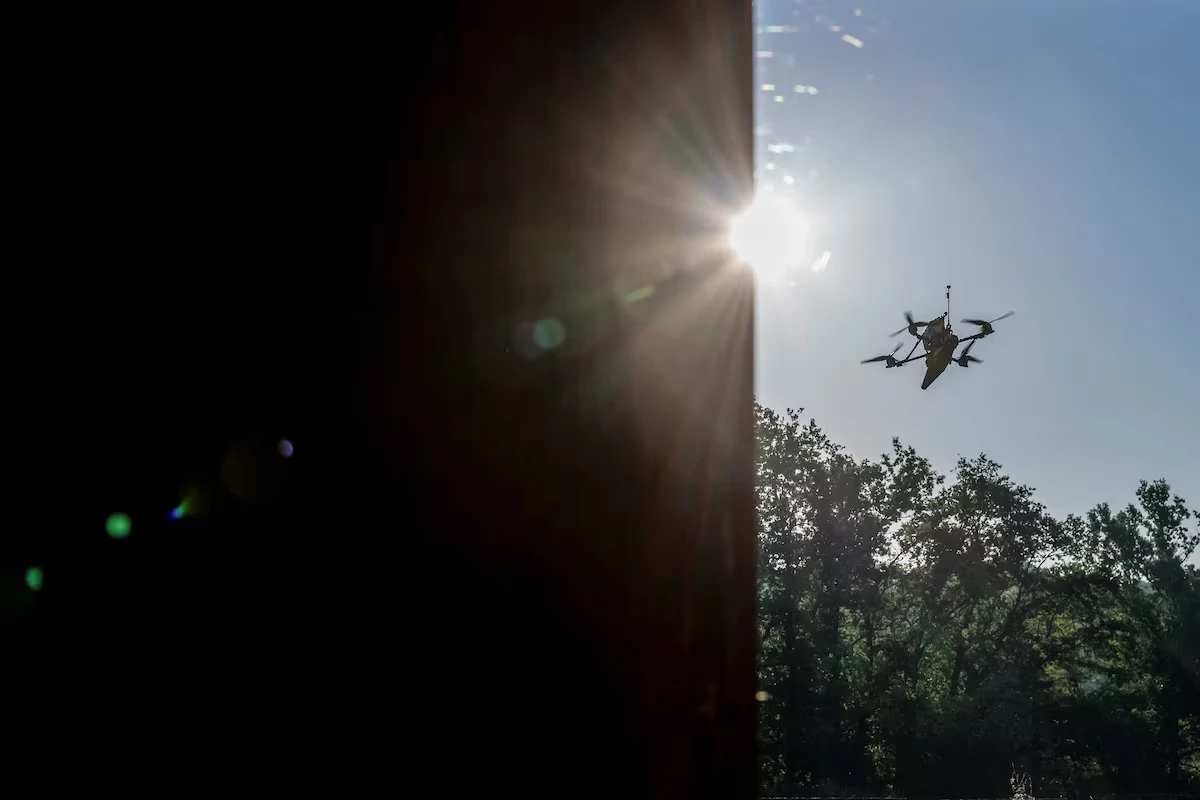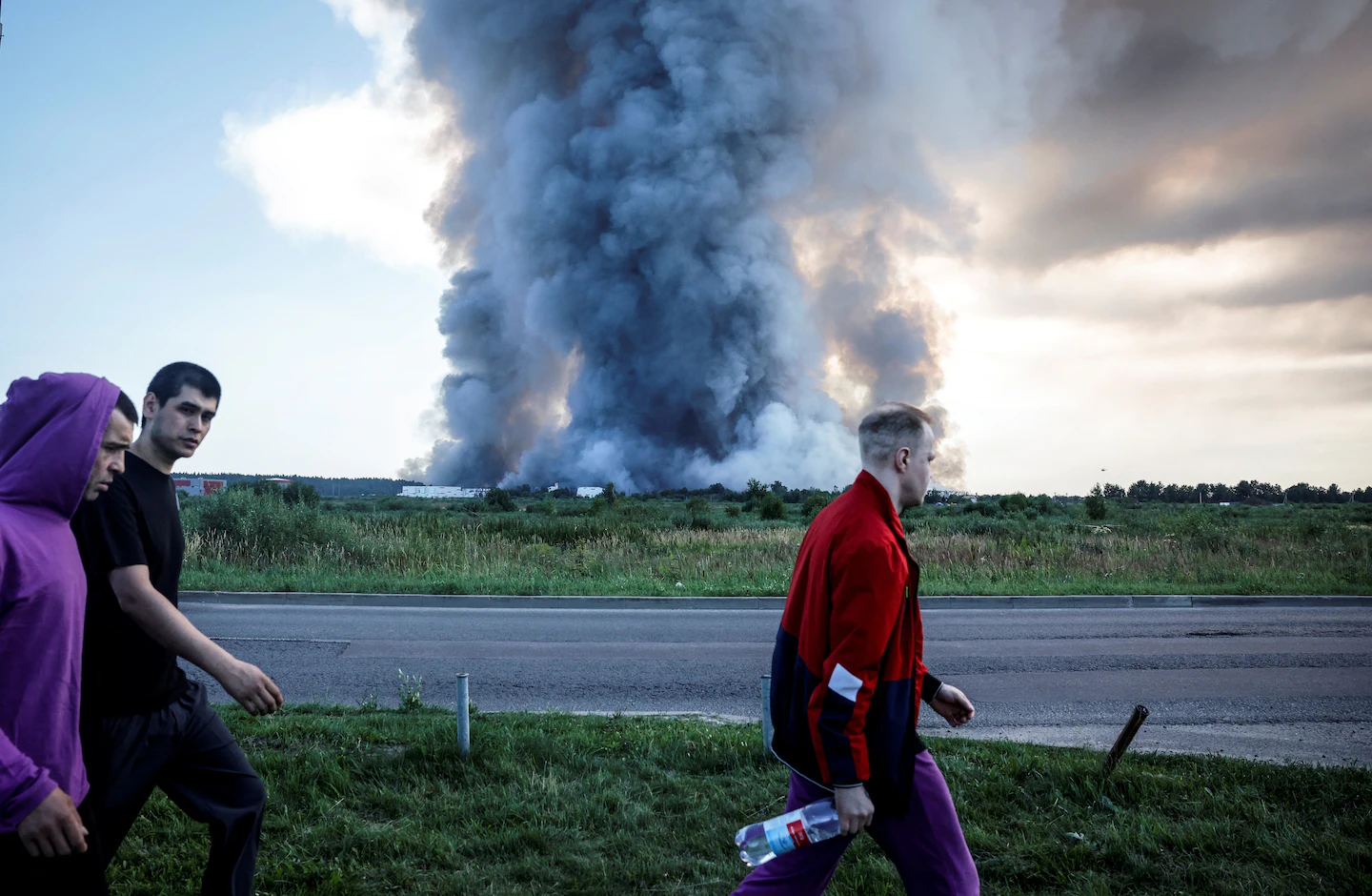





















A series of drone attacks has hit or threatened six facilities belonging to Ozon, Russia’s second-largest online retailer, in just three days. On August 24, the company reported fires at logistics hubs in Dagestan and near Krasnodar, while workers at two other sites were evacuated as a precaution.
The most serious incident occurred at Ozon’s logistics facility in Makhachkala, where a fire broke out after a drone strike and operations were suspended. The company said several people were injured and received medical attention. Preliminary information indicated that none of the injuries was life-threatening.
A second major fire was reported at a facility in Enem, near the Krasnodar metropolitan area. More than 300 employees were evacuated. Ozon said no injuries were reported there, while warehouses in Adygeysk and Nevinnomyssk were also cleared but escaped physical damage.
That distinction matters. Four Ozon sites were reported as targeted or directly threatened on August 24, but not all four were damaged. The clearest physical destruction was recorded at Makhachkala and Enem, while elsewhere the principal consequence was the interruption of work and evacuation of employees.
Daycom’s analysis of verified public reporting indicates that the drone strikes on Ozon warehouses are no longer easily dismissed as an isolated incident. In three days, disruptions have appeared across several widely separated regions, turning a distributed commercial logistics network into a new category of wartime exposure.
The first confirmed strike in the sequence came on August 22 at an Ozon logistics centre in Chapayevsk, in Russia’s Samara region. Operations were halted after a drone attack and subsequent fire. A day later, another facility in the Orenburg region was evacuated and temporarily taken offline.
By Monday morning, six Ozon locations had either been struck or faced an immediate drone threat since August 22. The pattern is important because the incidents occurred across different regions yet involved facilities performing the same basic function: storing, sorting and moving vast quantities of consumer goods.
Ukraine had not publicly provided a detailed account of every individual Ozon incident by the time the latest attacks were reported, nor had it explained why particular warehouses might have been selected. Russian authorities have attributed the attacks to Ukrainian drones, but that is not the same as a separate Ukrainian claim of responsibility for each strike.
Ozon has begun rerouting merchandise through alternative centres. Goods stored at closed facilities may temporarily disappear from the marketplace, some orders can be cancelled or redirected, and new deliveries to affected locations have been suspended while damage and operating conditions are assessed.
That response demonstrates both the strength and weakness of a large marketplace network. The loss of one warehouse does not shut down the entire system because traffic can be shifted elsewhere. But every diversion adds distance, sorting pressure and potential delays for sellers and customers across neighbouring regions.
Ozon operates one of the largest e-commerce logistics systems in Russia, with millions of square metres of warehouse space and tens of millions of active customers. Its business model depends on the continuous movement of goods between large fulfilment hubs, sorting centres and thousands of local pickup points.
A major hub in that system is more than a building filled with parcels. It receives inventory from thousands of merchants, stores products, assembles orders and feeds them into regional delivery routes. When one such node stops working, the disruption can propagate far beyond the city where the facility is located.
Investors reacted immediately to the latest attacks. Ozon shares fell by as much as 12% on the Moscow Exchange, while shares in AFK Sistema, one of the company’s major shareholders, dropped almost 13%. The declines reflected concern not only about immediate losses but also about the prospect of repeated disruption.
For a large retailer, a single warehouse fire is primarily a matter of repair costs, insurance and temporary lost capacity. A series of attacks changes the nature of the problem. Management must begin planning for simultaneous evacuations, security expenditure, spare capacity and alternative routes across several regions.
Ozon is also not the first large Russian marketplace to confront this kind of threat. Warehouses belonging to rival Wildberries have also been hit during the expanding drone campaign. By the summer of 2026, large e-commerce distribution centres were increasingly appearing in the same security discussion as industrial and energy infrastructure.
Ozon had already received an earlier warning on July 31, when it evacuated a facility in Tatarstan because of a drone alert. The warehouse was not damaged and returned to work quickly, but the incident showed that aerial threats were reaching commercial infrastructure far beyond Russia’s western border regions.
The August attacks made that geography more difficult to ignore. Samara, Orenburg, Dagestan, Adygea and Stavropol are separated by hundreds or thousands of kilometres. For companies operating nationwide networks, that means the drone risk can no longer be treated as a problem confined to a handful of exposed regions.
The status of the warehouses themselves, however, requires precision. Ozon is primarily a civilian e-commerce company serving ordinary consumers and merchants. There is no publicly available evidence establishing that every facility hit or threatened in the latest series was performing a specific military function.
That makes the attacks more legally and politically sensitive than strikes on oil refineries or clearly identified defence plants. Large logistics networks operate inside a wartime economy, but they also handle everyday civilian commerce. Those two roles cannot simply be treated as interchangeable without evidence.
Russian officials describe such incidents as Ukrainian attacks on civilian infrastructure. Kyiv, in the broader context of its long-range campaign, has repeatedly said that it seeks to increase the economic cost of Russia’s war and strike facilities supporting Moscow’s military capacity.
For individual Ozon facilities, however, any claim of military use would require specific substantiation. The size of a warehouse or its economic importance does not by itself make it a military objective. That distinction becomes especially important when the infrastructure is used daily by millions of civilians.
The attacks come as Ukrainian long-range drones increasingly reach refineries, factories, logistics installations and other facilities deep inside Russia. During some large overnight waves, the Russian Defence Ministry has claimed the interception of hundreds of drones, though the full scale of those figures is difficult to verify independently.
For e-commerce, this creates a new economics of security. Giant fulfilment centres were designed for efficiency: dense inventories, automation and the ability to serve large territories from a small number of hubs. Under sustained attack risk, the same concentration that lowers costs can become a strategic vulnerability.
Companies may eventually need more dispersed warehouses, redundant transport corridors and the ability to shift operations between regions within hours. Such resilience is expensive and runs partly against the economies of scale that made enormous centralised logistics centres attractive in the first place.
Insurance could also become a more significant cost. Once drone attacks are viewed as recurrent rather than exceptional, the price of protecting buildings, stored merchandise and transport chains can rise. Those expenses may eventually filter through to seller fees, delivery charges and consumer prices.
There is not yet enough information to calculate Ozon’s total losses from the August 22–24 incidents. The company has not disclosed the full value of destroyed merchandise, damaged equipment or lost operating time, and it remains unclear how quickly the worst-affected facilities can resume normal work.
The market reaction nevertheless suggests that investors are already looking beyond the cost of individual fires. The central question is recurrence. If distribution hubs continue to be targeted, wartime risk will have to be incorporated into warehouse investment, insurance, network design and the economics of Russian online retail.
For Ozon, the scale of its own expansion creates an additional dilemma. The more regions it tries to serve with rapid delivery, the more infrastructure it must expose and protect. In peacetime, that footprint is a competitive advantage. During a prolonged war, it becomes another layer of operating cost.
The drone strikes on Ozon warehouses therefore matter as more than another episode in the expanding long-range air war. They show how the geography of economic risk inside Russia is changing, reaching facilities that were designed solely around commerce, speed and consumer convenience.
If the pattern continues, the lasting consequence may not be the destruction of several individual warehouses but a gradual redesign of Russian logistics itself. A war long felt by consumers mainly through inflation, sanctions and shortages is increasingly reaching the physical system that moves everyday goods to their doors.