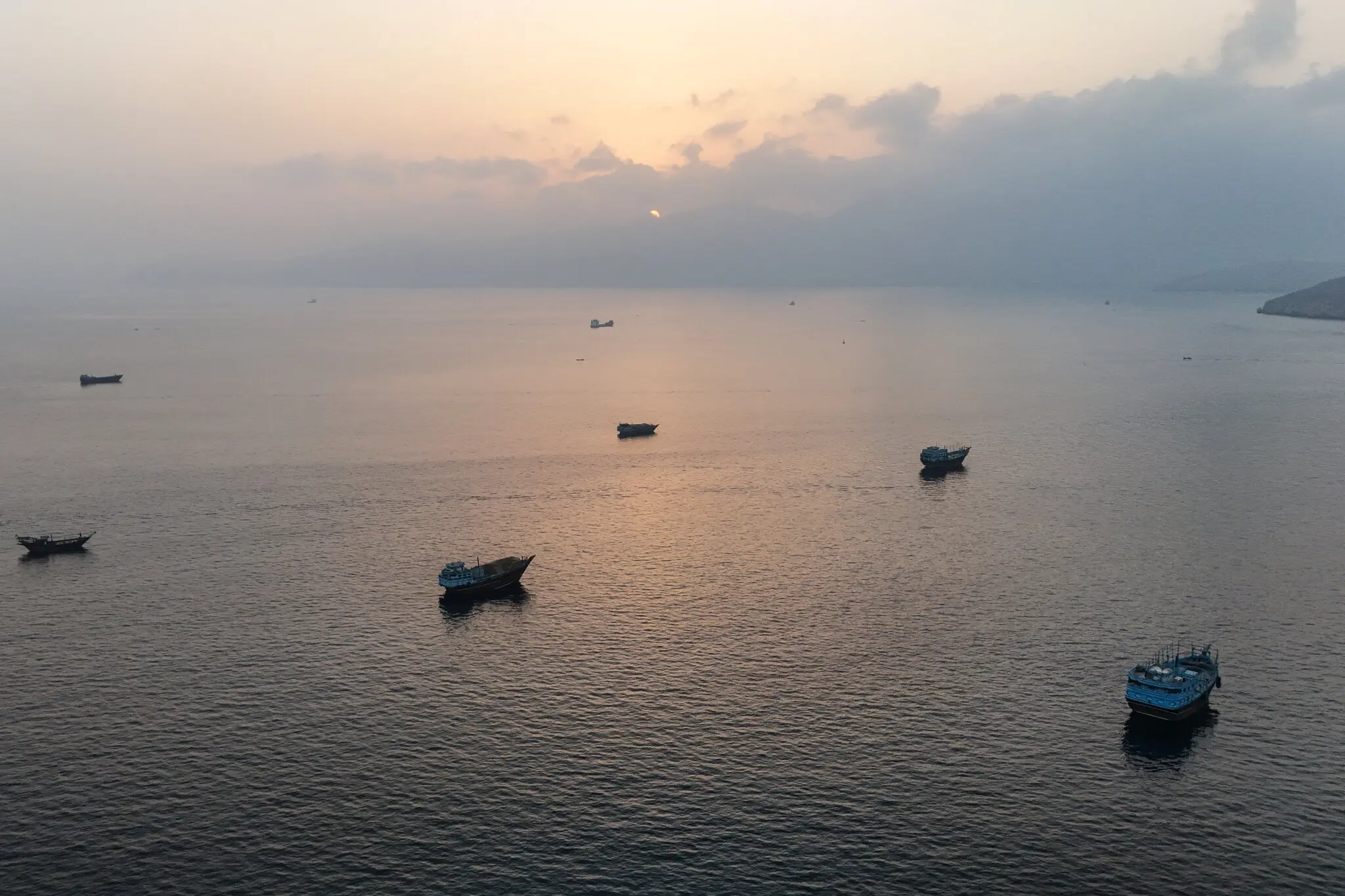






















The Strait of Hormuz has again become the point where a single military act can alter the entire Middle Eastern balance. After Iran’s navy attacked a container ship, the United States launched new strikes on Iran, effectively acknowledging that the diplomatic pause no longer works.
Tehran presented the attack as a response to an “unapproved” shipping route. Iran’s military insists that vessels must pass only through waters it considers acceptable. In that formula, there is no freedom of navigation. There is an attempt to impose a permission regime over the strait.
The most important element was not only the use of force, but Iran’s political message. Tehran said it would close the strait until the end of American interference in the region. This is no longer bargaining over a single route. It is a claim to define the conditions of movement through one of the world’s key energy corridors.
According to Daycom’s assessment, Iran has moved from limited pressure to the open use of Hormuz as a strategic weapon. The strait is no longer merely a maritime passage for Tehran. It is leverage against the United States, the Gulf states, insurance markets, oil traders and every country dependent on stable energy supplies.
The talks in Oman were meant to create at least a minimal framework for de-escalation. Iran’s foreign minister, Abbas Araghchi, discussed safe passage for ships, but offered no public guarantee that the strait would be reopened. Within hours, military logic had destroyed diplomatic caution.
That reveals the central problem of the current crisis: negotiations are moving more slowly than strikes. While diplomats search for language around “safe passage,” militaries define reality on the water. If a ship takes a route Tehran does not approve, it may become a target.
Washington had already issued an ultimatum: Iran must stop attacks on commercial vessels and recognize all channels of the Strait of Hormuz as open. Iran answered not with a concession, but with a shot at a container ship. For the United States, that became a direct challenge the Trump administration could hardly leave unanswered.
The American strikes continued a heavy week of military exchanges. Earlier, Iran had attacked several ships in the strait, some linked to Gulf states allied with the United States. The American response had already been large: dozens and then hundreds of targets, including military sites and infrastructure that could support Iranian pressure at sea.
But airstrikes did not force Iran to loosen its grip. Instead, Tehran showed that it was ready to raise the stakes after every American attack. For the Islamic Republic, Hormuz is the ideal place for asymmetric pressure: narrow, sensitive, globally important and complex enough that no side can easily establish full control.
The United States holds advantages in airpower, intelligence, naval strength and precision strikes. But that advantage does not automatically produce a political result. Washington can destroy missile positions, depots, communications nodes and military bases. It cannot restore confidence in shipping by order if Iran retains the ability to strike individual vessels.
For the merchant fleet, the risk has become practical. Captains, insurers and operators must now consider not only weather, navigation and freight costs, but the political interpretation of a route. If one state declares a channel “wrong,” safe passage becomes a matter of force rather than law.
That is especially dangerous for energy markets. Hormuz does not need a full blockade to affect prices. Regular attacks, threats and uncertainty are enough to raise insurance rates, increase transport costs, unsettle exchanges and change importers’ expectations. Markets react not only to the loss of barrels, but to the loss of predictability.
That is why Iran’s statement about closing the strait until American interference ends matters more than one shot. It moves the crisis from the technical realm of shipping into the political realm of a struggle over regional order. Tehran is effectively saying that if the United States wants to define Persian Gulf security, Iran can question the very possibility of normal movement through its exit.
Trump is answering in the language of force and threats. After declaring the June cease-fire effectively over, he returned to rhetoric about massive strikes. For his administration, this is a way to show that the United States will not allow Iran to dictate rules in Hormuz. But such rhetoric also narrows the space for compromise.
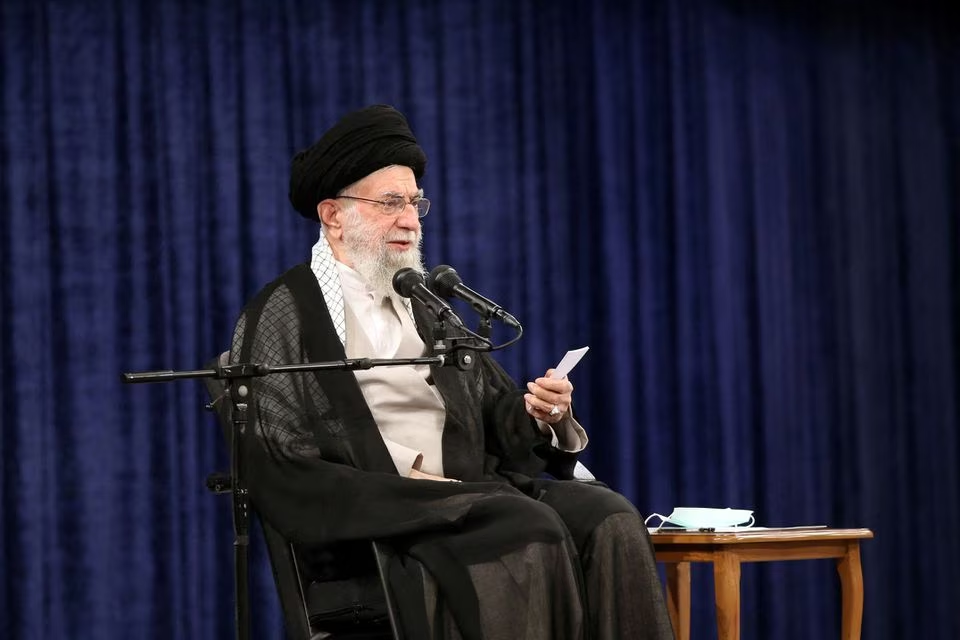
Iran’s domestic scene is also pushing toward hardness. The new supreme leader, Mojtaba Khamenei, has vowed revenge for the death of his father and predecessor, Ali Khamenei. After a week of funeral ceremonies that the regime used as a display of unity, that promise became not a private emotion, but part of state mobilization.
For the new leader, concessions in Hormuz would be dangerous. He inherited a country after strikes, war, losses and internal tension. He must prove strength not only to external enemies, but to his own system. That is why even a diplomatically useful compromise may look like weakness in Tehran.
This is what makes the cease-fire almost an empty form. The June agreement was supposed to open a 60-day space for broader negotiations over Iran’s nuclear program. Instead, that space has been filled with attacks on ships, American strikes, Iranian threats and an increasingly hard fight over routes in Hormuz.
Oman’s proposal for joint administration of the strait with Iran could appear to be a compromise for reducing tension. But it would also mean a deep change to the prewar order, in which ships generally passed freely. For the United States, that is an almost impossible choice: accept partial Iranian control for the sake of stability, or fight for the principle of free passage.
The Gulf states are caught between those options. They need American protection, but they fear becoming targets of Iranian retaliation. Their economies depend on a calm sea, while their security depends on their alliance with Washington. Hormuz forces them to pay for both dependencies at once.
For Saudi Arabia, Qatar, the United Arab Emirates, Kuwait, Bahrain and Oman, this is not abstract geopolitics. It is tanker routes, port insurance, currency stability, investment plans and domestic confidence in state security. Every new shot in the strait enters their budgets faster than it enters diplomatic communiqués.
The nuclear issue, meanwhile, is slipping into the background, even though it was meant to be the central subject after the cease-fire. It is impossible to build an agreement on uranium enrichment, inspections and guarantees while the sides are simultaneously fighting over who controls the most important maritime corridor in the Middle East.
That is the strategic trap for the United States. To force Iran toward negotiations, Washington increases pressure. To avoid looking defeated, Iran raises its own stakes. To answer those stakes, the United States strikes harder. Each new round makes a political agreement less likely.
Hormuz is now not only the subject of the dispute, but the mechanism that reproduces it. Each attack proves the need for a response. Each response proves Iran’s claim of American interference. Each Iranian claim justifies tighter control over the strait. It is a closed loop in which ships become arguments rather than transport.
The coming days will show whether diplomacy can restore even minimal rules of the game. But after Iran’s statement about closing the strait and the new American strikes, the chance of quickly rebuilding confidence has sharply declined. Shipping may formally continue, but its safety will no longer be treated as a given.
Iran has turned Hormuz into an instrument of coercion, and the United States has answered with force. Both sides believe they are defending vital interests. That is precisely what makes the crisis dangerous: neither has an easy exit without losing face. If the strait remains hostage to this logic, the cease-fire will finally become only the name of a brief pause between strikes.