



















A new detail in the Kyiv shooting case sharply changes the way this tragedy is understood. Where the public first saw the attack primarily as an act of terror with an unclear motive, a different and no less alarming picture is now emerging: the massacre may have grown out of a long-running neighborhood conflict that, at a critical moment, spun beyond all control. That possibility makes the story more frightening, not less.
Under the current account, the gunman first quarreled with a neighbor, and the chain of events then unfolded with terrifying speed. Shots were initially fired from a non-lethal pistol near the entrance to the building. The man then returned to his apartment, took a rifle, set the apartment on fire, and went into the street shooting at people. What followed came with the logic of collapse: hostages in a supermarket, a police assault, dead and wounded civilians, and a city left stunned. The sequence reads like the rapid breakdown of every safeguard at once — personal, institutional and social.
That is where the deepest anxiety lies. When mass violence begins not with an ideological plot or a carefully prepared act of sabotage, but with a local quarrel between neighbors, it suggests that danger is closer than society would like to admit. It does not always arrive from outside. It can grow inside the routines of urban life itself — out of accumulated resentment, mental instability, access to weapons, and a social environment accustomed to living under pressure.
According to Daycom’s earlier analysis, the war in Ukraine has altered not only the country’s security reality, but also the psychological texture of everyday life. Chronic stress, coarsened reactions, the normalization of force, and a constant sense of threat do not always directly produce violence. But they can lower the threshold at which a conflict ceases to be verbal and becomes lethal. What makes the Kyiv case so chilling is precisely that it suggests the distance between a private argument and a mass killing in an exhausted society may be much shorter than many assumed.
One detail makes that picture more unsettling still: the dictaphone. If the gunman was indeed recording the dispute, apparently to preserve evidence in case he later needed to defend himself before the police or in court, that suggests he may not initially have been thinking in terms of immediate mass murder. He may have been thinking in terms of documenting his version of events. And that is where the most frightening rupture appears: between the attempt to preserve one’s legal position and the decision to take a rifle, set an apartment on fire, and go into the street shooting lies a boundary that was crossed suddenly and irreversibly.
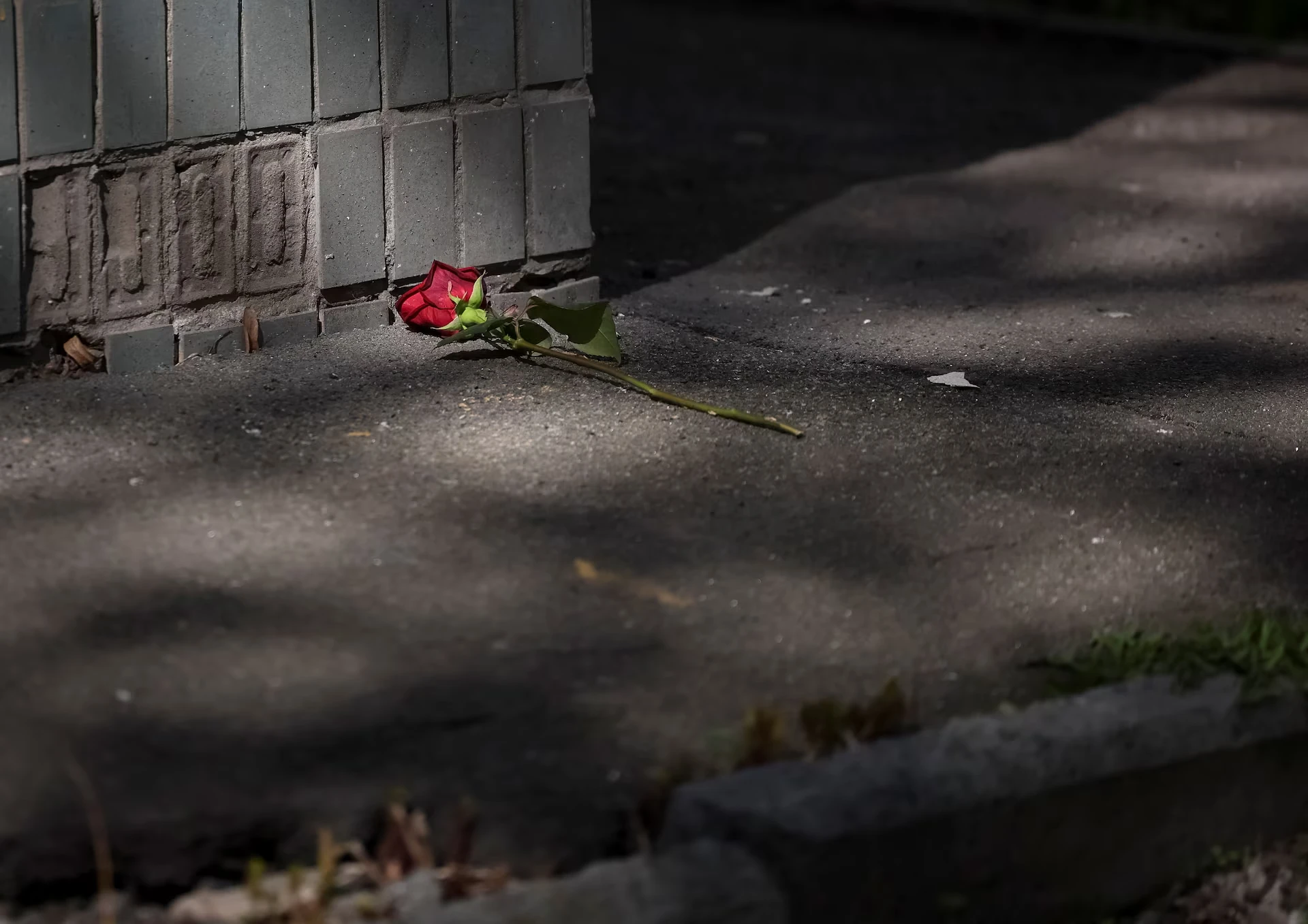 Квітка лежить на землі на місці вчорашньої стрілянини, у Києві, Україна, 19 квітня 2026 року — Гліб Гаранич
That matters both for investigators and for the public. It suggests the attack may not have been a fully formed operation from the outset, but a catastrophic escalation in real time. Which means the central question is not only who this man was, but what failed in his personal, social and institutional surroundings before the point of no return. Tragedies like this rarely emerge from nowhere. They accumulate inside fractures that often go unnoticed until they open all at once.
That is why public outrage is no longer focused only on the gunman. It has spread, inevitably, to the police. The video of patrol officers running from the sound of gunfire has become the moral center of the second phase of this crisis. Against the backdrop of a dispute that appears to have begun as something private and local, the institutional failure looks even harsher. The state did not fail to stop a highly trained outside saboteur in a complex operation. It failed to stop a man who, in the middle of an ordinary city space, moved step by step from argument to mass violence.
The reported removal of the entire management chain of Kyiv’s patrol police pushes the matter to another level. This is no longer only about the cowardice or professional inadequacy of two individual officers. It is an acknowledgment that the problem may run deeper — into training, command culture, crisis protocols and the ability to assume responsibility in the first seconds after gunfire begins. In that sense, the tragedy has exposed not merely human failure, but systemic fragility.
That brings the most dangerous issue back into view: weapons. If the attack did indeed begin with a quarrel between neighbors, then the question of access to firearms becomes even more urgent. In that case, this is not an exotic scenario involving foreign infiltration or a clandestine terror network. It is a case of internal breakdown in the control over who can possess a tool of instantaneous mass violence and under what conditions. For a country in which war has already blurred the psychological boundary between civilian and military space, that is one of the hardest questions of all.
And yet the demand for self-defense will also grow after an event like this. When people see police retreat and a gunman move freely down a city street continuing to kill, some will inevitably conclude that safety begins with personal arms, not state protection. The problem is that this logic can deepen the crisis rather than solve it. The weaker trust in the police becomes, the stronger the demand for armed self-defense. And the wider the access to weapons becomes, the greater the risk that new conflicts will end the same way.
This is where the state has to act with unusual clarity. It must do more than complete the investigation and assign blame. It must answer broader questions: how firearm permits are issued, how the mental fitness of gun owners is assessed, how patrol officers are trained for an active shooter scenario, and how the chain of command in the capital actually functions under pressure. Without those answers, every new detail in the case will only reinforce the sense that Kyiv was not confronted by a single madman, but by an entire system of delayed reactions.
In the end, the new account of a quarrel with a neighbor does not narrow the meaning of the Kyiv shooting. It widens it. It shows that in a wartime city, the source of a major tragedy may be not only an external attack, but an internal explosion of a private conflict multiplied by weapons, stress and institutional weakness. That is why this story has already moved far beyond the bounds of criminal reporting. It has become a mirror for a city learning to live under war — and discovering, each time, that some of the most dangerous fractures may run not only through the front line, but also between neighboring doors.