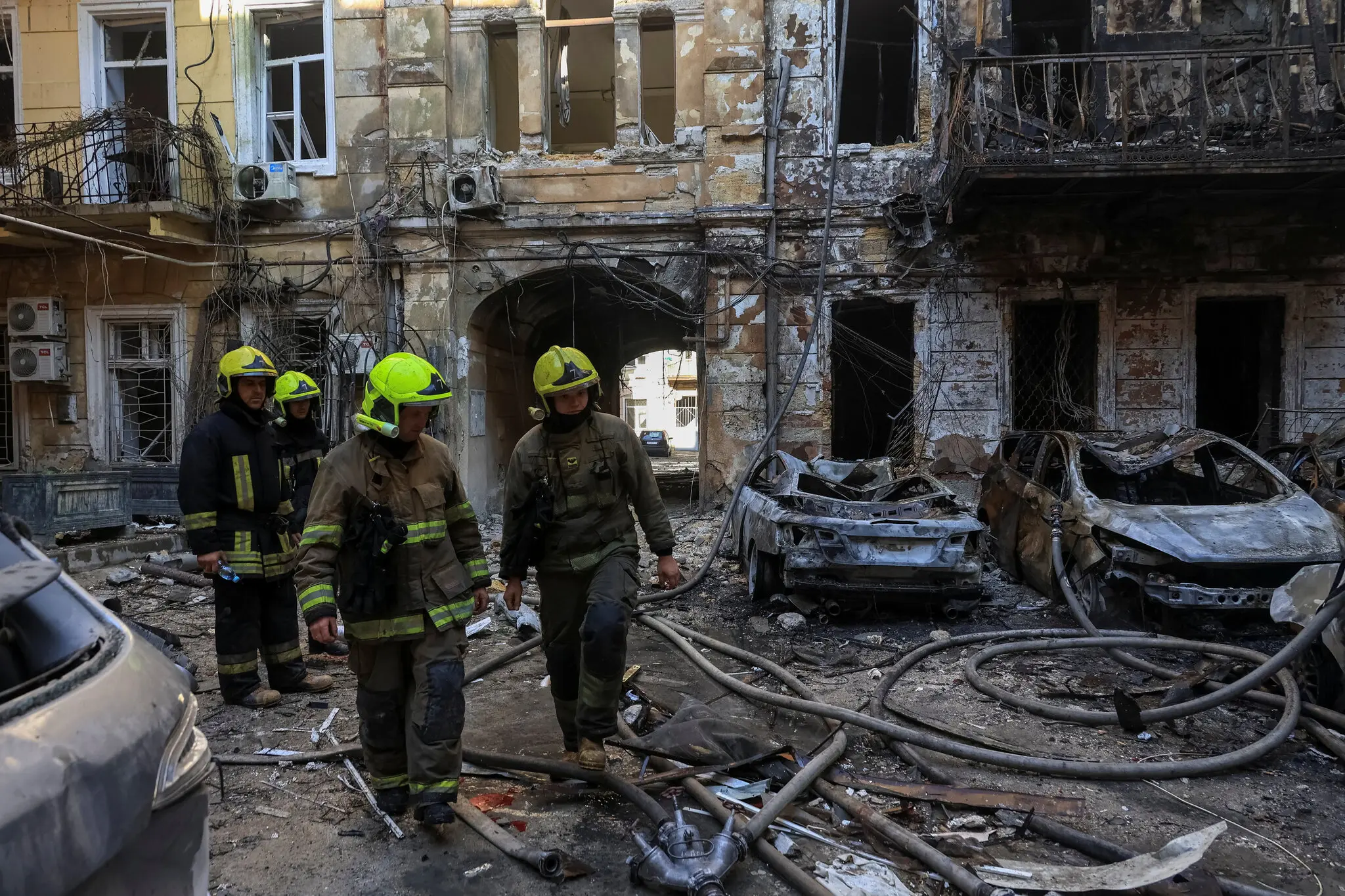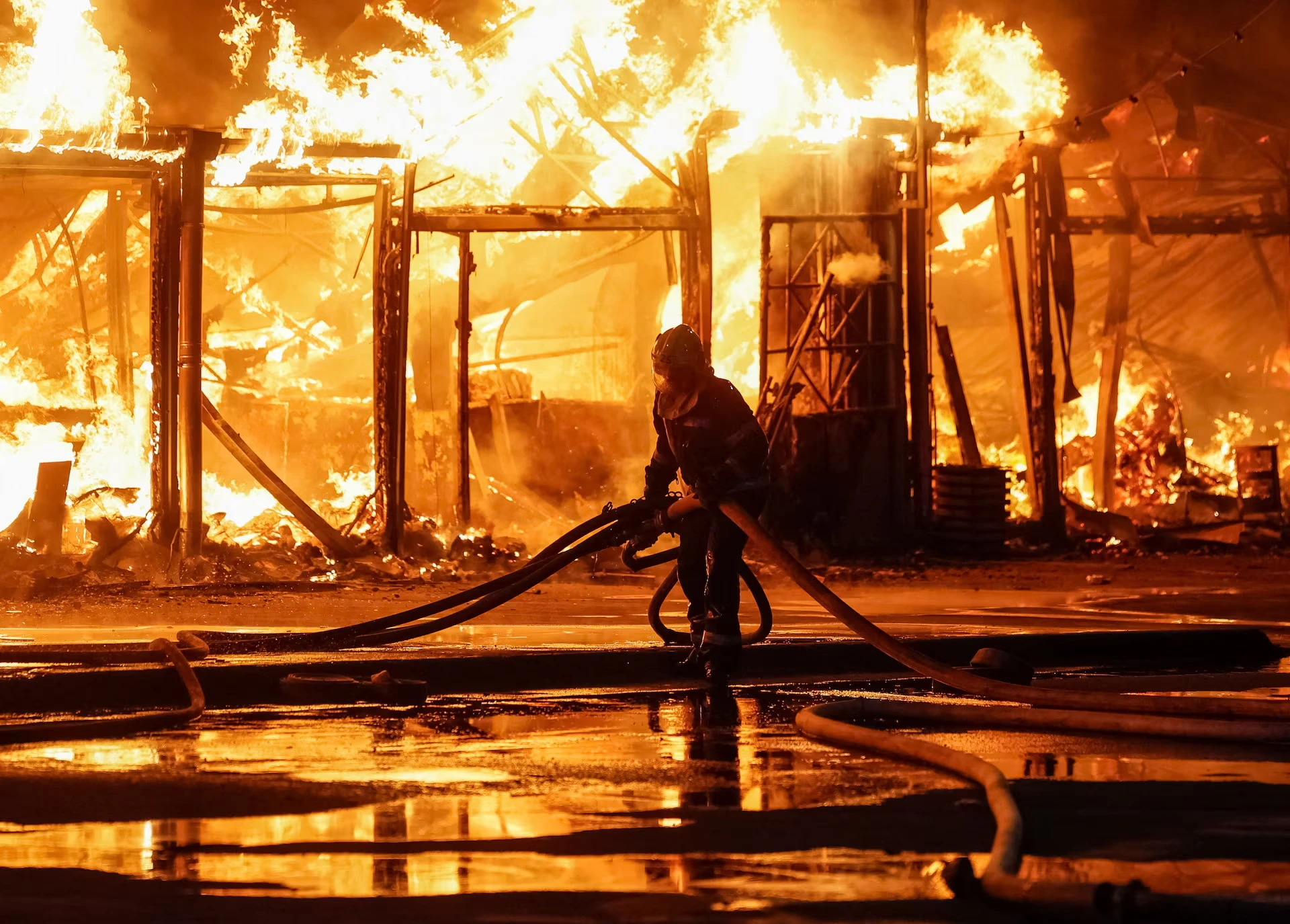




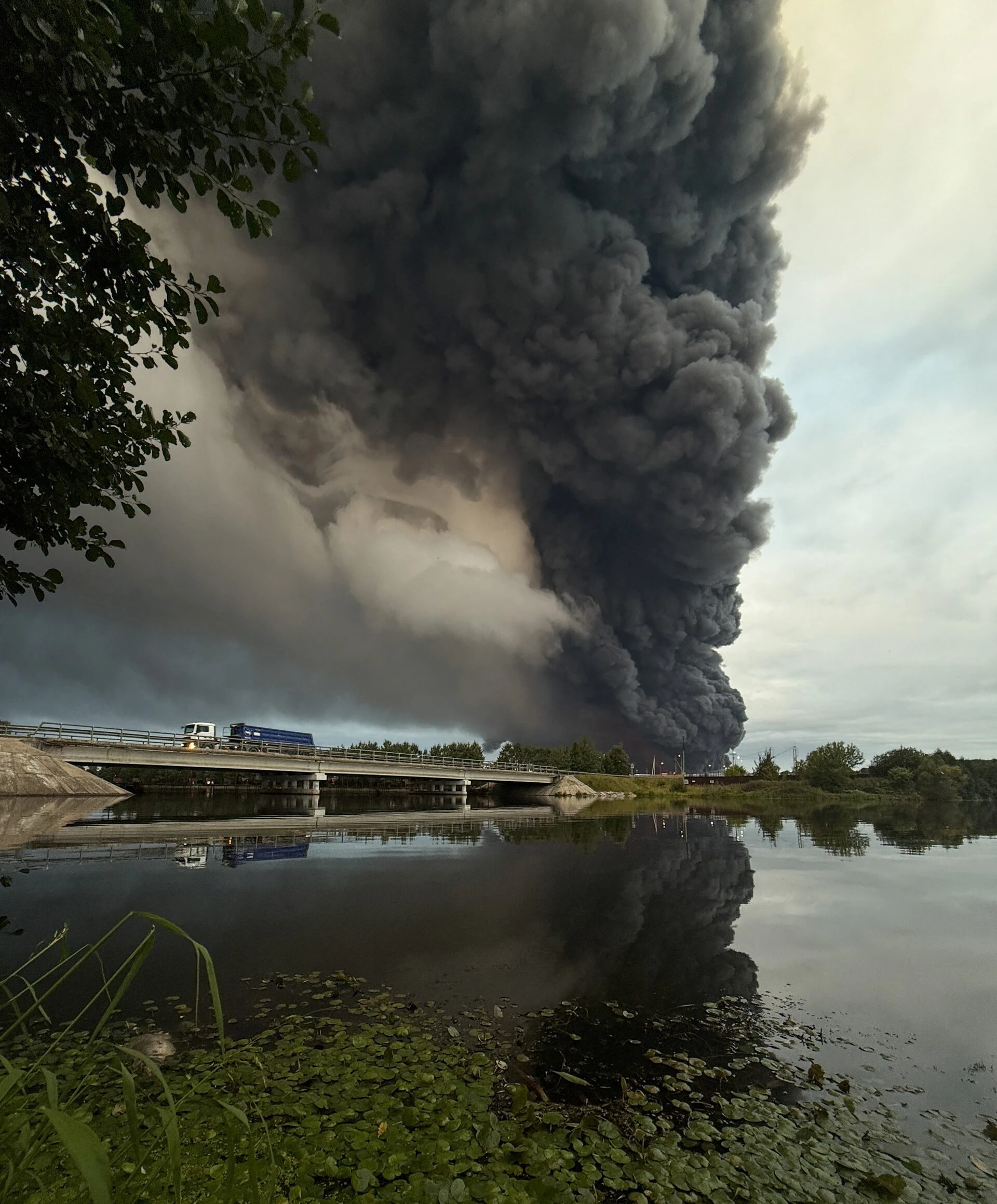




















At dawn on August 16, thick smoke was rising over one of Kyiv’s most recognizable book markets. After an overnight Russian strike, fire swept through trading stalls near Pochaina metro station — an area generations of residents still know by its former name, Petrivka. Firefighters worked among charred structures as the city emerged from another night of explosions.
Russian forces attacked the capital with missiles and drones during the night. Air-raid alerts sounded twice after 2 a.m., followed by explosions across Kyiv. Damage was reported in at least two districts, Obolonskyi and Holosiivskyi. By morning, city officials said three people had been injured.
In Obolonskyi district, the fire at the market became the most visible consequence of the attack. Trading structures and vehicles burned, while other nonresidential buildings were damaged. Another fire broke out south of the city center. Russian drones meanwhile continued toward the Kyiv region, where three additional people were wounded.
As Daycom has previously noted, Russian air attacks are increasingly defined not by a single weapon but by combinations of threats. Ballistic missiles, attack drones, short intervals between alerts and strikes from several directions force Ukrainian air defenses to respond simultaneously to targets moving at different speeds and along different trajectories.
For Kyiv, that combination is especially dangerous. Ballistic missiles leave far less time between detection and possible impact than slower attack drones. Residents may have only minutes to reach shelter, while air-defense crews face an equally compressed window in which to identify and intercept the incoming threat.
The overnight assault was not confined to the capital. Air threats were reported across several Ukrainian regions, and Russian forces used multiple types of missiles and unmanned aircraft. Such attacks are designed to stretch air-defense coverage, test weaker sectors and prolong the period during which the country must remain on alert.
Even when a large share of incoming weapons is intercepted, the danger on the ground does not disappear. Debris from destroyed missiles and drones can ignite fires, damage homes and vehicles, and disrupt infrastructure. A few minutes of air-defense activity above a city can translate into hours of work for firefighters, medics, utility crews and police.
This time, the most emotionally resonant image came from the book market near Pochaina. For Kyiv, Petrivka is more than a collection of commercial stalls. For decades, it has been one of Ukraine’s best-known centers of book trading, where new editions, textbooks, secondhand volumes, music and rare publications were sold side by side.
That history gave the fire a meaning beyond the immediate damage. In military reporting, a burned market is classified as a nonresidential site. In the memory of the city, it is a familiar cultural landmark tied to the everyday life of Kyiv long before Russia’s full-scale invasion.
The attack, however, did not end with the explosions inside the capital. In the morning, Russian strike drones again targeted the Kyiv region. Three people were injured, among them a child. Private property and residential structures were also damaged.
The pattern created several consecutive waves of pressure: a nighttime missile strike on Kyiv followed by drone attacks on communities outside the capital. This extension of attacks over hours has become one of the most exhausting features of the air war. The end of one alert no longer guarantees that the danger has passed.
For Ukrainian air-defense forces, this means maintaining readiness for prolonged periods. Emergency crews can be forced to respond to earlier damage while preparing for new incidents. For civilians, it erodes the sense that life can simply resume once a siren stops.
The effect is not purely military. Repeated attacks compel Ukraine to expend costly interceptor missiles, keep large numbers of personnel on constant alert and divert substantial resources to emergency response and repairs even when destruction is relatively localized.
Every impact can generate consequences well beyond the point where it lands. A fire may require road closures. A damaged structure needs inspection. Debris must be cleared. Public transport may be rerouted, utility systems checked and emergency teams kept at the scene for hours.
That is why the impact of Russia’s air campaign cannot be measured only in destroyed buildings or casualty figures. A war of attrition works through accumulation: repair costs, pressure on infrastructure, lost sleep, repeated alerts and the psychological burden placed on millions of people living under the expectation of another strike.
Kyiv has become highly practiced at restoring its daily rhythm after such nights. Metro trains continue running, shops reopen, municipal crews clear debris and residents go back to work. But the speed of that recovery can obscure the cost that accumulates beneath the surface.
That cost is measured in damaged homes, destroyed property, air-defense ammunition and hundreds of hours of emergency work. It also includes less visible losses: chronic exhaustion, anxiety and the knowledge that another warning siren can interrupt an ordinary night without notice.
The August 16 attack illustrates that broader pattern. Ballistic threats, drones, damage in several districts of Kyiv, strikes in the surrounding region and fires at civilian sites all unfolded within the same sequence. These are no longer isolated incidents but part of a sustained method of applying pressure to a major city and the communities around it.
Russia does not need every missile or drone to produce a strategic result on its own. The frequency of the attacks forces Ukraine to spend continuously on interception, recovery and the maintenance of basic urban life. That cumulative demand is one of the central mechanisms of an air campaign built around exhaustion.
Kyiv entered Sunday morning with smoke above a book market and firefighters working among damaged structures. Hours later, the consequences of new attacks were being recorded outside the capital, where a child was among the wounded. The events were separated by geography but connected by the same logic: turning the permanent possibility of air attack into part of daily life.
The city’s answer is not that the strikes are insignificant. It is that urban resilience is now measured differently — not by the absence of attacks, but by the ability to survive them, repair what was damaged and restore the rhythm of the city before the next siren sounds.