



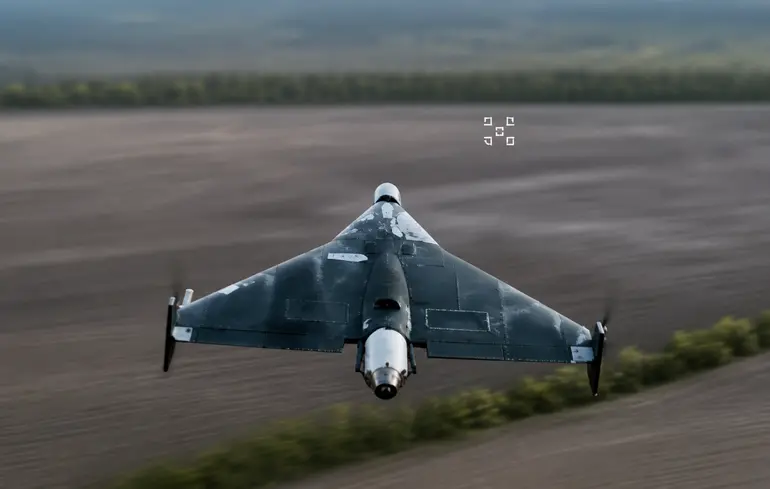




















In the predawn hours of August 16, an event unfolded over eastern Romania that only a few years ago might have seemed exceptional but increasingly resembles the new reality of NATO’s eastern frontier. Radar systems detected an unmanned aerial vehicle that had illegally entered Romanian airspace from Moldova, roughly 24 kilometers north of Galați. A Spanish F-18 operating as part of NATO’s air policing mission moved to intercept the target. After establishing radar contact, the crew received authorization to engage. At 5:01 a.m., the drone was shot down. According to Romanian authorities, the debris fell in an uninhabited area between the settlements of Băleni and Cudalbi, preventing casualties or damage in residential areas.
Bucharest did not officially determine the drone’s origin in the first hours after the incident. Romania’s Defense Ministry limited its initial account to the aircraft’s flight path, the location of the interception and the circumstances in which it was destroyed. A NATO military spokesman, U.S. Army Colonel Martin O’Donnell, went further, saying that additional details were still under investigation but that the drone appeared, on preliminary assessment, to be Russian. That conclusion is reinforced by the aircraft’s route. Moldova had also tracked a drone resembling the Shahed/Geran type as it crossed its airspace toward the Romanian border. A final technical identification, however, will depend on the examination of recovered wreckage, making the phrase “likely Russian” an important distinction until that process is complete.
Search operations in the crash area continued throughout the day. Joint teams from Romania’s defense and interior ministries examined the territory between Băleni and Cudalbi from the air and on the ground. According to official information, the operation ended at around 4:20 p.m. Specialists recovered fragments of the destroyed drone as well as debris from the interceptor missile. Explosive ordnance teams neutralized hazardous missile components. By August 18, Romania therefore had physical remnants of the aircraft available for further examination, but authorities had not yet issued a public statement with a definitive conclusion about its model and origin.
For Romania, this was neither an isolated episode nor even the first such shootdown this year. In July, Romanian F-16s opened fire for the first time on Russian drones that had violated the country’s airspace, destroying three aircraft. For years before that, Romanian authorities had repeatedly reported fragments of Russian drones discovered in border districts, brief incursions by unidentified aerial targets and nighttime civil defense alerts in Danube communities. In May, a Russian drone struck an apartment building in Galați, injuring two people. What could once be described as collateral fallout from attacks on Ukrainian territory has gradually become a persistent national security problem for Romania itself.
According to a preliminary analysis by “Deikom,” the significance of the August 16 incident lies not only in the Russian drone in Romania, but in the mechanism by which it was destroyed. This time, the aircraft that opened fire was not Romanian but a Spanish F-18 deployed in the country as part of NATO’s allied air policing system. In practical terms, the episode demonstrates how collective defense of Alliance airspace functions even before any discussion of Article 5 of the Washington Treaty becomes relevant. NATO did not need to wait for a political meeting after debris hit the ground: the multinational response structure was already in place, radar detected the target, an allied aircraft established contact, authorization reached the crew and the threat was eliminated.
That sequence of decisions matters more than the drama of a single aerial interception. For decades, NATO has maintained Air Policing as a permanent peacetime mission in which allied fighter aircraft and crews remain ready around the clock to respond to airspace violations. After Russia launched its full-scale war against Ukraine, that system was reinforced along the eastern flank. Since September 2025, the Alliance has further expanded activity under Eastern Sentry in response to a growing number of border violations involving Russian aircraft and drones. The Romanian incident illustrates the practical consequence of that transformation: air policing is no longer merely a tool for identifying unknown aircraft but is increasingly becoming a forward layer of defense against inexpensive strike drones.
Geography makes Romania particularly vulnerable. The country shares more than 600 kilometers of land border with Ukraine, while its Danube frontier runs directly opposite areas that Russia has repeatedly attacked with drones and missiles. Izmail, Reni and other Ukrainian Danube ports are critical to exports, logistics and supply routes, and have therefore been frequent Russian targets. In some locations, only the river separates them from Romanian territory. When dozens of Shahed drones fly at low altitude at night along complex routes, even a small deviation, technical failure, electronic warfare interference or deliberately planned trajectory can carry a combat drone across the border of a NATO member within minutes.
That is why Russia’s intent in each individual incident remains important but is no longer the only issue. Moscow may insist that a particular drone entered Alliance territory accidentally, yet for the country beneath an armed aircraft the difference between deliberate intrusion and navigational error does not remove the immediate danger. A drone does not become less explosive because its operator did not intend to strike Romania. Once such incidents become repetitive, their frequency itself becomes a strategic factor: allied countries must build defenses not around the political explanation of each violation but around the reality that combat drones are repeatedly appearing close to their airspace.
For Moscow, this emerging practice creates a different operational environment. Russian strikes against southern Ukraine are now taking place beside a border where NATO combat aircraft may do more than track an approaching target; they may receive orders to destroy it. This does not automatically amount to direct confrontation between Russia and the Alliance. Shooting down a drone already operating illegally inside NATO airspace is fundamentally different from attacking a Russian launch platform or striking targets beyond Alliance territory. But the margin for error is narrowing. Every additional drone that crosses the border forces military commanders to make decisions in real time, against the background of a war in which Russia and NATO countries are already operating under heightened military tension.
At the same time, the mass use of unmanned aircraft exposes a problem confronting almost every European air defense system: the relationship between the cost of a target and the cost of intercepting it. Shahed-type attack drones are far cheaper than modern fighter aircraft, air-to-air missiles and many traditional air defense systems. Using an F-18 against a single target is entirely possible, particularly when civilian lives and sovereign airspace are at stake. Turning that method into an economically sustainable response to dozens or hundreds of drones is far more difficult. NATO is therefore increasingly developing layered counter-drone defenses, ranging from radar and electronic warfare systems to cheaper interceptors and dedicated short-range weapons.
For Bucharest, the shift also has a domestic political dimension. For several years, Romanian society has heard reports of drone fragments discovered in fields and near Danube villages, fighters scrambled in the middle of the night and emergency warnings sent to civilians. As such incidents repeat, the central question changes. It is no longer simply, “Can the war spill across the border?” but rather, “How reliably can the state stop its physical consequences?” The destruction of four drones in a single year represents Bucharest’s response to that changing public expectation. Romania is increasingly making clear that its territory cannot become a permissive corridor for aircraft that lose their course or attempt to shorten their route toward Ukrainian targets.
The episode also has broader implications for Ukraine. Russian air attacks have long ceased to be a purely bilateral problem between Moscow and Kyiv. Poland, Romania, Moldova and the Baltic states are being forced more frequently to scramble aircraft, restrict parts of their airspace, deploy additional radar systems and refine rules of engagement. The war has created a broad belt of military surveillance around Ukraine’s borders, where the trajectory of a single drone can simultaneously become a matter for Ukrainian air defense, Moldovan sovereignty, Romanian national security and NATO’s allied command structure.
The Alliance’s own response is equally revealing. In the days before the incident, NATO members had already been discussing new violations of Polish and Romanian airspace and reiterating solidarity with countries on the eastern flank. NATO maintains that its forces are permanently prepared to respond to threats and that its integrated air and missile defense system must provide not only surveillance but also rapid interception capability. The missile fired by the Spanish F-18 over Romania should therefore be understood not as an improvised decision by one crew, but as the product of an established multinational command and defense system.
The most difficult question now is where the boundary lies between routine territorial defense and a new level of military escalation. As long as drones are destroyed after entering NATO airspace, the legal and political logic of allied action remains relatively straightforward: a state is defending its own territory. Situations will become considerably more complex when the aircraft’s trajectory is clear before it crosses the border, or when dozens of drones approach Alliance territory simultaneously during a large-scale Russian attack. Military commanders would then have to balance the need to prevent warheads from falling on populated areas against the desire to avoid extending combat operations beyond NATO territory.
The August 16 incident therefore matters not because of a single destroyed aircraft. It shows how quietly the nature of the boundary between Russia’s war against Ukraine and NATO territory is changing. At first, Romanian authorities found wreckage. Then radar systems began detecting violations more frequently. After that, fighter crews received genuine authorization to engage targets. In July, Romanian F-16s opened fire. In August, a Spanish F-18 operating under a NATO mission did the same. Each episode may appear local in isolation, but together they are shaping a new security architecture across the Black Sea region and Europe’s eastern flank.
The Russian drone in Romania was destroyed within minutes of being identified as a threat. That speed, rather than the wreckage scattered across a field between two villages, is the central result of the incident. Years of repeated violations have taught NATO members that waiting for a drone to crash and only then determining its origin is becoming an increasingly unacceptable strategy. The war has not crossed NATO’s border in the form of a ground offensive, but its drones, debris, missiles and risks have been crossing that boundary for years. And the Alliance’s response is becoming just as physical: targets entering its airspace may now not only be seen on radar — they may be destroyed.