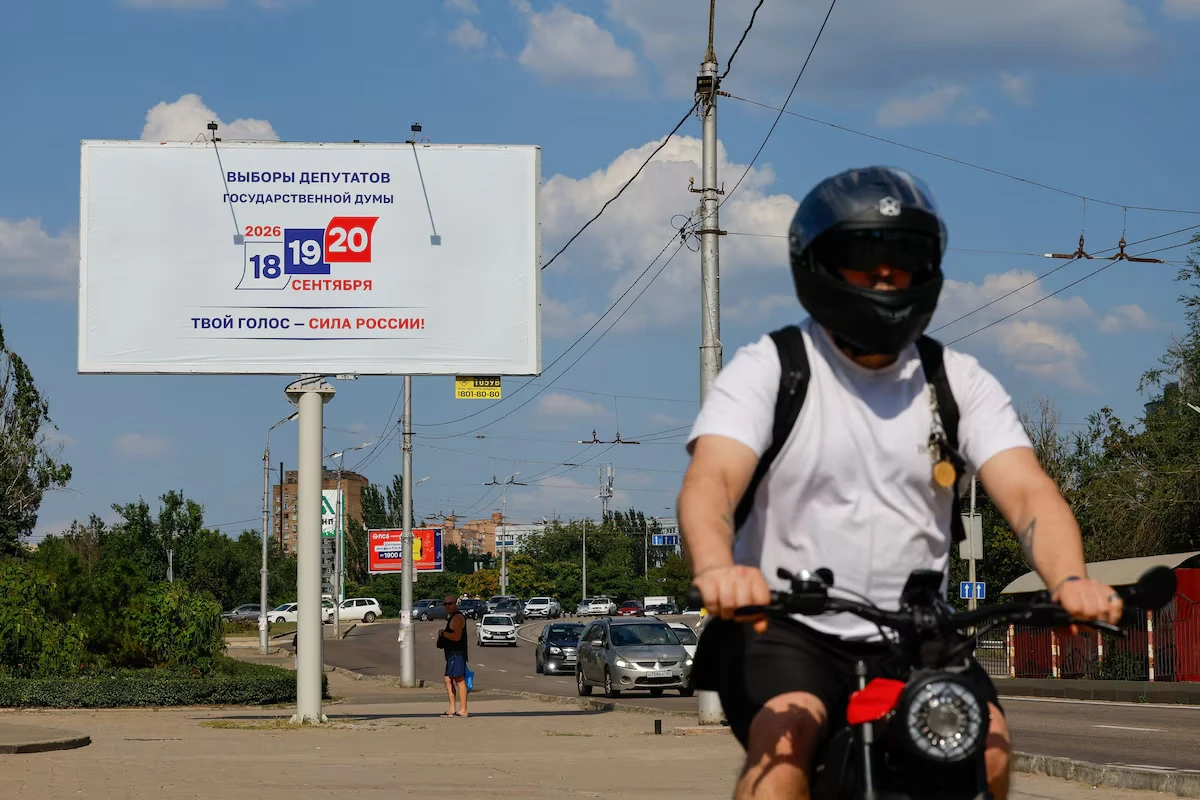

















Ukraine has rejected in advance any results from Russian parliamentary elections planned for September in occupied parts of the country. Kyiv’s position is categorical: a vote organized by Russia within Ukraine’s internationally recognized borders cannot create lawful political consequences.
The elections are expected to include parts of the Donetsk, Luhansk, Zaporizhzhia and Kherson regions, which Moscow declared annexed in 2022 after staging referendums under occupation. Russia still does not fully control all four regions within their administrative boundaries.
That makes the coming vote more than an internal Russian political exercise. By incorporating occupied Ukrainian territory into a federal election, the Kremlin is trying to convert military control into routine state administration — complete with polling stations, parties, deputies and formal representation.
As Daycom has previously noted, one of the central features of Russia’s occupation policy is the normalization of seized territory through bureaucracy. Passports, taxes, schools, elections and local administrations are meant to create the impression that the question of status has already been settled, even while the war continues.
For Ukraine, that logic is fundamentally unacceptable. Kyiv argues that organizing a vote does not alter sovereignty, and that participation by residents living under occupation does not transform Russian authority into lawful government.
The key issue is the source of political authority. Elections can confer a mandate only within a legal order that has legitimate jurisdiction over the territory where the vote takes place.
Russia does not possess such jurisdiction over occupied areas of Ukraine. That is why, from Kyiv’s perspective, the central question is not whether ballots are counted accurately, who wins or how many people turn out.
Even a perfectly administered vote would not resolve the basic contradiction: one state is conducting its national election on the territory of another state that it controls through war.
The presence of foreign observers does not change that. Observers can assess voting procedures, but they cannot create a legal right for Moscow to organize elections on Ukrainian territory.
This is the distinction between procedural legitimacy and territorial legitimacy. Ballot boxes, voter lists and vote counting can all be monitored, but none of that answers the more fundamental question of who has the authority to hold the election in the first place.
For Moscow, international delegations serve a different purpose. Even limited participation by representatives of foreign states can be used to project an image of external recognition, particularly for a domestic audience.
Such missions become part of a political staging designed to suggest that the occupied regions have already been integrated into Russia’s legal and political system — and that this process is being treated abroad as ordinary and legitimate.
For Ukraine, the danger lies in the cumulative effect of such symbolic acts. A referendum, an election or an administrative reform does not by itself change the international status of a territory.
But Moscow is building a chain of formal decisions in which each new step rests on the last: annexation, Russian citizenship, local elections, parliamentary representation and inclusion in federal programs.
This is less a strategy of legal persuasion than one of creating facts on the ground. The Kremlin is seeking to make Russian rule so deeply embedded in institutions that any future return of the territories to Ukraine would appear not as restoration of the previous legal order, but as dismantling an established system.
That is why the parliamentary vote matters even though there is little suspense over the broader result inside Russia. Pro-Kremlin forces are overwhelmingly positioned to retain control of the federal legislature.
Electoral competition, in other words, is secondary. The more consequential act is the incorporation of occupied Ukrainian territories into Russia’s national political map as if they were ordinary parts of the federation.
The process also works inward, on Russian society itself. Citizens are encouraged to see the war and annexation not as a temporary military episode, but as a completed stage of territorial expansion.
The more elections and administrative procedures are built around that premise, the more politically expensive any future compromise becomes for the Kremlin. Giving up occupied territory would then require more than a military withdrawal. It would mean reversing laws, constitutional arrangements, electoral districts and an entire political architecture constructed since 2022.
Elections therefore become part of the mechanism by which the war is embedded into Russian statehood.
At the same time, Russia’s own political system is offering less space for dissent. The country’s only registered party openly opposed to the war has been excluded from the election, while the next parliament is highly likely to remain dominated by forces loyal to the Kremlin.
That adds another layer to Ukraine’s objections. The vote in occupied territory is not simply an election conducted by an occupying power; it is being held within a system where the boundaries of political competition inside Russia itself have narrowed sharply.
For residents of occupied areas, this means voting takes place in an environment where the question of sovereignty has already been decided by the authorities, while refusing to participate or expressing a disloyal political position can carry consequences far beyond those found in an ordinary democratic contest.
That is why the issue cannot be reduced to ballots and polling stations. It is part of a wider struggle over how the occupation itself is described and normalized.
Moscow is trying to turn military control into administrative routine. Kyiv is trying to prevent repeated Russian procedures from gradually creating an illusion of legality.
The most important question is therefore not the result of the September vote. It is whether Russia can make occupied Ukrainian regions appear to be a normal, settled part of its political system.
Ukraine’s answer remains unchanged: however many elections Moscow organizes there, voting cannot turn control established through war into legitimate sovereignty.