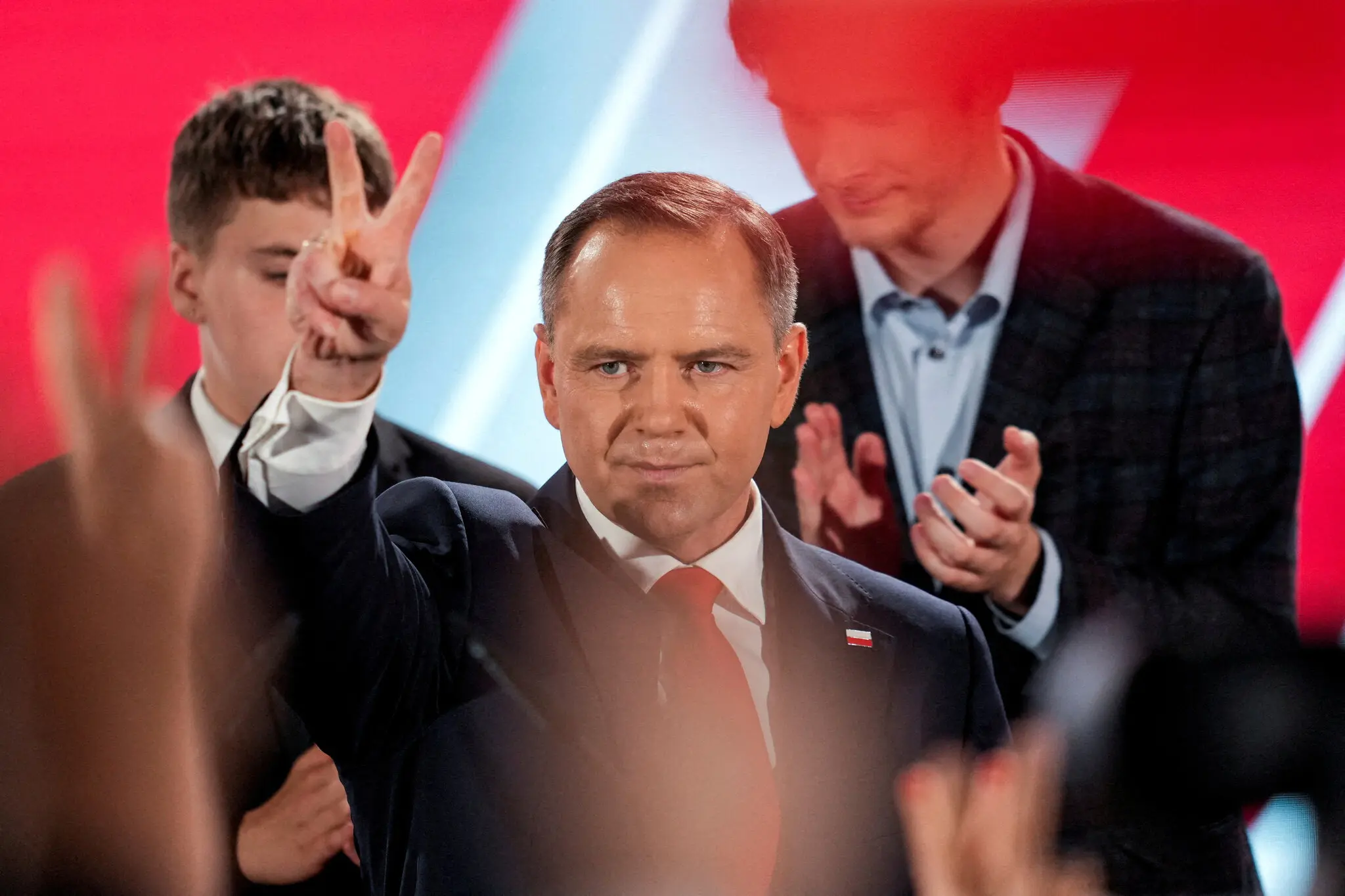




















Volodymyr Zelensky returned Poland’s Order of the White Eagle after President Karol Nawrocki decided to strip him of the country’s highest state honor. What began as a dispute over historical memory turned within a day into a broader crisis of symbols between two countries whose security remains closely connected.
Zelensky explained that in 2023 the award had been understood not as a personal distinction, but as a sign of respect for the Ukrainian people and the Ukrainian army. Its return therefore carries a double meaning: the president is not merely answering his Polish counterpart, but showing that the insult concerns not one person, but a country at war with Russia.
Leonid Kuchma, Viktor Yushchenko and Petro Poroshenko also joined Zelensky’s gesture, announcing that they would return their own Polish awards. Other senior Ukrainian officials renounced separate honors. The dispute has moved beyond protocol and taken on the features of a collective political response.
According to Daycom’s assessment, this is where the greatest risk lies. Symbols can defend dignity, but they can also accelerate a crisis when each next step becomes a mirrored grievance. Polish-Ukrainian relations now need not a war of orders, but a channel that returns the dispute from public theater to political work.
Nawrocki revoked the award after Zelensky named a unit of Ukraine’s Special Operations Forces after the Ukrainian Insurgent Army. In Ukrainian historical memory, the UPA is part of the struggle for independence from Moscow. In Polish memory, it is tied to the Volhynia tragedy and the mass killing of Polish civilians.
This is not a technical dispute over the name of a military unit. It is a collision between two historical languages. The Ukrainian language speaks of anti-Soviet resistance, underground struggle, statehood and the right to its own national pantheon. The Polish language speaks of victims, family memory, exhumations, unburied dead and the fear of crimes being justified.
That is why neither side can simply dismiss the other’s pain. Ukraine cannot allow foreign politicians to dictate its history. But Poland also cannot be forced to accept symbols that, for a significant part of its society, mean not liberation but the death of civilians.
The problem is that Nawrocki chose the most public and punitive form of reaction. He said the decision was not directed against the Ukrainian people and did not change the strategic course of Polish security policy. But politics is made not only of explanations. It is made of images, and images are remembered faster than caveats.
The image is simple and dangerous: the president of Poland withdraws the highest honor from the president of Ukraine at a time when Ukrainian cities are enduring Russian missile and drone attacks. For Polish voters, it may look like the defense of historical dignity. For Ukrainians, like a cold gesture during wartime. For Moscow, like ready-made propaganda.
That danger was also sensed by members of Poland’s government, who are often at odds with Nawrocki. Foreign Minister Radoslaw Sikorski effectively warned that the only winner in a war of history and orders could be Moscow. Defense Minister Władysław Kosiniak-Kamysz also said that escalating tensions among allies benefits the enemy.
Those words matter because they show there is no full unity in Poland over the president’s method. Support for Ukraine remains part of Poland’s security logic, but domestic politics, war fatigue, disputes over refugees and grain, and the burden of history are making the environment for this alliance increasingly difficult.
Polish society has indeed changed over the years of full-scale war. The first shock and wave of solidarity have gradually been overlaid by fatigue, everyday tensions, economic fears and political competition. Ukrainians in Poland work, pay taxes and support the economy, but they are also facing more prejudice and irritation.
Nawrocki is operating precisely in that field. His reference to the Polish nation’s “pain threshold” appeals not only to history, but to a contemporary electoral mood. Historical memory in such a context easily becomes an instrument of domestic mobilization. That does not erase the reality of Polish trauma, but it makes the manner of its political use extremely important.
Ukraine’s response also has limits. Zelensky’s return of the order can be understood as a gesture of dignity: if an award given to the Ukrainian people is revoked because of a political dispute, it loses its original meaning. But the mass return of honors risks turning moral rightness into an emotional chain that will be difficult to stop.
The former Ukrainian presidents explained their decisions by saying that the current conflict harms the work they had invested for years in Polish-Ukrainian rapprochement. There is a bitter irony in that. Awards that once symbolized reconciliation are now becoming evidence of its fragility. The symbols did not disappear; they changed charge.
Most dangerous of all is that the crisis erupted at a moment when Kyiv needs maximum allied concentration. Ukraine is trying to increase international pressure on Russia, accelerate weapons deliveries, preserve Western support and prepare for future reconstruction. A quarrel with Poland strikes precisely at that external foundation.
Poland remains for Ukraine more than a neighbor. It is a logistical corridor, a political advocate in Europe, an important military platform, a rear base for millions of Ukrainians and a country that understands the nature of the Russian threat better than many others. Weakening that connection serves neither Kyiv nor Warsaw.
But strategic partnership does not mean a ban on difficult history. On the contrary, if it is pushed aside, it returns in a sharper form. The Volhynia tragedy, Ukrainian victims of retaliatory violence, the role of the UPA, the Polish underground, Soviet occupation and Nazi terror require not political blows, but a long institutional process.
Progress on the exhumation of Polish victims was exactly such a process. It did not produce quick television results, but it created a foundation of respect: find burial sites, name the dead, give families the right to memory and avoid turning history into a weapon of the day. That work may now again come under emotional pressure.
In his response, Zelensky left an important door open: Ukraine remains ready for meaningful formats of engagement with Poland to avoid conflicting interpretations of painful chapters of the shared past. That should become the basis for exiting the crisis. The order has already been returned. The main task now is not to let that gesture replace diplomacy.
Nawrocki, too, left himself room for maneuver by stressing that Poland’s strategic security course has not changed. If those words carry weight, they must be supported by practice: military assistance to Ukraine, transit, political coordination and joint reconstruction work cannot become hostages to a historical dispute.
Kyiv and Warsaw need a formula that humiliates neither side. Ukraine has the right to honor the struggle for statehood, but it must clearly separate that from any justification of crimes against civilians. Poland has the right to demand memory for its dead, but it must not turn that memory into a tool for weakening an alliance with the country holding back Russia.
Russia did not create this historical trauma, but it knows how to use it. For the Kremlin, any conflict between Ukraine and Poland is proof that Kyiv’s allies are growing tired, quarreling and unable to preserve unity. Moscow does not need to win the historical argument. It only needs that argument to paralyze politics.
That is why both capitals now have to move out of the logic of mutual humiliation. An order can be returned. A statement can be made harsher. But broken trust is far harder to restore. Polish-Ukrainian relations have survived empires, wars, deportations, massacres, occupations and reconciliation. They should not become a casualty of political drama useful to Moscow.
The main lesson of this crisis is simple and difficult: memory cannot be abolished, but it can be disciplined by responsibility for the future. Ukraine and Poland may speak about the past in different voices. But if they allow the past to break their common front against Russia, the real winner will be not historical truth, but the Kremlin.