
















Ukraine is beginning to be viewed not only as a country in need of support, but as an economy worth entering before competitors do. The change is still limited, yet it is already visible in the language of investment forums, where aid is giving way to calculations of return, risk and future asset value.
At the Ukraine Recovery Conference in Gdansk, the central argument was no longer humanitarian responsibility. It was the prospect of profiting from postwar growth. Businesses were urged to invest now, while the war keeps prices low but has not erased the prospect of an independent state moving toward European Union membership.
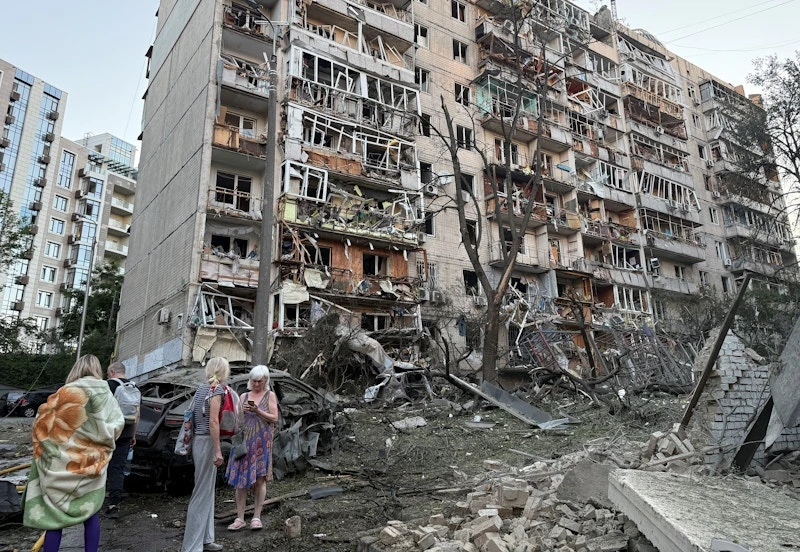
That shift has been made possible by a changing assessment of the battlefield. Russia has not stopped advancing entirely, and missile strikes on Ukrainian cities remain frequent, but Moscow has lost the ability to expand control quickly. Ukraine, meanwhile, is extending the reach of its attacks and disrupting logistics far behind the front.
In Daycom’s assessment, investment optimism does not mean that business believes peace is close. It means more investors now expect Ukraine to endure, preserve its political sovereignty and emerge from the war with enormous demand for capital, technology, energy and infrastructure.
About 7,500 participants attended the Gdansk conference, which produced 160 agreements worth roughly $11 billion in private investment and assistance. The scale of those commitments suggests that reconstruction is beginning to move beyond political promises and into contracts, credit lines and corporate planning.
One of the clearest examples was a credit facility of up to $300 million for Naftogaz. The money is intended for American construction equipment and energy-sector services. This is not charity, but a model in which rebuilding Ukraine also generates business for Western companies.
The logic behind the new approach is straightforward. The war has caused immense destruction, but it has not erased Ukraine’s economic foundations. The country still has a large domestic market, an industrial base, a powerful agricultural sector, major gas reserves, critical minerals and a workforce that has adapted rapidly under technological pressure.
The prospect of EU membership strengthens that argument. For investors, Ukraine may become not a peripheral market defined by wartime risk, but part of a single European economic space with access to capital, common standards and hundreds of millions of consumers.
The sectors attracting the greatest attention are energy, defense technology, construction, logistics, real estate and digital infrastructure. In each of them, war has created both losses and demand. Destroyed capacity must be replaced, while surviving businesses need modernization to function under persistent threat.
The European Bank for Reconstruction and Development announced more than €500 million in new financing in Gdansk. Since the start of Russia’s full-scale invasion, its investment in Ukraine has reached about €10 billion, making it one of the central institutional players in the country’s future reconstruction.
Energy transformation offers a particularly important opportunity. Russian attacks on coal-fired power plants have accelerated the shift toward distributed generation: solar and wind projects, battery storage and smaller local facilities. Such a system is harder to cripple with a single large strike and aligns with Europe’s decarbonization goals.
For Ukraine, this creates a chance not to rebuild the old Soviet energy model in its previous form, but to construct a more resilient network from the outset. What began as an emergency response could become a long-term advantage if the country gains access to financing, equipment and war-risk insurance.
Interest is not limited to public banks and international institutions. Former Google chief executive Eric Schmidt and his wife, Wendy, have invested in commercial real estate in Kyiv. Their stake was estimated at between $55 million and $70 million. Schmidt has also backed Ukrainian defense technology, including drone manufacturers.
Deals of this kind carry two meanings. They are a bet on the postwar rise in Ukrainian asset values, but also an attempt to secure an early position in industries where Ukraine has become a testing ground for technologies that may reshape the global security market.
Still, it is too early to speak of a full investment breakthrough. Companies that operated in Ukraine before the invasion are gradually expanding, but most newcomers remain cautious. Insurance, staff security, regulatory predictability and the threat of renewed destruction continue to be major barriers.
Political stability will be equally decisive. After the war, Ukraine will compete for capital not only with Eastern Europe, but also with markets in Asia and the Middle East. The scale of reconstruction alone will not be enough. Investors will demand credible courts, transparent procurement, property protection and a clear tax regime.
The current optimism is therefore both a vote of confidence and a warning. Battlefield resilience has opened an opportunity, but converting it into economic growth will require institutional reform. A postwar market will not emerge automatically from the ruins; it will have to be built on rules trusted by private capital.
The choice of Gdansk as the conference venue was symbolic. It was there that the Solidarity movement began to dismantle the Soviet order in Central Europe. The former shipyard has since become a district of apartments, galleries and cafes, a visible example of how political liberation can lead to decades of economic renewal.
Ukraine hopes to follow a similar path, but from far more difficult starting conditions. It is preparing for reconstruction before the war has ended. Every investment made now is therefore not only a financial transaction, but a wager that Russia’s attempt to destroy Ukrainian statehood has already failed strategically.
The most important shift is not the amount of announced financing, but the way Ukraine is being perceived. It is gradually moving from the category of aid recipient to that of a market in which competition is beginning. The war is not over, but the contest for Ukraine’s postwar economy has already started.