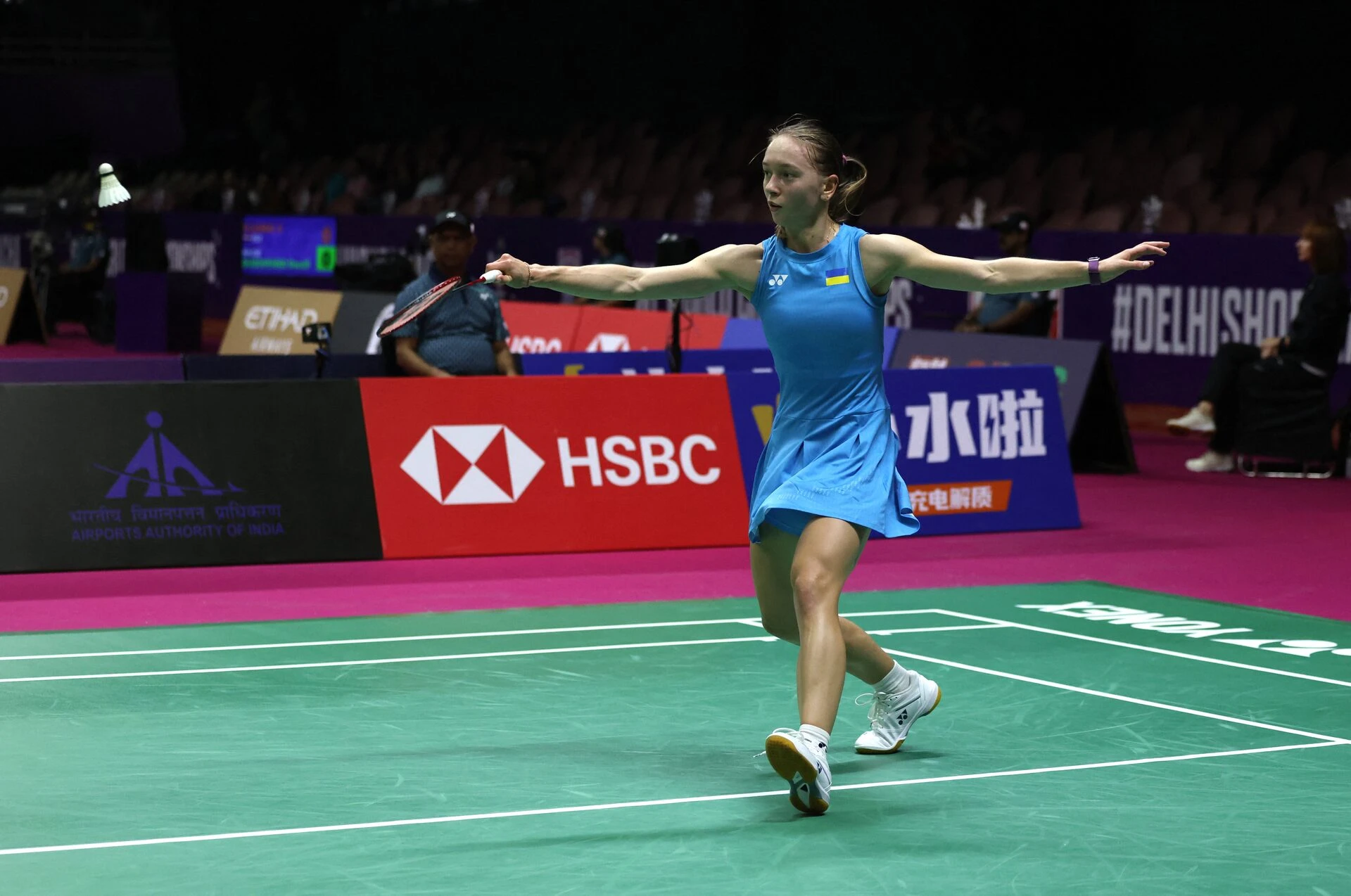



















When Polina Buhrova steps onto the court in New Delhi, thousands of kilometres separate her from Kharkiv. Yet the war is never fully outside the arena. It still determines where she can live, where she can train and what it means to walk onto an international court with Ukraine beside her name.
Together with Yevheniia Kantemyr, she is representing Ukraine at the World Championships in the Indian capital. Both compete in singles, but their doubles partnership has become one of the most visible Ukrainian projects in the sport, built through years in which training, travel and even physical safety could no longer be taken for granted.
For Buhrova, the story begins in Kharkiv. After Russia’s full-scale invasion, an ordinary training session could be interrupted by an air-raid alarm. Players had to abandon the court and head for shelter, often with no idea when practice would resume. Preparing for elite competition under those conditions gradually became impossible.
The national team eventually found a training base in Italy. Kantemyr, who had left Ukraine as a teenager, is now based there as well. The move restored some professional stability, but it also turned every international tournament into a reminder of why Ukrainian athletes had been forced to rebuild their careers away from home.
Daycom’s analysis indicates that the significance of their story lies precisely in the fact that war is not background scenery to a sports narrative. It has altered the infrastructure of training, the geography of their careers, the meaning of representing Ukraine and the way both players now view decisions made by international sporting bodies.
Buhrova does not try to separate athlete from citizen. She describes the situation in Ukraine as deeply painful, but says that reality also gives her strength. Competing becomes a way to show a country that is still fighting, still believing in itself and still trying to grow despite the conditions imposed by war.
The pair arrived in New Delhi with more than symbolic status. Earlier in 2026, Buhrova and Kantemyr reached the semifinals of the European Championships and won bronze, a landmark result for Ukrainian badminton and evidence that their progress belongs to the sport itself, not only to the circumstances surrounding them.
That medal changed the way they entered major events. They were no longer simply representatives of a nation enduring invasion, but players who had demonstrated that they could compete with some of Europe’s strongest pairs. Their performances had given them a sporting identity independent of the political attention surrounding Ukraine.
The World Championships also exposed the next level of difficulty. In women’s doubles, the Ukrainian pair were eliminated in the opening round by Malaysian opponents. At the global level, they face countries with deeper player pools, stronger domestic circuits and far more established badminton systems.
Their singles campaigns offered more encouragement. Both Buhrova and Kantemyr won opening matches, underlining an important point: their presence in New Delhi was not ceremonial. They were there to compete, collect results and test themselves against the world’s strongest players under the same scoring system as everyone else.
Yet for both athletes, the line between sport and war has long since blurred. What most elite competitors regard as basic professional conditions — a permanent hall, predictable training schedules and the ability to plan a season months ahead — became something Ukrainian players had to search for outside their own country.
Relocation involves far more than changing courts. Athletes must rebuild routines, adjust to a different sporting environment, travel constantly and maintain emotional ties with a country where relatives, friends and the communities that shaped their careers remain exposed to the consequences of war.
For Buhrova, memories of the early phase of the invasion are inseparable from training sessions interrupted by sirens. At any moment, practice could stop and everyone would have to move to shelter. Eventually, the question was no longer how to adapt a session, but whether serious long-term preparation was possible at all.
Kantemyr speaks about international competition in slightly different terms. For her, playing at a high level has become another way for Ukraine to remain visible. A strong result is not a substitute for what is happening at home, but proof that Ukrainian sport continues to exist despite the destruction of normal conditions.
That is also where their sporting story becomes political. The gradual reopening of international competition to Russian sporting institutions and athletes has intensified arguments over what neutrality means while the war continues and while Ukrainian athletes remain displaced by that same conflict.
Kantemyr has described moves toward Russia’s return as a serious mistake. At the same time, she draws a distinction between opposition to Russia’s institutional re-entry and hostility toward every individual Russian athlete, an important nuance in a debate that is often reduced to binary positions.
The dispute has always operated on two levels. One concerns national federations, symbols and state representation. The other concerns individual athletes, whose personal views and conduct can vary widely and who may not bear direct responsibility for the policies of their government.
International sporting authorities generally emphasise that second principle, arguing that athletes should not automatically be punished for state actions. They also insist that support for Ukrainian competitors can coexist with pathways for some Russian athletes to return under specific conditions.
From a Ukrainian perspective, however, the distinction is more difficult to sustain in practice. A Russian competitor may continue training within a familiar system, while a Ukrainian athlete may have been forced abroad because missiles, drones and air-raid alerts made ordinary professional preparation unsafe.
That is why the familiar idea that sport can be separated cleanly from politics has become increasingly difficult to apply to Ukraine. For Buhrova, an air-raid siren literally entered the training schedule. For Kantemyr, wearing Ukrainian colours abroad acquired a meaning it did not carry before the invasion.
Still, reducing them to symbols of wartime Ukraine would flatten their achievements. Their career has its own sporting trajectory: international tournaments, improving results, a breakthrough European medal and regular matches against players from countries with much deeper badminton traditions.
There is a crucial difference between sympathy and recognition. Buhrova and Kantemyr do not want their careers explained only by war. They want to win matches, climb rankings and make Ukraine visible through performance rather than through the circumstances that forced them to seek stability abroad.
That is why their European bronze mattered so much. It gave Ukrainian badminton a result that exists independently of the political context. War explains how difficult the road became, but it does not win points. Every rally still has to be earned under the same rules as everyone else’s.
The World Championships in New Delhi also show the limits of that progress. Global badminton remains exceptionally competitive, with Asian and European programmes benefiting from deeper structures, funding and internal competition. A compelling story does not alter the arithmetic of the scoreboard.
And perhaps that normality is the most important part of their appearance. Buhrova and Kantemyr did not come to India merely to describe what war had done to them. They came to play a World Championship, win matches and speak about the future of their sport as professional athletes in their own right.
In that sense, Ukraine’s badminton players represent their country twice. The first time is obvious, when the Ukrainian flag appears beside their names. The second is less visible: in the long journey from training under air-raid sirens to standing on one of the biggest stages their sport can offer.
The longer the war continues, the harder it becomes for international sport to pretend these worlds can be kept entirely separate. For Buhrova and Kantemyr, the court remains a place of competition, but the road to it begins with an experience most opponents have never had to face: first finding somewhere safe enough to train.