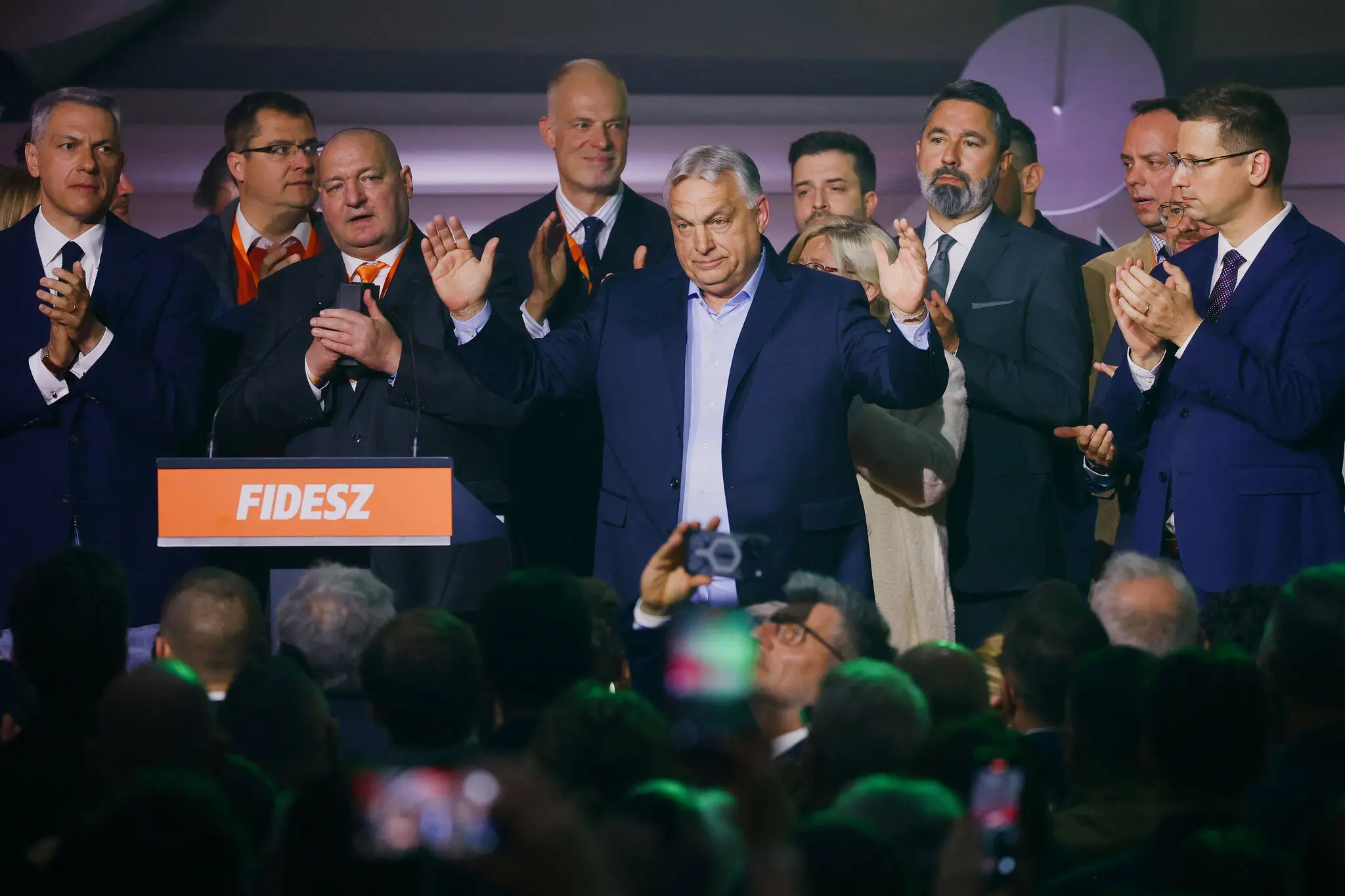






















Viktor Orbán did not truly lose when he lost his majority. He lost when he ceased to look politically inevitable. That is the real meaning of Hungary’s election. After sixteen years in office, during which he turned the country into Europe’s most emblematic laboratory of right-wing populism, the prime minister was forced to concede defeat less than three hours after the polls closed. The speed of that concession revealed almost as much as the numbers themselves.
The early count showed the scale of the rupture. Péter Magyar’s Tisza moved decisively toward victory, while turnout surged to a post-communist record. In Hungary, that level of participation meant far more than ordinary electoral interest. It signaled a mass decision by voters to intervene personally in a system that had come to feel static, closed and self-protective.
That is the central political fact of this election. Long-running regimes rarely crack because of one scandal or one failed campaign. They begin to fail when public frustration finally finds a figure capable of speaking not in the language of a protest subculture, but in the language of the country itself. As Daycom has argued before, that is precisely what made Péter Magyar dangerous for Orbán: he did not arrive from outside the Orbán world, but from within it, and he was able to explain to voters why the system no longer worked even for those it claimed to defend.
That is why Orbán’s defeat feels historical rather than cyclical. For years he presented his model as proof that a leader could rule for a very long time, very aggressively, and with few real consequences if he combined media control, a favorable electoral structure, a permanent culture war, the rhetoric of siege and a disciplined network of political loyalty. For a long while, that formula worked. It offered society a simple bargain: less institutional freedom in exchange for stability, identity and predictability.
The election exposed the limits of that bargain. Orbán spent years telling Hungarians that only he could protect them from migration, Brussels, war, “woke ideology,” liberal elites and geopolitical disorder. But every such system eventually collides with a simple domestic question: if power is so strong, why does the state feel weaker in hospitals, schools, transport, prices and ordinary daily life? That was where Magyar struck most effectively. He did not build his campaign around abstract anti-Orbánism. He built it around fatigue with corruption, stagnation and the decay of public services.
Corruption became the key language of political exhaustion. Once a government that constantly speaks of national dignity and sovereignty becomes identified with patronage, privilege and a closed circle of beneficiaries, it begins to hollow out not only its reputation, but its moral claim to rule. At that point, the argument is no longer ideological. It becomes visceral. People begin asking not what the government says about the nation, but whom the state actually serves.
What makes the result even more damaging for Orbán is that he lost despite the system he had spent years calibrating for survival. Until the final days of the campaign, it remained possible to imagine that even an opposition lead in the polls might not become a full parliamentary landslide because single-member districts, media asymmetry and the administrative machinery still favored Fidesz. That is why the scale of the result matters so much. It suggests that the social wave against Orbán had become large enough to overwhelm even a political architecture designed to protect him.

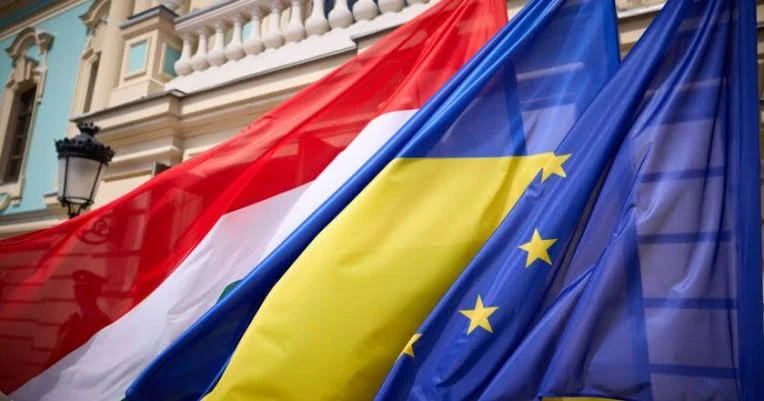
For the European Union, the election may mark the end of an era of systematic disruption from Budapest. Orbán was not merely an inconvenient partner. He was a consistent saboteur of consensus, a leader who slowed decisions on Ukraine, diluted sanctions against Russia and repeatedly portrayed Brussels itself as the central threat to Hungarian sovereignty. Tisza’s victory does not guarantee instant harmony with the EU, but it strongly suggests a less confrontational relationship and an attempt to pull Hungary back from the edge of political self-isolation.
For Ukraine, the implications are even more concrete. Orbán was one of the Kremlin’s most valuable political voices inside the European Union, not only because he could obstruct aid, but because he promoted the deeper narrative that Europe’s real problem was not Moscow, but the war itself and the demands placed on Europe by Kyiv. Fidesz’s defeat does not automatically make Budapest pro-Ukrainian, but it does weaken one of Russia’s most useful channels of influence inside European politics.
Still, this moment should not be romanticized. Orbán lost the government, not the entire state. Over sixteen years, Fidesz embedded itself in the bureaucracy, the media market, the regulatory system, the judiciary and the habits of political management. Even if Tisza secures a commanding majority, dismantling that architecture will be slow and conflict-ridden. Magyar may inherit a country in which the old ruling party has lost power but still leaves its institutional fingerprints everywhere.
The result is also a blow to the wider international right. Orbán was more than the leader of a mid-sized Central European country. He served as proof for populists across the Atlantic that culture war, demonstrative sovereignty, conflict with liberal institutions and political aggression could produce not just episodic victories, but durable rule. His defeat damages not only Fidesz, but the myth of invulnerability surrounding this kind of regime. A model that was marketed globally as a durable answer to liberal democracy has now shown its mortality.
At the same time, Orbán’s loss should not be confused with an automatic liberal restoration. Magyar did not campaign as a progressive messiah. He avoided many of the issues most closely associated with the classical liberal camp and kept his appeal in the center, sometimes even on conservative ground. His strength was not radical ideological contrast, but the promise of change without cultural shock. That makes the outcome more interesting, not less. Society did not vote for a symbolic revolution. It voted for a practical reset.
That is the deeper lesson of Hungary’s election. Orbán did not lose because his opponents suddenly became better at the mechanics of power. He lost because the technology of control that had compensated for the country’s real problems for years finally stopped convincing people that there was no alternative. That is the true scale of what happened in Hungary. This was not simply the fall of one prime minister. It was the moment one of the world’s most famous illiberal systems was forced to confront a basic fact: control over the state is not the same thing as control over the future.