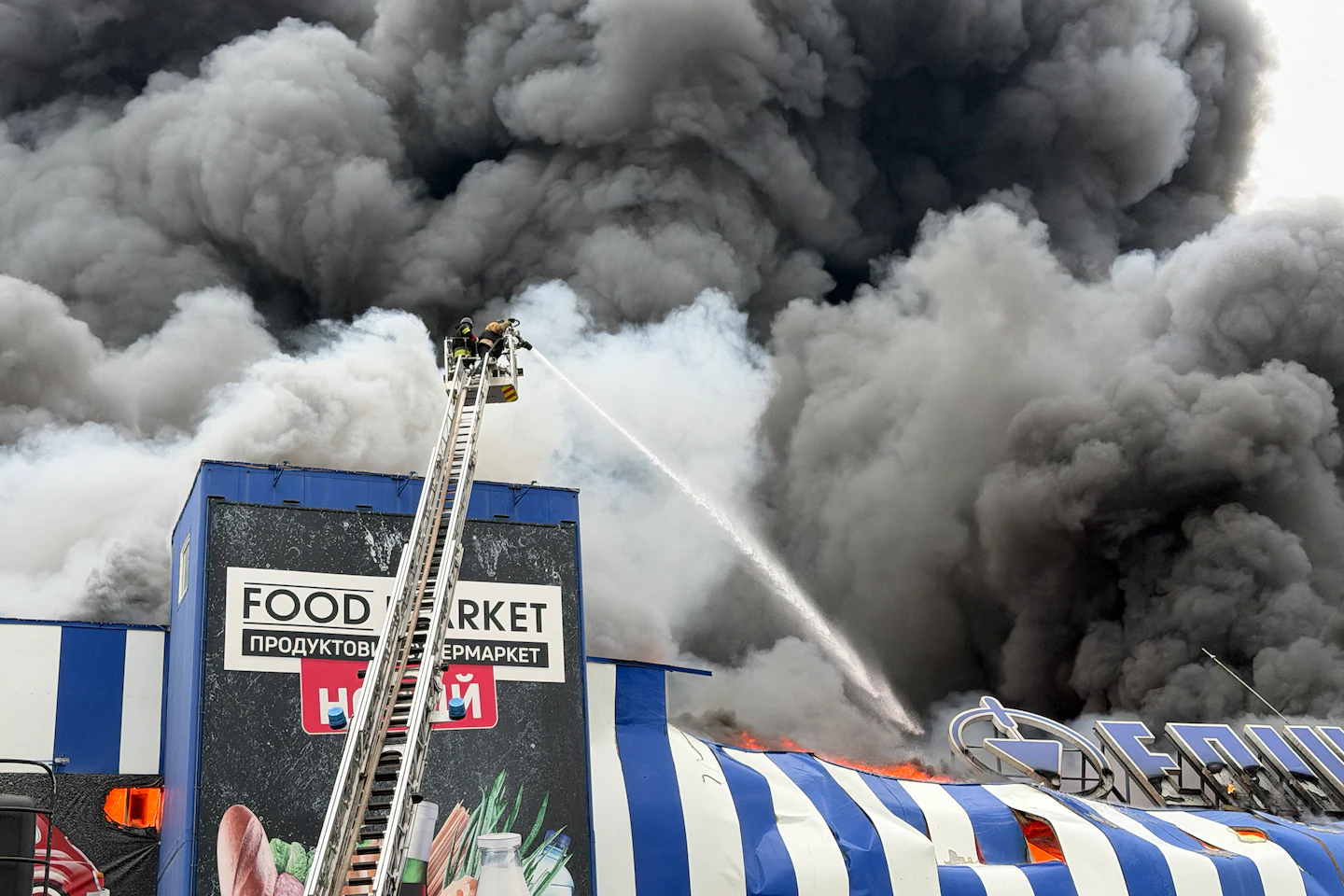



















Ukrainian drones have again carried the war deep into Russia’s energy system. Oil facilities near Perm and in the Orenburg region came under attack roughly 1,500 kilometers from Ukraine — far beyond the borderlands and the familiar radius of front-line war.
The most significant target was a refinery near Perm, one of Russia’s large oil-processing plants, owned by Lukoil and capable of processing nearly 13 million tons a year. The strike hit a key unit for primary oil refining, effectively taking it out of operation at least for a time.
An oil pumping station supplying crude to the refinery was also struck again. Fires had already broken out there after an earlier attack; the latest strike created new pockets of burning. Ukraine’s campaign increasingly looks less like isolated raids and more like a systematic effort to disrupt the logic of supply.
According to Daycom’s earlier analysis, this is the central shift in the war of attrition. Kyiv is no longer striking only symbolic targets or sites easily explained by proximity to the battlefield. It is trying to make Russia’s energy system feel permanent risk across the full depth of its industrial map.
The second target area was Orsk, in the Orenburg region, where the Orsknefteorgsintez refinery was hit. A fire broke out on the grounds of the enterprise after the strike. The facility matters not only as part of Russia’s fuel complex, but also as a node serving the army waging war against Ukraine.
For Russia, such attacks are dangerous not only because of direct damage. Their effects accumulate through repairs, downtime, logistics disruptions, shortages of specific components and the need to reroute crude and refined fuel. A large system can absorb a single strike. A series of strikes changes how it operates.
Oil infrastructure is one of the few Russian assets that simultaneously supports the budget, exports, military logistics and the Kremlin’s political resilience. That is why Ukrainian drones are increasingly seeking not tanks at the front, but primary refining units, storage tanks, terminals, pumping stations and transport nodes.
This does not mean Ukraine is abandoning military targets along the line of contact. But the war has long outgrown the front. If Russia finances missiles, artillery, drones and mobilization through energy revenue, then energy can no longer remain an untouchable part of the rear economy.
The range itself is especially important. Perm and Orsk are so far from Ukraine that their safety was once treated almost as a given. Now a distance of 1,500 kilometers is no guarantee. Russian regions are being forced to live with a new geography of war, in which the rear no longer means protection.
For the Kremlin, this creates a difficult defensive problem. Russia cannot evenly cover every refinery, oil depot, pumping station, port, airfield, warehouse and industrial hub across its vast territory. Each additional site that must be protected pulls resources away from somewhere else.
Ukraine’s strategy here is built on asymmetry. Kyiv cannot match Russia in missiles, aircraft or manpower. But it can force a far larger state to disperse its defenses. A drone that costs far less than the industrial unit it damages creates an economic and administrative imbalance.
The strikes on refineries also carry psychological weight. Russian society was long trained to believe that the war was happening somewhere far away, while normal life inside the country could remain almost unchanged. When facilities burn beyond the Urals and in Russia’s southeast, that distance begins to collapse.
At the same time, Ukraine’s attacks on oil infrastructure come against a fragile global energy backdrop. War in the Middle East has already pushed prices upward, and any disruption to Russian refining becomes part of a broader market anxiety. That makes Kyiv’s campaign politically sensitive for partners worried about price shocks.
But for Ukraine, the question is harsher. Russia has spent months striking Ukrainian energy facilities, leaving cities without electricity and heat, destroying substations, thermal plants and grids during the coldest periods of the year. Kyiv is now showing that energy vulnerability cannot remain one-sided.
Russia’s economy has adapted to sanctions, but not to an endless combination of sanctions, repairs, insurance risks, logistical rerouting and long-range strikes. Even when individual plants resume operations, the process becomes more expensive, slower and less predictable.
This will not collapse Russia’s war machine overnight. Moscow has reserves, alternative routes, shadow export schemes and the administrative ability to redistribute resources. But Ukraine’s strategy is not built around a single decisive blow. Its logic is the gradual raising of the cost of war.
When a refinery in Perm burns, it is not merely an industrial accident after an attack. It is a signal to Russian elites, regional administrations, energy companies and insurers: the war is no longer confined to occupied territories or the border zone. It has reached the system that feeds aggression.
For Ukraine, this campaign is a way to speak to the Kremlin in the language of costs. If diplomacy does not change Moscow’s calculations and the front moves slowly, economic arteries become a field of pressure. Oil turns from a source of Russian strength into one of its vulnerabilities.
The strikes on Perm and Orsk show that Ukraine’s long-range war is entering a new phase. Its purpose is not only to damage a single plant, but to make Russia constantly doubt the safety of its own depth. For a country that began the war convinced of its own inaccessibility, that may be one of the most painful blows.