






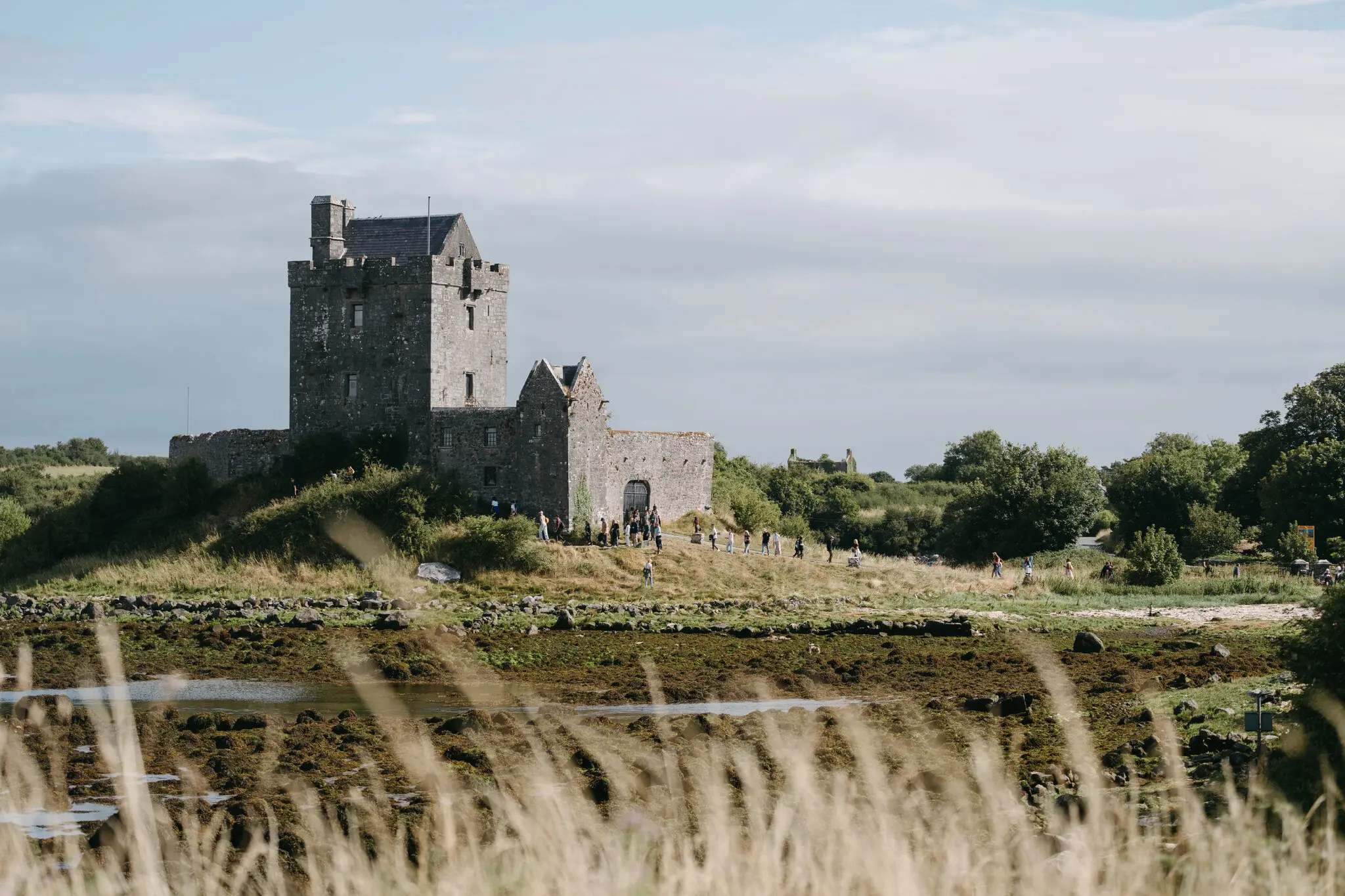




The buses still turn off the road beside Galway Bay. Visitors step out, phones already raised, and walk toward the grey stone tower of Dunguaire Castle. It is exactly the image many came to Ireland to find: medieval walls, Atlantic water and green shoreline. Then they reach the gate and discover that the visit is over.
Dunguaire has been closed to the public since 2023. For decades, travellers could enter the tower, explore its rooms and attend evening banquets. Now one of County Galway’s best-known landmarks functions largely as a photograph: visible, accessible from outside and still heavily promoted by the landscape around it, but locked.
The stalemate is not the result of a collapse in tourist demand. Galway County Council says it intends to acquire Dunguaire as a flagship tourism asset. The difficulty is the cost of making that transfer workable: its 2026 budget says €5 million in central-government support would be needed for repairs, conservation and redevelopment.
That has left the castle suspended between public bodies. The Shannon Airport Group remains associated with the site, while the council is prepared to take responsibility only if the funding needed to protect and operate the property comes with it. Three years after the gates shut, the ownership question remains unresolved.
According to Daycom’s analysis of public and verified records, the Dunguaire Castle closure is less a dispute about whether the landmark matters than about who carries the financial risk of reopening it. Almost everyone involved agrees on its cultural and economic value. Agreement becomes harder when that value has to be translated into a budget.
For a visitor standing outside, the distinction can seem absurdly bureaucratic. The castle is already there. The road reaches it, coaches arrive, photographs are taken and nearby businesses are ready for customers. But ownership of a historic building also means accepting responsibility for structural safety, conservation, insurance, staffing and maintenance.
Galway County Council’s own plans make clear that the proposed €5 million would not simply pay for a ceremonial handover. The authority envisages remedial structural and conservation work, a new visitor experience, a sustainable operating model and a renewed digital and marketing strategy intended to make Dunguaire viable over the long term.
That helps explain why the council has resisted simply taking the keys and worrying about the bill later. A medieval tower house can be a valuable tourism asset, but it is also a permanent conservation obligation. Once the transfer is complete, responsibility for every future repair and every safety requirement moves with it.
The impasse is particularly visible because other former Shannon Heritage attractions have already made the transition to local authorities. King John’s Castle moved into Limerick’s control in 2022, while Bunratty Castle, Knappogue Castle and other Clare properties were transferred to Clare County Council the following year.
Those precedents inevitably sharpen the question in Galway. If neighbouring counties were able to bring major heritage properties into public local management, why has Dunguaire remained behind a locked gate? The answer lies partly in the financial terms attached to each transfer, rather than in any lack of enthusiasm for the castle itself.
Dunguaire’s tourism appeal is unusually easy to understand. Technically a tower house rather than a grand later castle, it was built in the early 16th century on a low promontory outside Kinvara. Its compact vertical form, enclosing wall and position above Galway Bay have made it almost unnaturally well suited to postcards and tourism campaigns.
Its name recalls Guaire, a seventh-century king of Connacht, although the surviving structure was built centuries later. Over time the building passed through several families, periods of neglect and successive restorations, acquiring layers of history that reached far beyond its original purpose as a fortified residence.
In the early 20th century, Dunguaire became associated with Oliver St. John Gogarty, the Irish surgeon, poet and writer who acquired the property and began restoring it. Its later reputation became intertwined with the cultural world of the Irish Literary Revival and with the mythology of an artistic west of Ireland.
For much of the past half-century, that history was packaged into an accessible visitor experience. Tourists could go through the gate instead of merely looking across it. The castle offered tours and medieval-style banquets that gave tour operators a reason to make Kinvara more than a roadside photography stop.
That distinction matters to a village economy. A traveller who spends ten minutes photographing a castle contributes very differently from one who stays for a tour, eats nearby, attends an evening event or books accommodation. The building’s economic value depends not merely on drawing people toward Kinvara but on giving them a reason to remain there.
The campaign group Save Kinvara Castle has made precisely that case. It says visitors continue to arrive at the site every week only to find chains and closed gates, and it has organised a campaign encouraging tourists to contact the public bodies that could resolve the dispute.
Its argument is deliberately simple: Dunguaire welcomed visitors for more than 50 years, the council is willing to take it on, and the missing element is a government funding commitment. The group wants that gap closed before another tourism season passes with the tower visible but inaccessible.
There is also concern about what prolonged closure does to the building itself. Campaigners warn that a historic structure cannot simply be left indefinitely in administrative limbo without consequences. On the Atlantic coast, exposure to moisture, wind and weather means maintenance is not optional merely because tourists have stopped entering.
That concern should not be exaggerated into a claim that Dunguaire is about to collapse. No public evidence supports such a dramatic conclusion. But Galway County Council itself identifies structural repairs and conservation as essential elements of the proposed project, confirming that reopening requires more than removing a padlock.
The castle therefore sits at the intersection of two different ways governments value heritage. One is cultural and promotional: Dunguaire is a recognisable piece of the Irish landscape, useful in telling the story of Galway and the Wild Atlantic west. The other is administrative: every historic asset carries costs that must be assigned somewhere.
Ireland has become exceptionally successful at the first task. Castles, coastal roads, traditional villages and Atlantic scenery form one of Europe’s most coherent tourism identities. Dunguaire fits that image almost perfectly. Its current predicament exposes the less romantic work required to keep such an image functioning in the real world.
A photograph does not require staffing, fire regulations or conservation budgets. A functioning heritage attraction does. That gap between the effortless appeal of the castle from the roadside and the complicated responsibility of opening its doors is essentially the entire Dunguaire dispute in miniature.
For Kinvara, however, the debate is not merely about heritage policy. Tourism is a significant part of the local economy, and Dunguaire sits on a well-travelled western route connecting Galway with the Burren and the Cliffs of Moher. Every closed season weakens the village’s ability to capture more of the traffic already passing its door.
The strange result is that success and failure coexist at the same location. Dunguaire has not been forgotten. It has not lost its beauty, its history or its audience. Tourists continue to find it. The failure lies in converting all that existing demand into an open, managed and sustainable attraction.
There is little evidence of a fundamental political disagreement over the desired outcome. Galway County Council calls Dunguaire a flagship asset and has placed the acquisition in its formal plans. Campaigners want the same thing. The unresolved issue remains the funding package and the structure through which ownership can finally move.
That makes the prolonged closure more frustrating than a dispute in which competing sides want incompatible things. Ireland does not need to build a castle, invent a tourism market or persuade people to come. Five centuries of history have already done that work. The remaining challenge is institutional.
Until it is solved, Dunguaire will continue in its peculiar half-life. Visitors will still pull over beside Galway Bay, frame the tower against the water and carry away an image that looks like uncomplicated Ireland. Only when they reach the gate will they encounter the modern part of the story.
And that may be the sharpest irony of the Dunguaire Castle closure. One of Ireland’s most photogenic monuments needs no campaign to make people want to see it. The tourists are already there. What is missing is the comparatively mundane agreement required to let them through the door.