























An explosive-laden drone found beside a Ukrainian cargo aircraft at Leipzig/Halle Airport has become something much larger than a failed act of sabotage. Nearly a month after the device was discovered, Germany has formally concluded that people acting for Russian state entities were behind the attempted attack.
Interior Minister Alexander Dobrindt said the conclusion rested on police work, the operational pattern and intelligence findings taken together. Berlin now describes the August 4 incident as a Russian hybrid attack, moving beyond the language of suspicion that German officials used while the investigation was still unfolding.
Russia rejects that conclusion completely. Moscow has called the accusations baseless, while President Vladimir Putin has argued that German authorities fabricated evidence for domestic political reasons. The Russian embassy warned that Berlin’s response represented an unprecedented escalation in bilateral relations.
What makes the case unusually serious is the intended environment. Leipzig/Halle is not an isolated military installation but a major European cargo airport used by Ukrainian Antonov aircraft and by NATO-linked strategic airlift operations. An explosive device there potentially endangered civilian workers as well as valuable aviation assets.
According to Daycom’s analysis of verified public reporting, the Leipzig drone plot matters because it tests a central weakness in Europe’s security architecture. Germany says a foreign state directed an explosive attack on NATO territory, yet the method was designed to remain below the unmistakable threshold of conventional warfare.
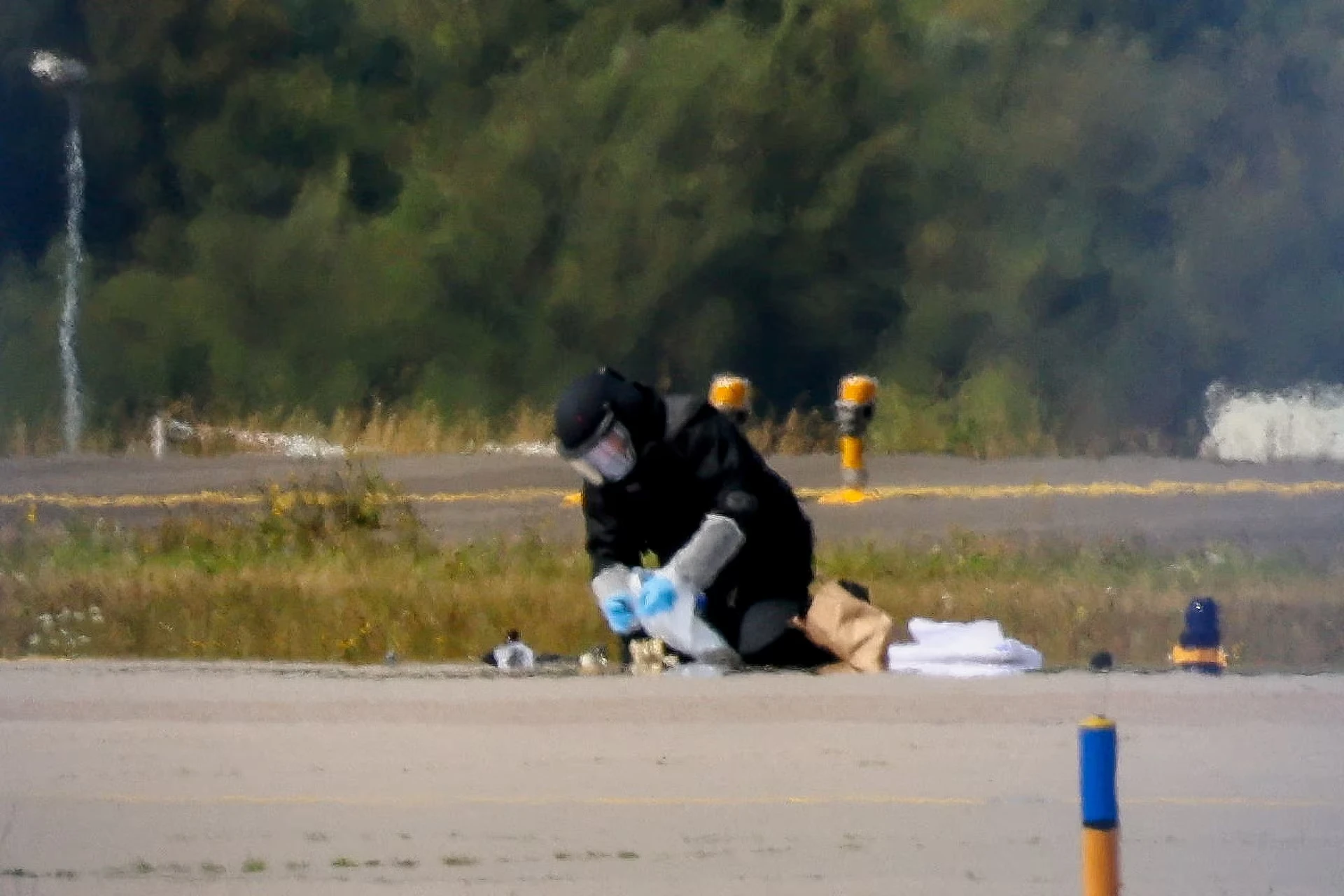
The drone was discovered near a Ukrainian cargo aircraft on the evening of August 4. German investigators determined that it carried explosives, and authorities later concluded that agents operating on behalf of Russian state structures had controlled it. The device failed to produce the destruction its operators apparently intended.
German officials have not released the full intelligence file supporting that attribution. That is common in cases involving suspected state operations: governments may rely on intercepted communications, technical signatures, intelligence sources or information from partners that cannot be disclosed without compromising how it was obtained.
The distinction is important. Germany has made a governmental attribution of responsibility, but the public does not yet possess every piece of evidence behind it. That does not invalidate Berlin’s finding, but it means an outside observer must distinguish between what German authorities say they have established and what can independently be examined in open sources.
Moscow is exploiting precisely that gap. Its response has focused less on presenting a detailed alternative explanation for the drone than on challenging Berlin’s motives. Russian officials argue that Germany is escalating confrontation deliberately and using the case to justify a harder policy toward Moscow.
Putin went further, tying the accusation to Chancellor Friedrich Merz’s domestic difficulties and Germany’s electoral politics. His argument was essentially political: Berlin needed an external enemy because its governing establishment was under pressure at home. Germany, by contrast, says the attribution is based on investigative and intelligence evidence.
The clash illustrates the information problem built into hybrid operations. A conventional missile strike usually leaves a clearer chain of military responsibility. Sabotage conducted through intermediaries, small drones or deniable operatives creates enough ambiguity for the alleged sponsor to contest attribution even after the target state reaches its own conclusion.
That ambiguity is strategically useful. A state can impose costs on an adversary while avoiding the clarity that might trigger a much stronger response. The victim must investigate first, decide how much evidence can be revealed and then determine whether sanctions, expulsions or other measures are proportionate to an attack that stops short of declared war.
Germany has decided that the threshold for political action has been crossed. Berlin announced measures including the closure of the Russian consular mission in Bonn and the termination of arrangements supporting a Russian cultural centre in Berlin. It also wants broader European sanctions and further pressure on Russian interests.
The response is deliberately punitive but non-military. Germany is treating the alleged operation as more serious than ordinary criminal sabotage without treating it as an armed attack requiring a military answer. That middle category is likely to become increasingly important as European governments confront what they describe as Russian hybrid activity.
Moscow has already retaliated. Russian Foreign Minister Sergei Lavrov said Russia would close Goethe-Institut cultural centres in response to Germany’s decision against Russian institutions. A failed drone attack has therefore already produced a further dismantling of the cultural and diplomatic infrastructure connecting the two countries.
That escalation is revealing because neither side is pretending the dispute concerns a single damaged or undamaged aircraft any longer. Germany says the Leipzig episode belongs to a broader campaign of Russian pressure against states supporting Ukraine. Russia says Germany is using fabricated accusations to deepen confrontation.
European allies have largely rallied behind Berlin. NATO Secretary-General Mark Rutte said the evidence of Russian responsibility was clear, while several European governments expressed solidarity with Germany. The response has helped turn a national investigation into another test of the West’s collective approach to suspected Russian covert action.
EU foreign policy chief Kaja Kallas used some of the strongest language, saying the Leipzig incident bore the hallmarks of state-sponsored terrorism. European foreign ministers have discussed additional sanctions as governments consider how to punish operations that are violent but intentionally designed to remain outside conventional military categories.
The broader context matters. European governments have spent several years investigating fires, explosive parcels, cyberattacks, navigation interference, suspected sabotage and unexplained drone flights around critical sites. Officials in several countries have alleged Russian involvement in parts of that activity, allegations Moscow routinely denies.
Not every suspicious incident can responsibly be folded into a single Russian campaign. Sabotage can have domestic perpetrators, ideological motives or criminal explanations unrelated to Moscow. The evidentiary discipline is essential precisely because Europe is now searching for patterns across large numbers of otherwise disconnected incidents.
Germany itself demonstrated that caution after fresh sabotage was reported against energy infrastructure. Homemade incendiary devices were discovered at a power facility in eastern Germany, but authorities did not immediately attribute the attack to Russia. A pattern may justify heightened scrutiny; it cannot substitute for evidence in an individual case.
Leipzig is different because Berlin says that investigative threshold has now been met. Dobrindt’s language was categorical: the combination of policing, operational patterns and intelligence findings established Russian responsibility. Once a government makes that judgment publicly, doing nothing carries its own strategic cost.
For Germany, the difficulty is calibrating deterrence. A weak response risks signalling that covert violence on German soil is inexpensive. An excessive response could allow a deniable operation to provoke the very escalation Berlin wants to avoid. Closing diplomatic facilities and pushing sanctions occupies the space between those two outcomes.
This is the fundamental advantage hybrid warfare seeks to exploit. It forces the target to spend heavily on protection and investigation while leaving the attacker’s own exposure limited. A small drone and a modest explosive charge can trigger airport shutdowns, security reviews, intelligence operations and diplomatic consequences costing vastly more.
Critical infrastructure makes the imbalance worse. Germany cannot defend every airport, electricity substation, railway junction, defence plant, warehouse and communications site as if it were a military base. Protecting one category of target often pushes an attacker toward another that is softer, cheaper to reach or harder to monitor.
Drones have widened that vulnerability. An operative no longer necessarily needs to approach a target carrying explosives personally. A small unmanned aircraft can cross fences and open ground remotely, creating both physical distance and investigative uncertainty between the person controlling it and the object being attacked.
The Leipzig case therefore has significance for aviation security well beyond Ukrainian Antonov aircraft. European airports were designed primarily around threats involving passengers, baggage, intrusions and conventional perimeter breaches. Low-cost unmanned aircraft require a different architecture of detection and rapid interception.
Yet absolute protection is unrealistic. Radar and electronic countermeasures can help, but small drones are difficult to detect consistently in cluttered environments. Jamming also creates complications around airports, where communications and navigation systems themselves require protection from interference.
The strategic answer consequently cannot be purely technical. Germany needs intelligence capable of identifying preparations before launch, police able to connect local incidents with foreign networks and security agencies able to combine information that may otherwise appear insignificant when viewed separately.
That is one reason the language of “hybrid warfare” has become so prominent in Berlin. The concept treats sabotage, espionage, cyber operations, disinformation and coercive activity not as isolated disciplines but as potentially interconnected tools for weakening an adversary without entering a declared conflict.
For Russia, such accusations carry their own political utility when rejected. Moscow portrays them as evidence that European leaders are manufacturing external threats to justify military spending, sanctions and support for Ukraine. The dispute over attribution therefore becomes part of the same information struggle as the alleged operation itself.
Domestic German politics make that contest sharper. Arguments over military assistance to Ukraine, relations with Moscow and the economic consequences of confrontation remain politically potent, particularly in parts of eastern Germany. Putin explicitly invoked those divisions when rejecting responsibility for Leipzig.
That does not prove or disprove Germany’s case. It does show why a covert attack can be valuable even if it fails physically. The resulting investigation, accusation and counteraccusation may itself deepen domestic disputes over Russia, security spending and whether support for Ukraine makes European countries safer or more exposed.
At the same time, Leipzig may demonstrate the opposite risk for whoever planned the operation. Once a suspected attack is convincingly attributed, it can strengthen precisely the policies it was meant to disrupt: higher security spending, tougher sanctions and greater political support for Ukraine.
That effect is already visible. Rather than treating Ukraine’s war as a distant security problem confined to NATO’s eastern frontier, German officials can now point to an explosive drone at a domestic airport as evidence that confrontation with Russia has reached infrastructure inside Germany itself.
The Ukrainian target also matters symbolically. Antonov aircraft became closely associated with Ukraine’s international logistics capacity after the full-scale invasion forced the company to reorganise operations abroad. Damaging one at a German hub would have carried meaning far beyond the direct financial loss.
Leipzig/Halle also supports strategic airlift activity linked to NATO, making the airport valuable within the broader European logistics network. That does not establish the intended purpose of the drone by itself, but it explains why an explosive device in that location immediately attracted national-security scrutiny.
The incident comes at a moment when Germany is strengthening its role in European defence and continuing substantial support for Kyiv. From Moscow’s perspective, German logistics, defence production and political backing make the country central to Ukraine’s ability to sustain a prolonged war.
From Berlin’s perspective, that is precisely why alleged sabotage cannot be treated as an acceptable side effect of supporting Ukraine. If assisting Kyiv automatically gives Moscow licence to conduct deniable violent operations inside Germany, the practical boundary of the war would effectively be determined by Russia.
The challenge for NATO is to establish a different boundary without allowing every covert incident to trigger uncontrolled escalation. Article 5 was designed for armed attacks, but much modern coercion is constructed specifically to complicate the question of when that category has been reached.
A drone carrying explosives to an airport demonstrates how uncomfortable that grey zone can become. Had the device detonated and killed airport workers, political pressure for a stronger response would have been much greater. The underlying alleged intent would be similar, but a faulty component would have determined the strategic consequences.
That randomness is itself dangerous. Hybrid operations may be designed to remain limited, yet planners cannot fully control fire, secondary explosions, casualties or the political response. An operation intended as sabotage can become a lethal international crisis because of fuel, timing or the presence of civilians.
Germany is therefore trying to impose consequences before such an incident succeeds. Its diplomatic measures send the message that failure does not erase responsibility. For deterrence to work, the cost of an attempted operation must not depend entirely on whether a detonator happens to function.
European institutions appear to be moving toward the same logic. Kallas’s description of the attack as bearing signs of state-sponsored terrorism suggests a growing willingness to treat violent covert operations collectively rather than leaving each affected country to absorb them as separate criminal cases.
But collective language creates a corresponding obligation to maintain high evidentiary standards. If European governments attribute attacks too quickly, genuine Russian operations become easier for Moscow to dismiss as politically motivated accusations. Credibility is itself a strategic asset in a conflict built around deniability.
That makes the next phase of the Leipzig case important. Germany will have to decide how much of its evidence can eventually be made public without compromising intelligence capabilities. Criminal proceedings, arrests or further technical disclosures would strengthen the attribution beyond the government’s present declaration.
Russia, meanwhile, has chosen retaliation rather than cooperation with Berlin’s account. The closure of Goethe-Institut branches makes the deterioration tangible: institutions that survived years of worsening relations are now disappearing as each side strips away another remaining channel of engagement.
The failed drone therefore succeeded in one respect regardless of who ultimately faces criminal prosecution. It pushed Russian-German relations deeper into confrontation, increased pressure for European sanctions and forced Germany to confront an uncomfortable question about what constitutes an attack in an age of deniable weapons.
Berlin’s answer is beginning to emerge. Germany is not calling itself at war with Russia, but it is also refusing to treat suspected state-directed sabotage as ordinary peacetime crime. It is building a category of response between the two — intelligence-led attribution, diplomatic punishment, sanctions and stronger domestic defence.
That middle ground may become one of Europe’s most consequential security doctrines. Conventional deterrence depends on an adversary knowing where the red line lies. Hybrid operations thrive when the line is blurred. Germany’s task after Leipzig is to make clear that operating below the threshold of war does not mean operating below the threshold of consequences.