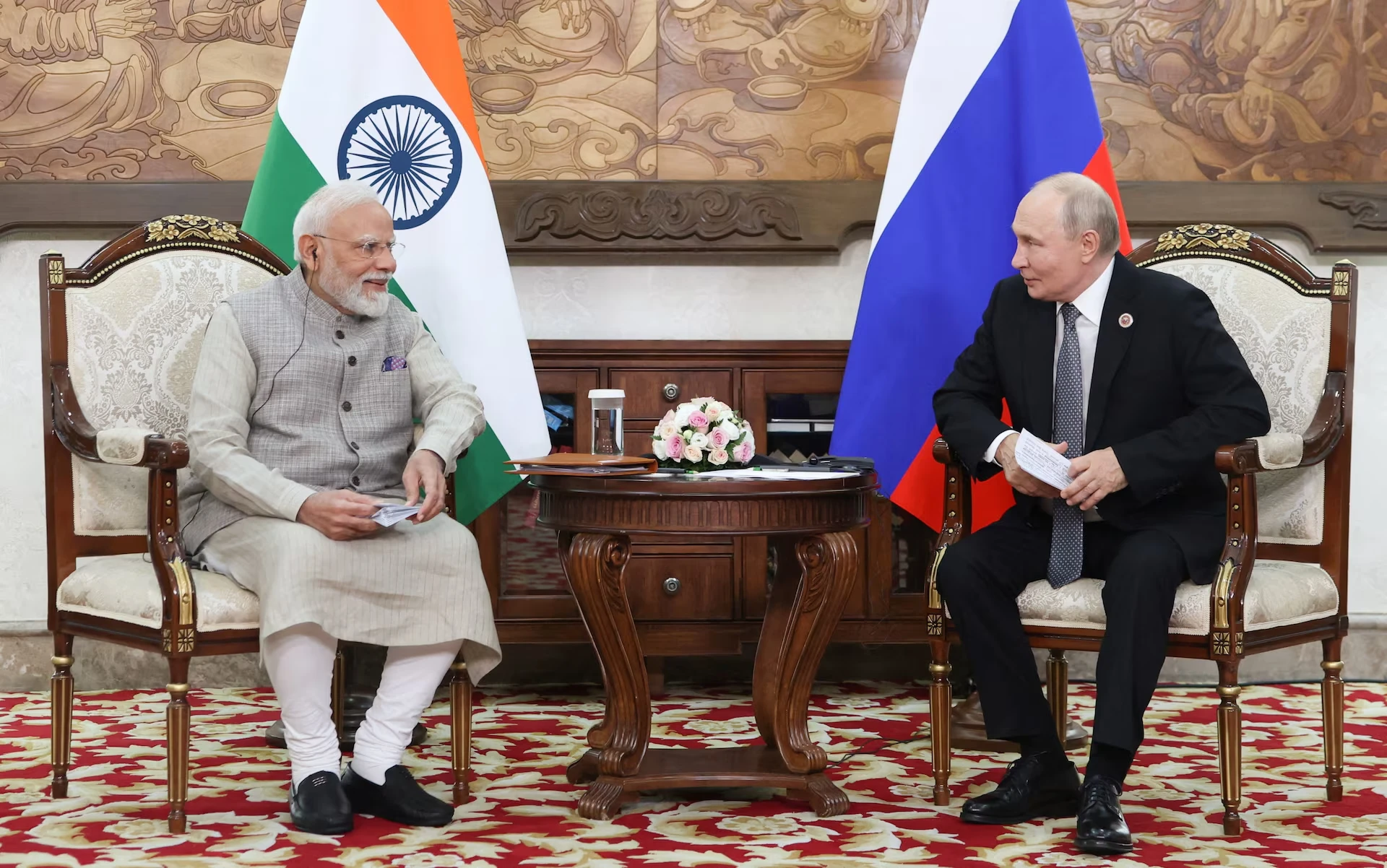

















Narendra Modi sat across from Vladimir Putin in Bishkek and used language noticeably firmer than New Delhi’s usual diplomatic formulas. The war in Ukraine must end, India’s prime minister said, because every additional day of fighting pushes humanity a step backward.
The meeting took place on August 31 on the sidelines of the Shanghai Cooperation Organisation summit. Modi pledged India’s support for every serious peace effort and called for a move from “endless war” toward an end to hostilities. At the same time, he continued to describe Putin as his friend.
That combination is deliberate. For more than four years, India has tried to sustain two positions at once: publicly supporting negotiations and an end to the war while preserving ties with Russia across energy, defence, nuclear cooperation, space and trade.
After the talks, India again stressed that any settlement must come through dialogue and diplomacy. Modi and Putin also agreed to continue strengthening what both governments call their “special and privileged strategic partnership,” a relationship New Delhi presents as resilient despite geopolitical upheaval.
Daycom’s analysis indicates that Modi’s words do not signal a strategic turn away from Russia. New Delhi is trying to create more diplomatic distance from the war itself without creating the same distance from Moscow — especially at a time when Russian oil has become increasingly important to India’s energy security.
Putin replied that Russia was supposedly moving along a path toward peace. But his response included neither an agreement to a ceasefire nor any retreat from Moscow’s territorial demands. After the meeting, the Kremlin said Putin had also briefed Modi on his own view of the course of the war.
That is why the diplomatic significance of the exchange should not be overstated. Modi did not unveil a new peace initiative or propose a mechanism for negotiations. He articulated a political position that allows New Delhi to stay engaged with Moscow without identifying itself with an indefinite continuation of the war.
This line is not new for Modi. He has repeatedly argued that the conflict cannot be resolved on the battlefield and that diplomacy must involve both sides. India consistently describes its position not as neutrality, but as support for peace, dialogue and negotiation.
Behind that diplomatic formula, however, lies a very concrete economic relationship. Since 2022, India has become one of the largest buyers of Russian crude redirected away from Europe after sanctions and the collapse of much of Moscow’s traditional Western market.
In July 2026, Russia’s share of India’s crude imports reached a record 50.83%, or roughly 2.47 million barrels a day. Between April and July, the average share exceeded 43%, compared with about 37% a year earlier.
The increase reflects more than Russian discounts. The war around Iran and disruptions affecting shipping through the Strait of Hormuz have made traditional Middle Eastern supply less predictable. For Indian refiners, Russian crude has become one of the main ways to offset that instability.
Russian flows to India eased from their July highs in August, but that did not amount to a political break with Moscow. China absorbed some Russian cargoes, while Asian refiners more broadly faced tight supply conditions linked to reduced availability from the Middle East.
New Delhi’s official position remains unchanged: Indian refiners choose suppliers on commercial grounds, weighing price, crude quality and reliability. The government says it does not instruct private and state refiners to purchase a fixed volume of Russian oil.
That allows Modi to separate the political and economic tracks. He can tell Putin that the war must end while Indian refiners continue buying millions of barrels of Russian crude, presenting those purchases not as political support for Moscow but as a matter of national energy security.
For the Kremlin, this arrangement is extremely valuable. Russia has lost much of the European oil market that once anchored its export model. Without large Asian buyers, redirecting those volumes would be far more difficult and Western sanctions would put much heavier pressure on Russian revenue.
India’s calculation is different. It is one of the world’s largest oil importers and remains highly sensitive to fuel prices. Access to multiple sources allows refiners to balance Russian, Middle Eastern, Latin American and other supplies according to price and risk.
That flexibility matters even more when Middle Eastern routes are unstable. In August, crude shipments from the region to India remained well below levels seen before the latest crisis around the Strait of Hormuz. Under those conditions, a rapid break with Russia would carry a larger economic cost for New Delhi.
This is where Modi’s peace rhetoric runs into growing pressure from Washington. The US Senate on August 7 approved legislation targeting Russian energy revenue and authorising tariffs of up to 100% against major buyers of Russian oil and gas.
Under India’s current import structure, it is clearly among the countries potentially exposed to such a mechanism. The legislation has not yet become law because the House of Representatives has not completed its work, but the prospect alone raises the political cost of Russian oil.
For New Delhi, this could prove more difficult than earlier sanctions. Restrictions on a particular Russian tanker, trader or bank can sometimes be mitigated by changing logistics. Broad tariffs on Indian goods entering the US would affect sectors with no direct connection to energy.
In that sense, Modi’s appeal to end the war came at a moment when its continuation is becoming more expensive for India too. The longer Russia fights, the stronger the pressure on countries whose purchases help preserve Moscow’s energy income.
That does not mean New Delhi is preparing to join the Western strategy of isolating Russia economically. India has for decades treated Russia as an independent strategic relationship that should not be wholly determined by the state of its ties with the United States, Europe or China.
In December 2025, the two countries again reaffirmed broad cooperation in defence, energy, trade, nuclear technology, space and security. Official documents continue to portray the relationship as one built on long-term trust and mutual respect for core interests.
That historical depth helps explain why Modi can publicly tell Putin that the war should end without breaking the relationship. Moscow understands that criticism from New Delhi does not automatically mean India is moving onto the Western sanctions track.
Russia also remains part of India’s strategic balancing in Asia. New Delhi has little interest in seeing Moscow become fully dependent on Beijing. Maintaining its own channels with the Kremlin gives India additional room to manoeuvre in a region increasingly shaped by Chinese power.
The relationship, moreover, is no longer confined to Soviet-era defence ties. Both governments are trying to expand cooperation in energy, fertilisers, innovation, space and civilian trade. Modi highlighted progress in several of those areas during the Bishkek meeting.
The immediate diplomatic calendar is revealing as well. Less than two weeks after urging an end to the war, Modi expects Putin in India for the BRICS summit on September 12–13. Firmer peace rhetoric is therefore being accompanied not by a freeze in contacts, but by another high-level meeting.
That captures the essence of Indian diplomacy. New Delhi wants to remain a power capable of speaking simultaneously to Moscow, Kyiv, Washington and European capitals without allowing any one of them to dictate the entirety of its foreign policy.
That position gives India some diplomatic capital. Modi maintains direct contacts with both Putin and Volodymyr Zelenskyy, which means India can theoretically relay messages between the two sides when direct channels are limited.
But the ability to maintain contact is not the same as the ability to alter Kremlin decisions. India has so far shown no willingness to use the economic weight of its oil purchases as direct leverage to force Moscow toward concessions over Ukraine.
Instead, New Delhi’s model rests on separating energy trade from diplomatic positioning. India buys Russian crude because it considers the purchases economically beneficial and calls for peace because that fits its foreign-policy posture. The government does not treat those choices as inherently contradictory.
For Ukraine, that distinction matters. Modi’s calls for an end to hostilities are significant as evidence that even one of Moscow’s most important partners does not want an endless war. But the political weight of that message depends on whether India is ever prepared to back it with material leverage.
So far, it has not. Russia remains a major energy supplier, Putin is preparing for another visit to India, and the strategic partnership continues to expand officially. The peace rhetoric is becoming more explicit, but the economic foundation of the relationship has not weakened.
The greatest pressure on this balancing act may come not from Bishkek or Moscow, but from Washington. If US legislation allowing tariffs of up to 100% passes the House and is actually enforced, India will have to assess Russian oil not only by the price of a barrel.
Possible losses in the US market would then enter the calculation. For export-oriented Indian industries, that cost could outweigh at least part of the benefit of discounted Russian crude and force the government into a much less comfortable choice.
At that point, Modi’s diplomatic formula — friendship with Putin, continued purchases of Russian energy and public appeals for peace — would face a far harder test. For now, all three can still coexist. The longer the war continues, the more expensive maintaining that balance may become.
That is why Modi’s call to move from “endless war” toward its conclusion matters beyond its tone. It came from the leader of a country that has become one of Russia’s most important economic partners since 2022. The real weight of those words, however, will depend not on how strongly they are phrased, but on whether policy eventually changes with them.