
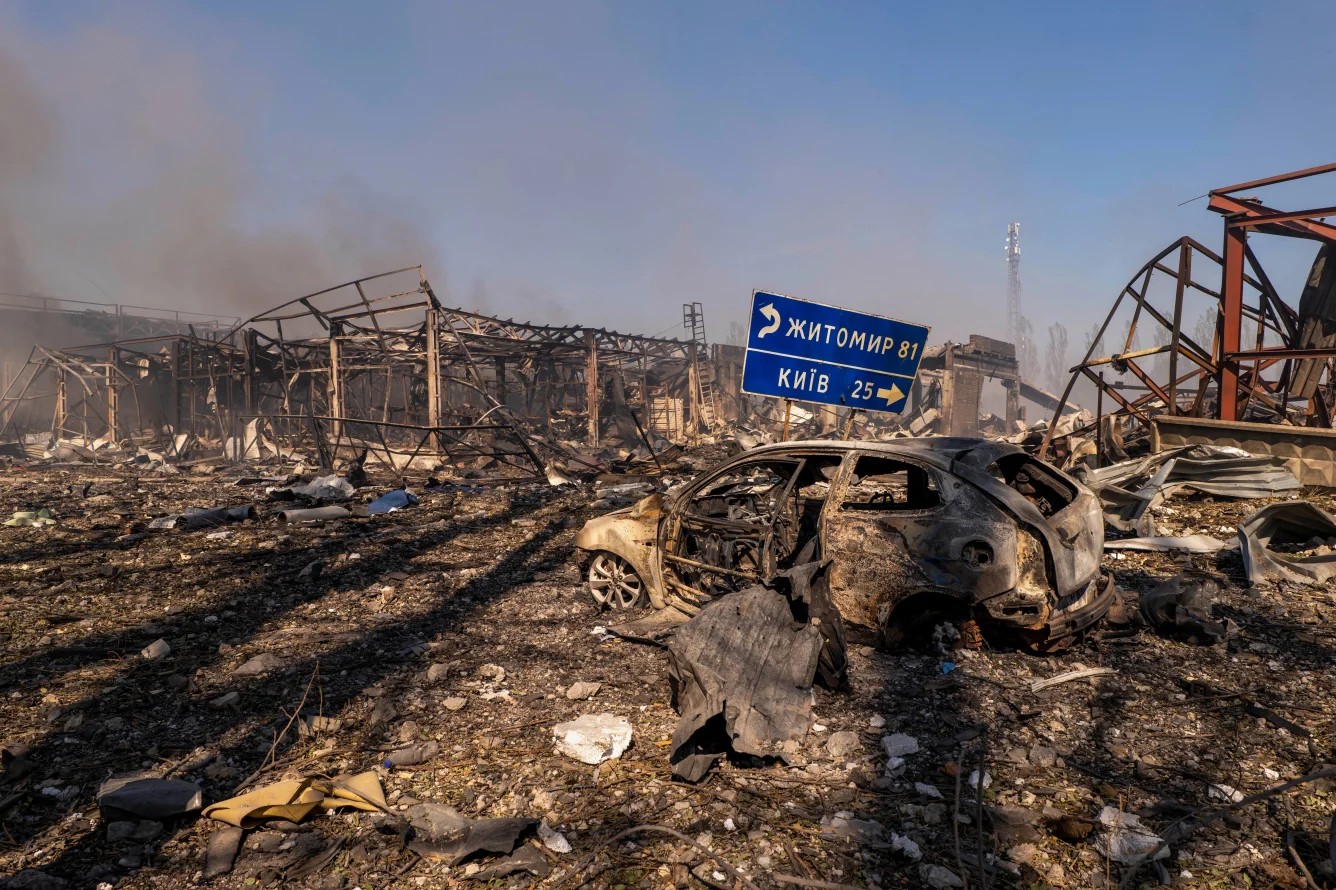


















A Russian strike on the village of Myla in the Kyiv region has become the deadliest attack on Ukraine since the beginning of 2026. By the morning of August 30, 38 people had been confirmed dead and four were still missing. Twenty people were wounded, including two children, while search operations continued.
The disaster unfolded on the evening of August 28 in the Bucha district, west of Kyiv. After a strike hit a warehouse complex, ammunition stored at the site began detonating in a chain of secondary explosions. Debris was thrown far beyond the compound, fires spread rapidly and surrounding residential areas were heavily damaged.
Ukraine’s Security Service said the site was struck by a Russian Geran-4 drone. Ammunition stored in the warehouses then exploded, greatly expanding the destruction. According to the preliminary investigation, about 130 homes and a number of other civilian structures were damaged.
But from the outset, the tragedy in Myla has raised two separate questions of responsibility. Russia launched the strike that triggered the catastrophe. Ukrainian authorities are also asking why significant quantities of ammunition and explosives were being stored so close to residential buildings.
Daycom’s analysis indicates that the Myla strike is both the consequence of a Russian attack and a warning about vulnerabilities inside Ukraine’s own rear. Wartime security cannot depend solely on air defence succeeding: one penetration should not be able to turn into a disaster for an entire community.
That is why the Security Service opened proceedings under two separate provisions of Ukraine’s criminal code. One concerns Russia’s act of aggression. The other concerns possible negligent performance of military duties. Investigators must determine who was responsible for the storage site and whether safety requirements were followed.
President Volodymyr Zelenskyy described the situation on August 29 not only as the result of a Russian strike, but also as “terrible negligence” by those who allowed explosive materials to be stored near civilians. He said a repeat of such a situation after earlier incidents was unacceptable.
That distinction is important. The presence of a military site does not remove Russia’s responsibility for launching the strike. At the same time, the Russian attack does not absolve Ukrainian institutions of their duty to reduce the risk that secondary explosions could kill civilians beyond the perimeter.
Ammunition depots are especially dangerous because the initial impact may be only the beginning of the attack’s destructive effect. A comparatively small warhead can trigger shells, mines, missile components and other explosives that then continue detonating independently of the weapon that first hit the site.
In Myla, those secondary explosions dramatically enlarged the damage zone. Emergency crews could not simply enter, extinguish the fires and begin clearing debris. Bomb-disposal teams had to work alongside rescuers, locating and neutralizing munitions that had failed to explode.
By August 30, most of the major fires had been extinguished, but operations were continuing around the clock. Search teams were still checking destroyed areas while explosive-ordnance specialists cleared dangerous remnants. Four people remained unaccounted for.
Among those killed was Taras Didych, head of the Dmytrivka community. He had arrived after the initial strike and joined the response effort. His death underscored another danger of ammunition-site attacks: secondary explosions can kill those who come to help after the first impact.
The scale of the disaster exceeded other major Russian attacks on Ukraine this year. A large strike on Kyiv earlier in the summer killed 30 people and wounded dozens. In Myla, a single strike combined with the detonation of stored ammunition killed 38.
That difference matters. A catastrophic outcome does not necessarily require hundreds of missiles and drones. If one weapon reaches a site containing a dense concentration of explosives near homes, a single air-defence failure can produce damage comparable to a much larger combined attack.
That is why dispersal of ammunition stocks now matters almost as much as the number of air-defence systems available. Large central depots are easier to guard, manage and supply, but they also create a major single point of failure. A direct hit multiplies the danger by everything stored inside.
Dispersal carries its own costs. It requires more sites, vehicles, guards and personnel, makes inventory control harder and increases logistical complexity. But the war is increasingly forcing Ukraine to give up peacetime efficiency where that efficiency creates an unacceptable concentration of risk.
The same logic is already reshaping energy, retail distribution, military manufacturing and civilian logistics. After repeated Russian strikes, companies have been spreading inventories across backup facilities and duplicating routes. With ammunition, the consequences of failing to do so are far more severe.
The Myla strike came as the intensity of Russian air attacks was sharply increasing. On August 29 alone, Russia launched more than 200 attack drones at Ukraine, many of them jet-powered. Kyiv and the surrounding region were among the principal targets.
The attacks continued overnight into August 30. Russia used ballistic missiles and more than 100 drones of different types. Ukrainian air defences reported destroying or suppressing the overwhelming majority, but some weapons still reached their targets.
In Kyiv itself, at least three people were injured. A fire spread through part of a 12-storey residential building in the Obolonskyi district, while rescuers responded to damage at other locations across the capital, including administrative and non-residential buildings.
The density of such attacks demonstrates how difficult rear-area defence has become. Air-defence units must simultaneously protect Kyiv, power infrastructure, military plants, railways, warehouses, airfields and dozens of other critical sites. Even a very high interception rate cannot guarantee that every dangerous weapon is destroyed.
After the Myla disaster, Moscow added another threat. Russia’s Defence Ministry said on August 30 that it was preparing “massive strikes” against Ukraine’s energy infrastructure, describing them as retaliation for Ukrainian attacks on Russia’s fuel and energy sector and other facilities.
Moscow presents the planned campaign as a response to Ukraine’s long-range strikes. Kyiv says its attacks on Russian refineries, fuel infrastructure and logistics are aimed at assets that finance and materially sustain Russia’s war effort.
Ukraine’s energy system has already endured several winters of systematic Russian attacks. The threat of another campaign is therefore not theoretical. Ukrainian authorities have spent the summer identifying protection of critical infrastructure, shelters and stronger missile defence as key priorities ahead of the heating season.
A shortage of ballistic-missile interceptors remains a particular concern. Ukrainian officials have warned that supplies of such interceptors have fallen significantly in 2026. That matters as Russia increasingly combines ballistic missiles with fast jet-powered drones designed to compress response time.
Winter preparations therefore cannot be based on the assumption that every incoming weapon will be intercepted. Ukraine is distributing backup generation, strengthening physical protection, preparing emergency systems and rebuilding damaged capacity on the assumption that some strikes will get through.
Myla demonstrates the same principle in military logistics. Security cannot be designed around confidence that an enemy drone will be shot down. Ammunition storage must be organized so that even a successful strike does not cause mass casualties beyond the military facility itself.
Investigators now have to reconstruct not only the Russian attack, but the entire chain of Ukrainian decisions surrounding the depot. Who selected the location, how much ammunition was stored there, what distance requirements applied and whether alternative sites existed will all be central questions.
Opening a case over possible negligence does not mean that any individual has been found guilty. It creates the legal framework for examining the decisions made by officials. Personal responsibility can be established only after evidence is gathered and formal conclusions are reached.
It is equally important not to confuse that investigation with Russia’s responsibility for the strike. Without the attack, the detonation would not have occurred at that moment. But a country living under sustained missile and drone attacks must assess storage sites on the assumption that an enemy weapon may eventually get through.
This is one of the hardest changes imposed by a long war. Safe distances, backup depots, reinforced shelters and dispersed logistics can look inefficient for years. Their real value becomes visible in a single night, when one hostile aircraft or missile penetrates the defensive screen.
After Myla, the price of that redundancy is measured in more than buildings and munitions. Thirty-eight dead, four people missing, scores of damaged civilian structures and a large area contaminated by explosive remnants have turned ammunition storage into a direct question of civilian protection.
At the same time, Russia’s threat of new large-scale strikes on the energy system suggests that the coming months may bring further tests of the same kind. Moscow is trying to raise the cost of Ukrainian attacks on its rear, while Kyiv continues targeting Russian oil and logistics infrastructure.
In this phase of the war, the rear can no longer be treated as territory separate from the front. A warehouse outside Kyiv, a transformer substation, a sorting hub or an apartment block can become part of the same strike within minutes. The difference is how well the system was prepared for the moment interception failed.
The Myla attack became Russia’s deadliest strike on Ukraine this year not only because of the weapon that reached the site. The catastrophic scale came from what detonated after impact. That is why the tragedy demands two responses: a defensive response to Russia’s attack, and a legal and institutional response to any Ukrainian negligence the investigation establishes.