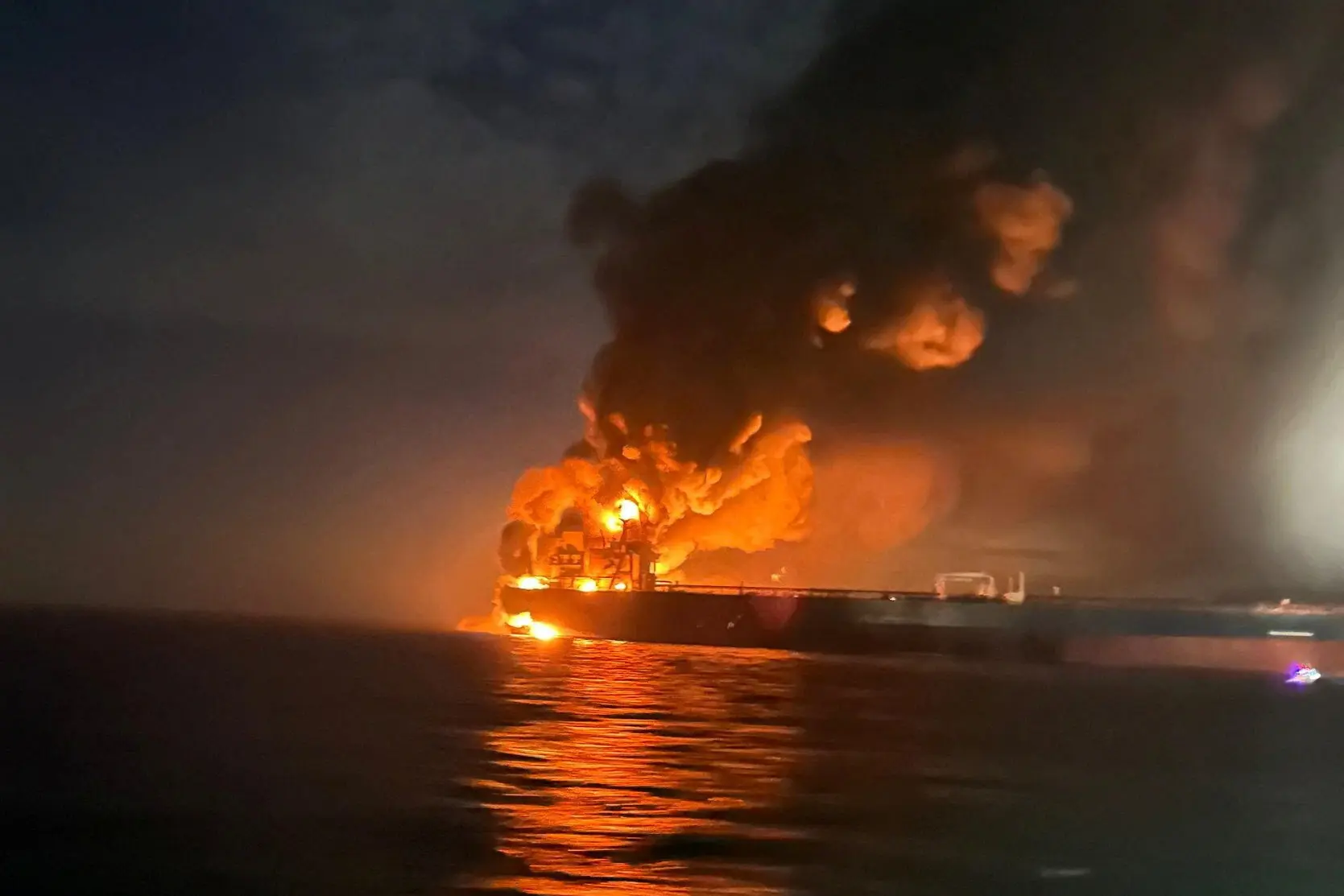

























The war between the United States and Iran may be acquiring a second maritime front. With the Strait of Hormuz effectively closed for months, the Red Sea has become a crucial alternative route for Saudi oil. The Houthis are now threatening to place that corridor under pressure as well.
The Yemen-based movement has declared a maritime blockade on Saudi Arabia, signaling that it is prepared to move from political warnings to direct disruption. Even without physically closing the waterway, the threat alone could reroute tankers, raise insurance premiums and sharply increase shipping costs.
The latest escalation began not at sea but on the runway of Sana’a International Airport. Yemen’s Saudi-backed government attempted to prevent an Iranian aircraft carrying a returning Houthi delegation from landing. After the airport was struck, the Houthis retaliated with an attack on Abha in southern Saudi Arabia.
In Daycom’s assessment, the significance of the crisis extends far beyond the old conflict between the Houthis and Riyadh. Tehran now has the potential to exert pressure across two strategic waterways, forcing Washington and its allies to divide military resources and political attention.
The Houthis control much of northern and western Yemen, including territory overlooking the Bab el-Mandeb. The narrow strait connects the Red Sea to the Gulf of Aden and remains one of the most important corridors for global trade, energy shipments and maritime traffic between Asia and Europe.
They do not need to physically seal the passage to create the economic effects of a blockade. A small number of missile or drone attacks could be enough to make shipowners alter routes, insurers raise premiums and tanker operators avoid the area.
That is the foundation of the Houthis’ asymmetric power. They do not possess a navy capable of imposing a conventional maritime blockade, but they can create conditions in which the global market behaves as though one already exists.
Saudi Arabia’s vulnerability has become more pronounced since the closure of the Strait of Hormuz. The kingdom redirected a substantial share of its exports through pipelines leading to the Red Sea port of Yanbu. The western route was meant to provide protection from Iranian pressure, but it is now within reach of one of Tehran’s closest regional allies.
This changes the architecture of energy security in the Gulf. The assumption had long been that disruption in Hormuz could be partly offset through land pipelines and western export terminals. The Houthi threat exposes the weakness of that strategy: the alternative route also depends on a narrow maritime passage vulnerable to missiles and drones.
For Iran, the arrangement offers leverage without requiring a direct attack on Saudi Arabia. Tehran can deny operational control over the Houthis while using their presence near the Bab el-Mandeb to send a clear message: pressure on Iran will produce consequences far beyond the Strait of Hormuz.
The Houthis tested this model during the war in Gaza. They attacked commercial vessels with missiles and drones, seized ships and forced major carriers to redirect traffic around Africa via the Cape of Good Hope.
Even a limited campaign caused delays, increased freight costs and disrupted global logistics. The present crisis is more dangerous because the threatened cargo is not limited to containers. It includes oil flows that have become increasingly important to global energy markets.
Saudi Red Sea terminals now serve as one of the main channels through which oil reaches international buyers while Hormuz remains constrained. A prolonged disruption could affect prices, inflation and industrial production far beyond the Middle East.
Riyadh has promised a swift and forceful response to any threat against shipping. Yet every military reaction carries the risk of destroying the fragile truce that has prevented Yemen’s civil war from returning to full intensity since 2022.
Saudi Arabia can reinforce security along selected routes, but it is unlikely to guarantee the safety of the entire Red Sea without substantial outside support. That inevitably raises the prospect of deeper American military involvement.
Washington faces an increasingly difficult choice. Escorting tankers, striking Houthi launch sites or opening another campaign in Yemen could reduce the immediate danger. Each step, however, would pull the United States further into a conflict that has already expanded from Iran to the region’s main transport arteries.
The Houthis also face considerable risks. They control Yemen’s capital and major population centers, but remain dependent on external supplies, limited financial resources and a deeply fragile domestic economy.
A large Saudi military operation could once again turn Yemen into the center of direct regional confrontation. Behind the strategic calculations lies a country already exhausted by war, poverty and humanitarian collapse.
Renewed strikes on airports, ports and transport infrastructure could cut access to food, fuel and medicine. Yemen’s civilians would again become the primary hostages of decisions made far beyond the country’s borders.
The Houthis are therefore likely to calibrate their escalation carefully. Their objective does not necessarily require a total halt to maritime traffic. Creating a sustained perception of danger may be more effective than attempting to close the strait outright.
A handful of targeted attacks could produce a greater political and economic impact than a prolonged campaign if they persuade shipping companies, insurers and governments to behave as though the passage were already blocked.
The blockade threat is therefore not a local episode. It is an attempt to redraw the geography of the U.S.-Iran war. The Strait of Hormuz is no longer the only center of energy pressure.
The Red Sea, the Bab el-Mandeb and Yemen’s coastline are becoming parts of the same strategic front. In this conflict, control over waterways means influence over time, prices and political decisions.
The Houthis do not need to defeat the American or Saudi navies. They only need to convince the world that every tanker entering the Red Sea could become the next target.