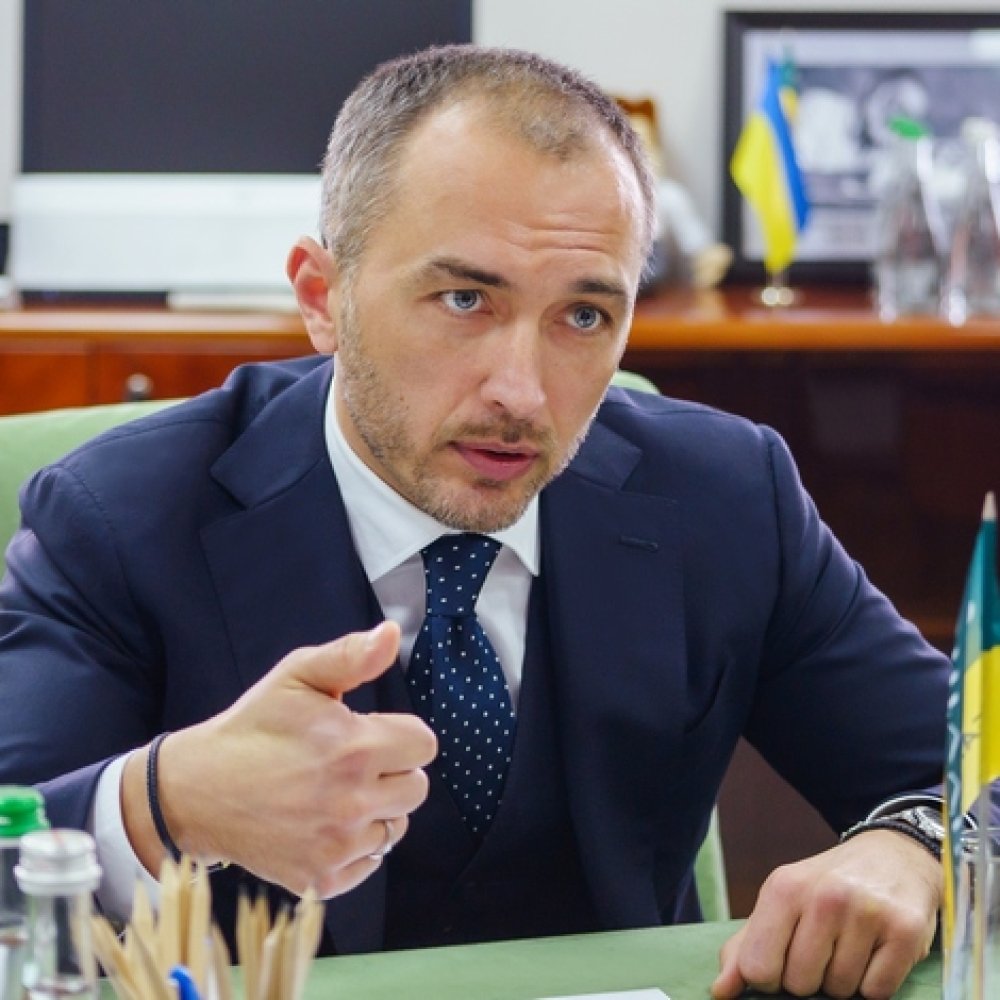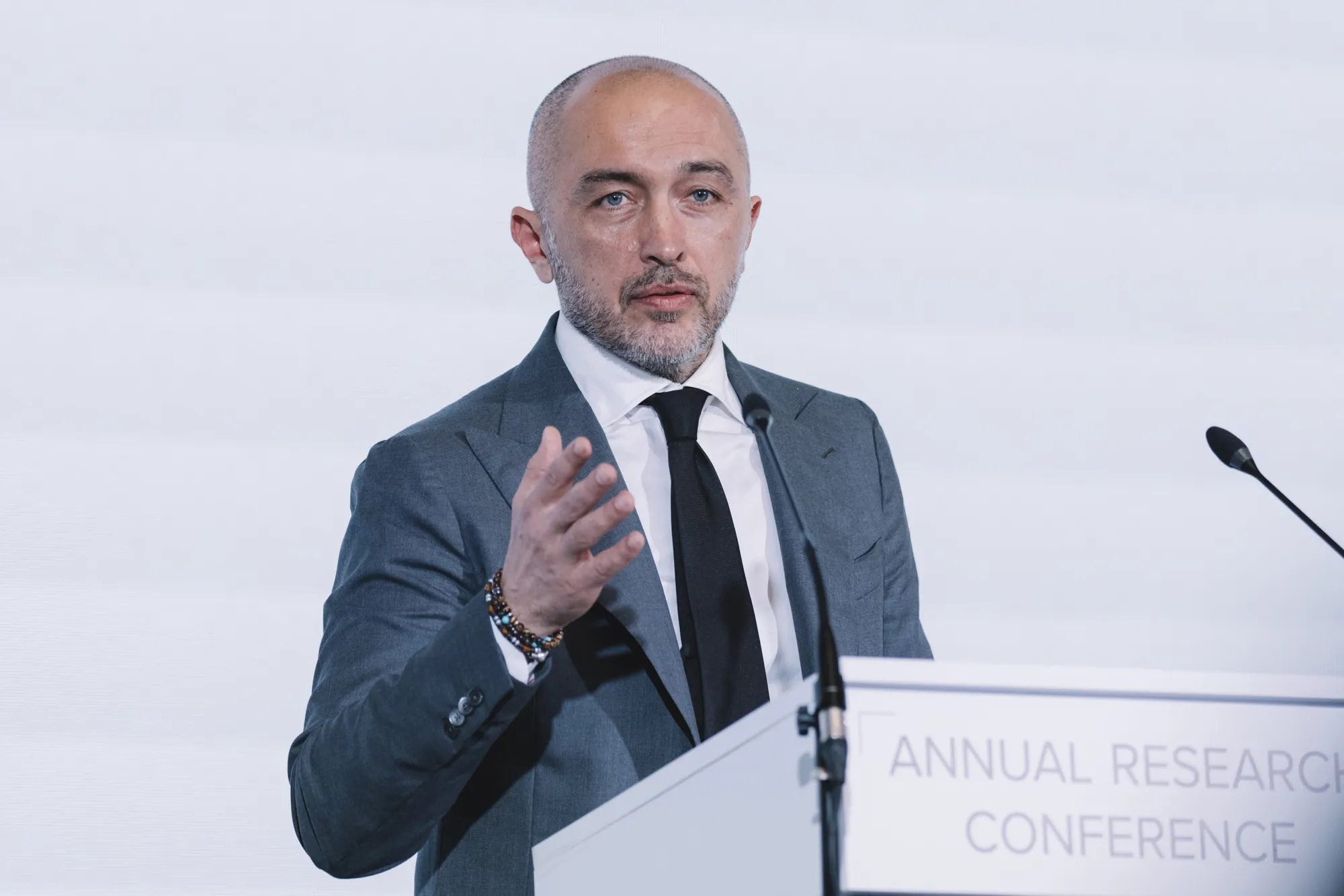























Tension is emerging between Ukraine’s presidential administration and the National Bank of Ukraine, and it is beginning to extend beyond a conventional argument over interest rates. At the center is Andrii Pyshnyi, the NBU governor and one of the most consequential officials managing Ukraine’s wartime economy.
President Volodymyr Zelenskyy has grown increasingly dissatisfied with the regulator’s direction. Inside the presidential administration, there is concern that the central bank is not doing enough to support an economy repeatedly damaged by Russian attacks and that its tight monetary policy is keeping financing too expensive for businesses trying to rebuild and expand.
There is also a political dimension. Pyshnyi is viewed as unusually close to the International Monetary Fund at a moment when IMF demands on taxes, fiscal discipline and structural reforms are increasingly colliding with the domestic political pressures facing a government entering another year of full-scale war.
As Daycom has previously assessed, the real issue is much larger than the personal relationship between Zelenskyy and Pyshnyi. Ukraine is approaching a point where the logic of a wartime economy increasingly conflicts with the logic of an independent central bank: the government needs money, credit and stimulus now, while the NBU is trying to prevent today’s support from becoming tomorrow’s inflation, devaluation and loss of confidence in the hryvnia.
That tension explains why the policy rate has become politically sensitive. In late July, the NBU unexpectedly raised it from 15 percent to 15.5 percent, its first increase since March 2025, after inflationary pressure proved stronger than policymakers had expected.
From the central bank’s perspective, the decision is defensible. Underlying inflation remains elevated, while businesses face higher costs from labor shortages, damaged energy infrastructure, expensive logistics and repeated Russian strikes against industrial and commercial assets.
The wartime state itself adds pressure. Massive public spending supports demand at a time when Ukraine’s productive capacity remains constrained. In such an economy, cheaper money does not automatically create more output. It can instead push up prices and increase demand for foreign currency.
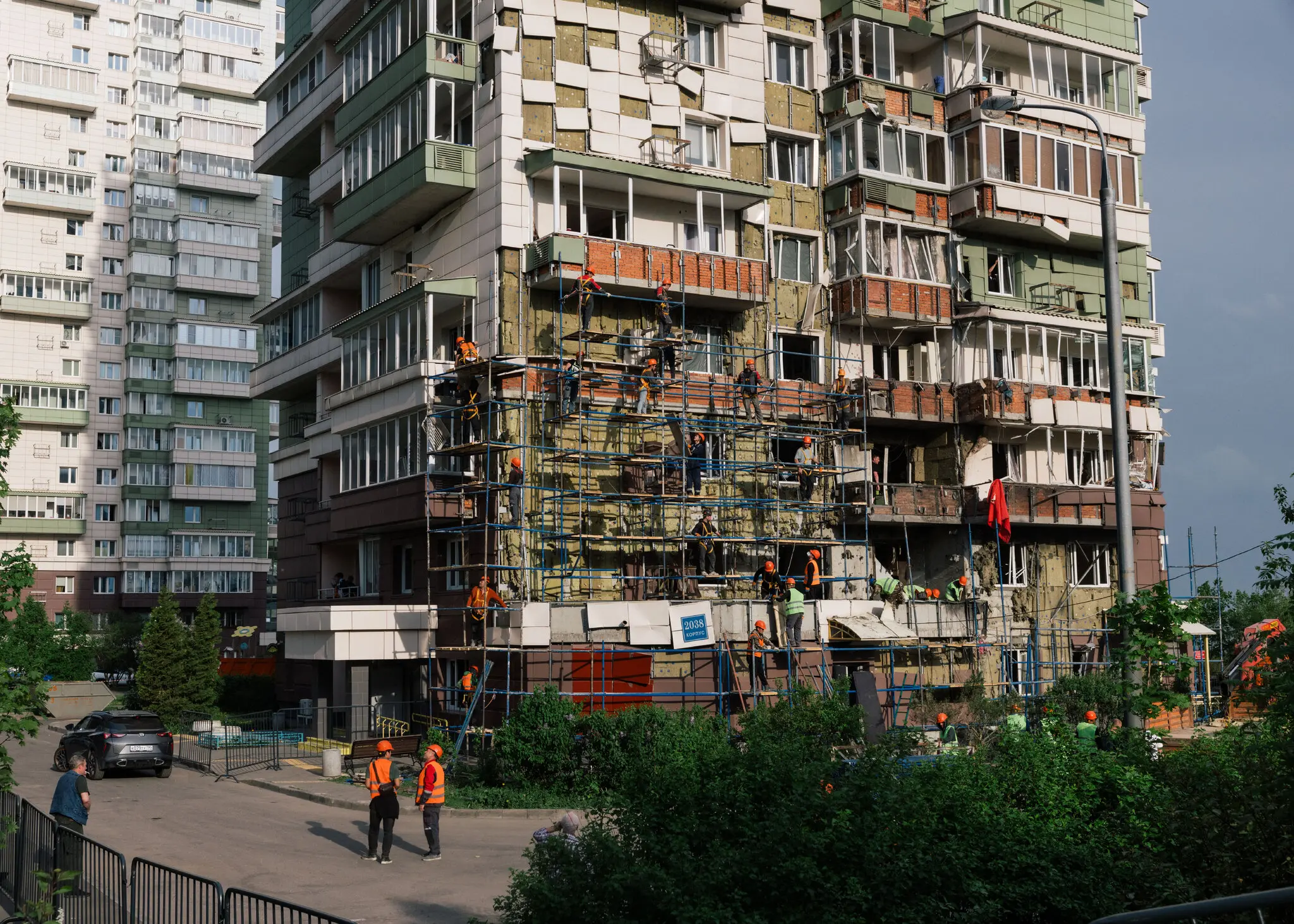
The presidential administration sees the problem from another angle. Ukrainian companies are repeatedly losing warehouses, electricity supply, transportation assets and production equipment. They need capital to rebuild quickly, install autonomous power systems, protect facilities and finance working capital. High borrowing costs make all of that harder.
Both positions contain a clear economic logic. Political leaders see companies that must survive today. The central bank sees the possibility that excessive stimulus will eventually produce a weaker currency, faster inflation and the need for even more aggressive rate increases later.
This is a familiar conflict between governments and central banks, but Ukraine’s circumstances make it unusually consequential. In peacetime, such disputes concern the pace of an economic cycle. In a country financing a large-scale war, they affect the state’s ability to pay soldiers, sustain imports and preserve confidence in its currency.
The argument that the NBU is holding back lending is also more complicated than it first appears. Hryvnia-denominated business lending has continued to expand strongly, while consumer lending has shown sustained growth. The banking system is not frozen; by several measures, Ukraine has been experiencing one of its longest periods of credit expansion in years.
Loans to defense-related companies and businesses restoring energy infrastructure have also increased. At the same time, the share of nonperforming loans has continued to decline and defaults on hryvnia business lending remain comparatively contained.
The real question, then, is not whether banks are lending. It is whether they should lend even faster — and what price Ukraine would pay in exchange-rate and inflation stability if monetary conditions were loosened aggressively.
That is where the debate over the role of the central bank in a wartime economy becomes fundamental. The NBU is not a development ministry and is not supposed to substitute for fiscal policy. Its central mandate remains price stability, while support for specific sectors primarily belongs to the government.
Since 2022, however, those boundaries have become less clear. The National Bank is operating under conditions that bear little resemblance to normal central banking: capital controls, large-scale foreign-exchange interventions, special rules for the financial sector and a carefully managed process of currency liberalization have become part of everyday policy.
The sharpest disagreement may be over the IMF. For Zelenskyy, the lender’s demands are increasingly difficult to separate from domestic politics. Tax increases, a broader revenue base, spending discipline and structural reforms may have a macroeconomic rationale, but they also carry an obvious political cost for a society that has lived through years of full-scale war.
Ukraine continues to receive financing under a multiyear IMF program, but the importance of that relationship extends far beyond the nominal value of individual disbursements. The Fund has repeatedly stressed that the NBU’s independence must be protected and that monetary policy should remain focused on containing inflation.
That makes Pyshnyi more than the official responsible for interest rates. The NBU governor is also one of Ukraine’s most important interlocutors with international creditors, whose judgment can influence financial flows far larger than a single IMF tranche.
For Ukraine, an IMF program functions as a form of external certification. Successful reviews reassure the European Union, G7 governments and other donors that Kyiv’s macroeconomic framework remains credible. Hundreds of millions of dollars from the Fund can therefore help unlock support measured in tens of billions.
That leverage matters because Ukraine’s wartime budget remains structurally dependent on international financing. Domestic taxes and borrowing alone cannot close the fiscal gap without creating far greater pressure on the economy.
This is the central paradox in Zelenskyy’s relationship with the IMF. The political leadership may resent the lender’s conditions, but Ukraine’s financial model makes cooperation with it extremely difficult to replace.
The same paradox applies to Pyshnyi. There is no immediate move to dismiss him. That reflects more than the absence of an obviously stronger successor. A sudden removal of the central bank governor would be interpreted by investors and international partners as a possible signal that the institutional rules are changing.
Pyshnyi took over the National Bank in October 2022, months after Russia began its full-scale invasion. Ukrainian law deliberately limits the ability of political leaders to remove the central bank governor arbitrarily, precisely to protect the regulator from short-term political pressure.
That safeguard is not procedural decoration. Central-bank independence exists for moments when governments want faster spending or cheaper credit but the economic costs of those decisions will only appear later.
Ukraine has ample experience with what happens when the opposite model prevails. A central bank that effectively becomes a financing arm of the government can cover deficits with newly created money for a time, but the cost ultimately appears through inflation, currency depreciation, capital flight and the destruction of long-term lending.
Even during the first year of the full-scale war, when the NBU resorted to direct monetary financing of the budget, the measure was treated as an emergency rather than a permanent policy. Returning to routine deficit monetization would reverse one of the central achievements of Ukraine’s wartime macroeconomic management.
That is why frustration over Pyshnyi’s relationship with the IMF cuts both ways. To the presidency, it can look like excessive rigidity in the face of wartime needs. But the same relationship strengthens the NBU’s ability to act as an institutional barrier between political demand for resources and the risk of macroeconomic destabilization.
There is also a personal and political dimension to the tension. Pyshnyi is more publicly visible than the traditional image of a technocratic central banker. He regularly publicizes meetings with foreign partners, appears at major events and communicates the NBU’s policies aggressively.
Inside the presidential administration, that level of visibility can be read as something more than technical communication. Wartime government has concentrated political authority around the presidency, making any independent institution with its own public profile more noticeable.
Yet communication is itself a tool of modern monetary policy. Exchange rates and inflation expectations are influenced not only by interest rates but by whether banks, companies and households believe the central bank’s statements about what it will do next.
A weaker governor might therefore be politically more convenient but economically more expensive. If markets begin to believe that interest rates or currency policy are set by the presidential administration rather than by macroeconomic conditions, behavior can change before any formal policy shift occurs.
The first reaction would not necessarily be panic. More likely would be a gradual erosion of confidence in hryvnia deposits and government bonds, higher demand for foreign currency and greater sensitivity to bad news from the battlefield or negotiations with foreign donors.
That risk is particularly important because the resilience of the hryvnia is supported by international assistance. Large external inflows allow the NBU to sell foreign currency into the market, finance critical imports and maintain substantial reserves at the same time.
Those reserves provide an important buffer, but they do not eliminate Ukraine’s reliance on continuing external support. Confidence in the institutional framework matters long before reserve levels approach a crisis point.
This is where central-bank independence stops being an abstract demand from international economists. It becomes part of the price at which Ukraine obtains access to tens of billions of dollars in financing.
Foreign partners do not need to have a personal preference for Pyshnyi. What they need is confidence that Ukraine has an institution capable of saying no to political leaders when a short-term decision would create a systemic threat to the currency, banking system or reserves.
It would nevertheless be a mistake to reduce the dispute to a story of a flawless central bank resisting politicians who merely want cheap money. Ukraine’s economy is operating under conditions for which standard monetary policy provides only part of the answer.
Russian strikes can destroy productive assets faster than normal credit mechanisms can replace them. Defense companies require capital to expand output quickly. The energy sector needs financing for decentralization and protection. Farmers and logistics companies face risks that an ordinary commercial bank would often refuse to finance in peacetime.
Asking whether the NBU is doing enough for the wartime economy is therefore legitimate. But the solution does not necessarily lie in cutting the policy rate. Cheap money for the entire economy may be less effective than targeted loan guarantees, war-risk insurance and state-backed programs for sectors where financing genuinely creates additional production.
That division of responsibilities is what preserves institutional balance. The government identifies strategic sectors, parliament allocates resources and accepts political responsibility, while the central bank protects currency and price stability.
The succession question around the NBU therefore matters less because of any one potential candidate than because of what kind of institution a future governor would represent. A replacement drawn from overtly political circles would send a different signal from a technocratic succession within the bank.
Ukraine has already experienced tensions over central-bank leadership. Pyshnyi’s predecessor, Kyrylo Shevchenko, left office in 2022, initially citing health reasons and later alleging sustained political pressure. He subsequently faced an anti-corruption case, allegations he denied.
Any new departure during the war would therefore be viewed not in isolation but as part of a longer history of difficult relations between political power and the country’s independent financial regulator.
For now, the system is still containing the tension within institutional boundaries. The NBU can raise rates despite political demand for cheaper credit. The president cannot simply dismiss its governor at will. International partners continue to emphasize the importance of regulatory independence.
The real test will come if economic conditions deteriorate. Further Russian attacks on energy infrastructure, worsening export constraints, weaker growth or another inflation surge would place more pressure on both the budget and the central bank.
At that point, the presidential administration could demand greater stimulus precisely when the NBU believes tighter policy is necessary. What is now a largely private dispute could become an open institutional confrontation.
For Ukraine, the cost would extend far beyond the career of one central banker. The country’s wartime economy rests on three forms of confidence at once: citizens’ confidence in the hryvnia, businesses’ confidence in the banking system and foreign partners’ confidence that the state will respect the institutional rules underpinning their support.
That is why the tension around Andrii Pyshnyi is not ultimately a story about whether the president likes the central-bank governor. It is about how far the political logic of wartime government can reach into monetary policy without weakening the institutions that have helped Ukraine’s economy survive the war.