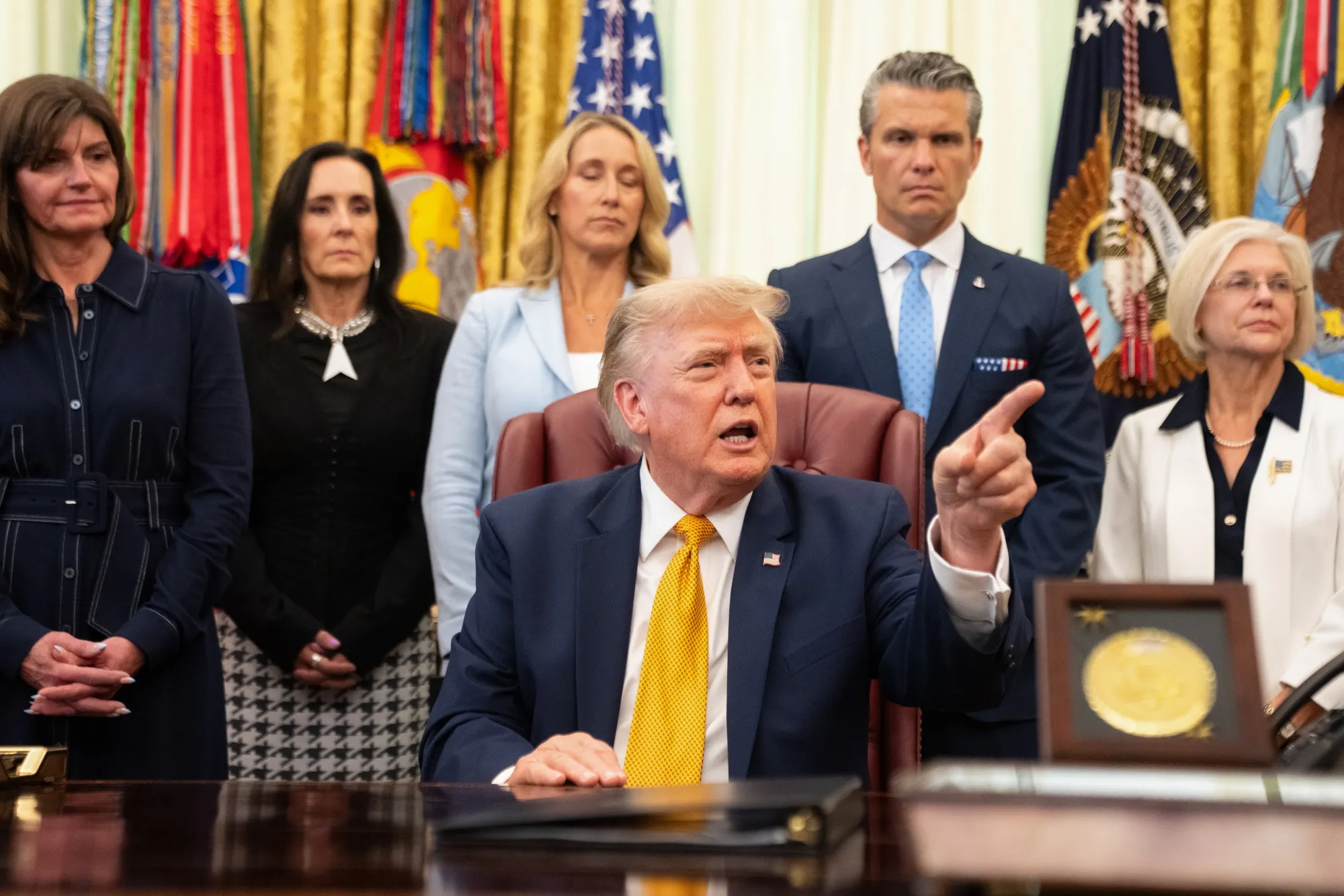























President Donald Trump said the United States may step back from its commitment to defend NATO allies if they are attacked. The remark came as his frustration deepened over the fact that European countries did not provide substantial support for the U.S. military campaign against Iran. In effect, his pressure on the alliance has again reached a point where the credibility of America’s security guarantees is being openly called into question.
Speaking at an investment conference in Miami Beach sponsored by the Saudi sovereign wealth fund, Trump said NATO “just wasn’t there” when he asked for help with the Iran war. He described that as a “tremendous mistake” by the Europeans and made clear that he sees their response as something that could carry lasting consequences for the future of the transatlantic relationship.
Trump stressed that the United States spends hundreds of billions of dollars a year on NATO and has protected European partners for years. But now, he said, based on their actions, Washington may no longer have to do so. He even framed the statement as “breaking news,” turning the remark into an unmistakable political signal with international implications.
This is not the first time Trump has moved close to the idea of a de facto American retreat from NATO. During his first term, he threatened to go his own way if allies did not increase defense spending. At that time he ultimately backed down under pressure from Republican leaders in Congress and senior figures in his own administration. Whether he would follow through now remains unclear, but Trump has long embraced the image of a leader who operates through unpredictability.
The White House has not formally confirmed that this amounts to an official change in U.S. policy. Press secretary Karoline Leavitt said only that Trump has long been vocal and candid about his displeasure with NATO. Even without a formal policy announcement, however, such rhetoric from the American president is already creating a new level of anxiety in European capitals ahead of the alliance’s next summit.
For years Trump has criticized European allies for relying on American military power while, in his view, failing to carry a comparable burden themselves. Yet after European countries and Canada agreed last year to significantly raise defense spending to 5 percent of GDP, his tone briefly became somewhat softer. That period now appears to be over.
In recent months Trump has once again become far more aggressive toward Europe. First the source of tension was his desire to take control of Greenland, a Danish territory. Then the war against Iran became the next major fault line. As a result, America’s commitment to NATO has once again come under scrutiny just as the alliance prepares for its July summit in Ankara.
Trump himself has made clear that he viewed his appeals to European leaders as a kind of test. He said he asked them to join the effort, send their ships through the Strait of Hormuz, and help protect people and vessels coming under attack. According to Trump, they failed to do so. In his reading, that proved that the allies were not prepared to stand with the United States even in a strategically vital theater.
He also warned that Europe would pay dearly for its unwillingness to get involved. That matters especially in the context of the Strait of Hormuz. Iranian attacks on ships and threats against oil tankers have in recent weeks nearly shut down the route, sending global energy prices sharply higher. The clash between Washington and Europe is therefore unfolding not on the margins, but around one of the central arteries of the global economy.
From the beginning, European leaders were wary both of the legality and of the wisdom of attacking Iran. Many of them continue to argue that diplomacy, rather than war, is the only sustainable way to contain Tehran’s nuclear ambitions. That is why Trump’s calls for immediate allied involvement did not produce the rapid response he wanted.
Domestic politics also shapes Europe’s position. The report notes that European voters were already furious after Trump suggested in January that he wanted to seize Greenland. That episode further reduced the willingness of political leaders to support another war initiated by Washington. Europe’s cool response to the Iran campaign therefore reflects not only strategic caution, but also electoral realities at home.
Trump was said to be particularly angry with British Prime Minister Keir Starmer. Before the war began on February 28, Starmer denied U.S. fighter jets access to key British air bases for the attack on Iran. Once the war started, he reversed course and said British law allowed the bases to be used for what he described as an effort to defend allied citizens under attack in the region.
Trump later claimed that Starmer offered to contribute two British aircraft carriers to the conflict, but by then, according to Trump, it was already too late because the offer came a week after the war had begun. The episode illustrates that the White House is judging allies not only by whether they eventually assist, but also by how quickly and unconditionally they align themselves with the U.S. course.
On a practical level, the administration is already moving toward shifting more responsibility onto Europe. The article says Washington has been working to place more of NATO’s Europe-based military planning and command structures under European control. At the same time, the Pentagon has in recent days discussed diverting military assistance intended for Ukraine to the Middle East.
A formal change in U.S. policy toward NATO, however, would be much more consequential. It would mean either pulling back tens of thousands of American troops stationed in Europe or effectively stepping away from the alliance’s core treaty principle that an attack on one member is to be treated as an attack on all 32. That is the scenario that would amount to a genuine political earthquake.
Against that backdrop, NATO’s July summit in Ankara is likely to be deeply contentious. Such gatherings are normally used to set priorities and coordinate strategy. But for Trump they have also long served as stages for pressuring allies, threatening them, and demanding that they spend more. Now the war against Iran has been added to that existing pattern of confrontation.
French President Emmanuel Macron has already said that France will not take part in combat operations around Iran while the war remains in its active phase, because Paris is not a party to the conflict. At the same time, he pledged to help secure the Strait of Hormuz afterward. That position reflects a broader European instinct: stay out of the war itself, but try to manage its fallout.
The article also highlights the position of NATO Secretary General Mark Rutte. In recent weeks he has tried to avoid a clash with Trump and has praised the American campaign against Iran so enthusiastically that he has begun drawing criticism from other alliance leaders who argue that he is not speaking on their behalf.
Rutte said openly that Iran has for years exported chaos to the region and the wider world, and that what the United States is doing now is degrading that capability. At the same time, he tried to explain why Europe did not move immediately. According to him, the United States could not warn allies in advance about the attack for fear of leaks, which meant Europe needed time to come together and determine its response.
That difference in logic captures the heart of the current conflict inside NATO. For Trump, the absence of immediate European support is grounds to question the value of the alliance for the United States. For many Europeans, it is the consequence of Washington acting unilaterally, consulting no one, and then demanding instant political and military alignment once the decision has already been made.
In the end, Trump’s latest assault on NATO is not just another emotional outburst. It coincides with the war against Iran, disputes over Ukraine, pressure on Europe over the Strait of Hormuz, and a long-standing White House effort to shift more of the security burden onto allies. That is why this rhetoric is being interpreted not as a passing episode, but as a signal that the transatlantic alliance may be entering a new and more dangerous phase of internal crisis.