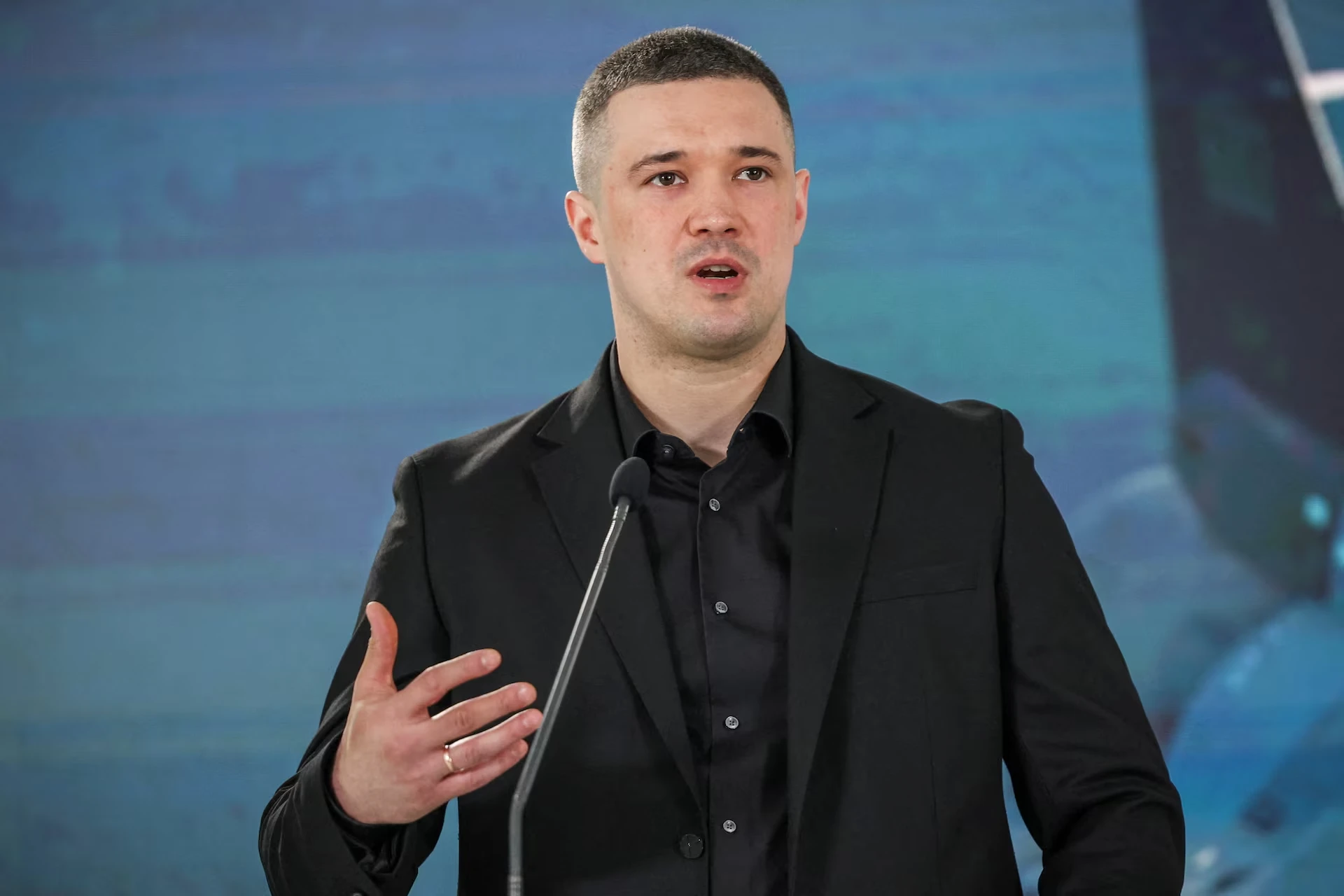




















Former Ukrainian defence minister Mykhailo Fedorov is looking to the United States for capital to finance a new generation of Ukrainian weapons companies. His proposed defence technology fund is meant to do more than back existing start-ups: it would also help create and manage businesses built around technologies Kyiv considers essential to the future of warfare.
According to the Financial Times, Fedorov has been speaking with American investors and seeking Western capital for companies working on battlefield robotics, interceptor drones and lower-cost missile systems that could incorporate artificial intelligence. The proposal is still at an early stage, with crucial details of its structure yet to be made public.
The timing matters. Ukraine has demonstrated an unusual capacity to create new military technologies quickly, but repeatedly struggles with the next step: scaling a promising prototype into tens of thousands of units. A system may be designed and tested in months; producing it in truly strategic quantities requires capital on an entirely different scale.
According to Daycom’s analysis of verified public reporting, that transition is the central bet behind Fedorov’s initiative. He is trying to recast Ukrainian defence technology from a wartime expenditure into an investable asset class — one that might attract private capital even after the immediate urgency of the war begins to recede.
Ukraine has something few other defence markets can offer investors: technologies that are tested under real combat conditions almost continuously. Drones, autonomous navigation software, electronic-warfare systems and interceptors can receive battlefield feedback within days, rather than moving through the multi-year testing cycles common in traditional Western procurement.
That speed has become one of Ukraine’s defining military advantages. Russian forces adapt rapidly to new Ukrainian systems, forcing engineers to revise frequencies, guidance, airframes and software within weeks. In effect, the battlefield functions as a brutal, accelerated research-and-development environment.
Fedorov’s investment case is built around that dynamic. Ukraine can offer more than inexpensive engineering talent; it can offer an enormous body of practical experience in mass drone warfare. Western capital, in his model, would help turn that experience into companies capable of competing in international defence markets.
Interceptor technology is likely to be one of the most important areas. Russia has expanded its use of drones, including faster jet-powered models, while Ukraine lacks enough expensive traditional air-defence missiles to engage every incoming target economically.
The basic arithmetic is increasingly unsustainable. Firing a missile worth millions of dollars at a comparatively cheap drone may sometimes be unavoidable, but it cannot form the foundation of a long-term defence strategy when attacks arrive in mass waves.
Ukraine is therefore trying to develop interceptors that can themselves be produced by the thousands. That kind of problem is unusually well suited to venture-style financing: several companies can pursue competing solutions, most may fail, and the strongest design can then receive enough capital to scale quickly.
Government procurement works differently. The state is generally better at buying a product once specifications are known, tests have been completed and a requirement has been defined. It is less naturally suited to funding dozens of risky experiments with the expectation that many will never become operational systems.
Private capital is designed to tolerate that kind of failure. Venture investors assume that a small number of successful companies can compensate for a much larger number of unsuccessful bets. Defence, however, introduces complications that do not exist in ordinary software investing.
Investors need returns and scalable markets. The military needs reliability and speed. The Ukrainian state needs control over sensitive technologies and confidence that critical systems will remain available for national defence. Those interests can overlap, but they are not identical.
That is why the largest unanswered questions around Fedorov’s proposal concern its financial architecture rather than its technology. No target size has been publicly announced, nor has there been a detailed description of jurisdiction, ownership structure, investment horizon, management or intellectual-property rules.
Reuters also highlighted another unresolved issue: Fedorov has not said whether he would personally benefit financially from the fund, nor has his precise role in overseeing it been explained publicly. There is no evidence of wrongdoing; the absence of detail simply makes governance and transparency important questions.
Those questions carry particular weight because Fedorov is a former defence minister. Companies backed by the fund could potentially work with government contracts, classified information, export-controlled technologies and dual-use systems. The boundary between public policy, private investment and personal financial interest would therefore need to be explicit.
Fedorov is also making a broader strategic argument in the United States. Ukraine has accumulated expertise in mass drone warfare that the world’s largest militaries are now studying, while Kyiv remains heavily dependent on American systems for high-end air defence.
The proposition is increasingly reciprocal rather than one-directional. The United States has capital, industrial scale and sophisticated missile systems; Ukraine has battlefield iteration, lower-cost design culture and hard-earned knowledge of how autonomous and unmanned systems behave in prolonged high-intensity war.
A defence tech fund could become one financial bridge between those two capabilities. An American investor gains exposure to a growing defence company; Ukraine gains money to increase production; allied militaries may eventually gain access to systems shaped by real battlefield conditions.
That should not be confused with solving Ukraine’s broader wartime financing problem. The country’s new defence minister, Yevhenii Khmara, is simultaneously trying to close a military funding gap of roughly $27 billion and secure earlier access to European financing planned for next year.
The scales are entirely different. Even a successful private fund cannot pay the salaries of an entire military, finance nationwide air defence or purchase millions of rounds of ammunition. Those requirements will continue to depend primarily on government budgets and support from allied states.
Private money is more useful at a narrower but strategically important point: the gap between prototype and mass production. If a company needs several million dollars to move from hundreds of interceptors per month to several thousand, a private investor may be able to make that decision faster than a multilateral government financing process.
Speed has long been central to Fedorov’s approach to defence technology. In his view, modern war is a technological competition in which an advantage may last only a few months. Once the enemy studies a new weapon and develops a countermeasure, engineers must modify it again.
After leaving the defence ministry, Fedorov appears to be trying to move that same philosophy into the private sector. His emerging role is less that of a Ukrainian official allocating a state budget and more that of an intermediary connecting Ukrainian developers, Western defence institutions and private investors.
That shift could also change how Ukraine monetises the experience it has accumulated during the war. Until now, much of the country’s defence innovation has existed to solve an immediate battlefield problem. The same technologies could eventually become export products sold to NATO members and other partners.
For American investors, the larger market argument is easy to see. Modern armed forces cannot build every layer of their defence around a small number of extraordinarily expensive platforms. Cheap mass-produced drones require equally scalable and affordable methods of detection, jamming and interception.
Ukrainian manufacturers have learned to design within exactly those constraints. Cost, ease of repair, component availability and the ability to build thousands of units often matter more than maximising the performance of one exquisite system.
That culture is quite different from parts of the traditional Western defence industry, where programmes can spend years in development and produce highly sophisticated systems at extremely high unit costs. Ukraine’s experience suggests that future military procurement may need both models.
Combat performance alone, however, does not make a company investable. Investors need secure ownership rights, predictable export rules, protection for intellectual property and a plausible market beyond a single emergency wartime purchaser.
Intellectual property may become one of the most sensitive issues. If American capital finances a Ukrainian technology, agreements will have to establish who owns it, where it may be manufactured, who can export it and whether Ukraine retains priority access while the war continues.
The concept of building companies inside the fund raises an additional layer of complexity. Such a structure would not merely invest in founders who already exist. It could assemble teams, define specific defence problems, finance development and build companies around solutions from the ground up.
That could be faster than waiting for the market to produce the right start-up. It would also concentrate substantial influence in the fund’s management, increasing the need for clear rules on project selection, ownership and access by the Ukrainian state.
For now, even the simplest benchmark remains unknown: how much money Fedorov intends to raise. No initial close has been announced, no confirmed American investors have been identified publicly, and no overall capital target has been disclosed.
The project should therefore be understood as an ambitious fundraising initiative rather than a fully established investment vehicle. Its significance lies as much in what it represents as in whatever capital it ultimately attracts.
After years of full-scale war, Ukraine is trying to move beyond a model in which every new weapon requires another appeal for foreign assistance. It wants to build a defence technology sector capable of attracting capital because investors believe the companies themselves have enduring commercial value.
That model has an obvious strategic attraction. Private investment is potentially less dependent on annual political votes in allied parliaments. If a Ukrainian defence company becomes commercially compelling, money can flow into it not only because governments want to support Kyiv, but because investors expect a return.
That same logic makes transparency indispensable. A structure cannot credibly ask states for access, engineers for technology, soldiers for battlefield data and investors for capital without making clear who ultimately controls the companies and who profits from them.
Fedorov therefore has to sell American investors more than the story of Ukrainian drones proven under fire. He must offer a financial architecture with understandable ownership, governance, export rules and protections for Ukraine’s strategic interests.
If that structure emerges, the fund could become one mechanism for turning Ukraine’s battlefield innovation into an international defence industry. If it does not, the proposal may remain an ambitious presentation built around one advantage Ukraine undeniably possesses: the ability to create and adapt military technology at a speed imposed by war itself.