



















In a Kyiv supermarket, the consequences can look deceptively ordinary: a gap where fresh vegetables should be, fewer dairy products than usual, or an aisle rearranged to make thin stocks less obvious. Behind those empty spaces sits a much larger disruption — the destruction of the infrastructure that normally keeps shelves continuously replenished.
Throughout August, Russian strikes repeatedly hit distribution centres, warehouses, sorting hubs and retail infrastructure belonging to some of Ukraine’s largest companies. Fozzy Group, Novus, Fora, KOLO, Varus, Nova Poshta and other logistics operators have all reported facilities damaged, destroyed or forced temporarily out of operation.
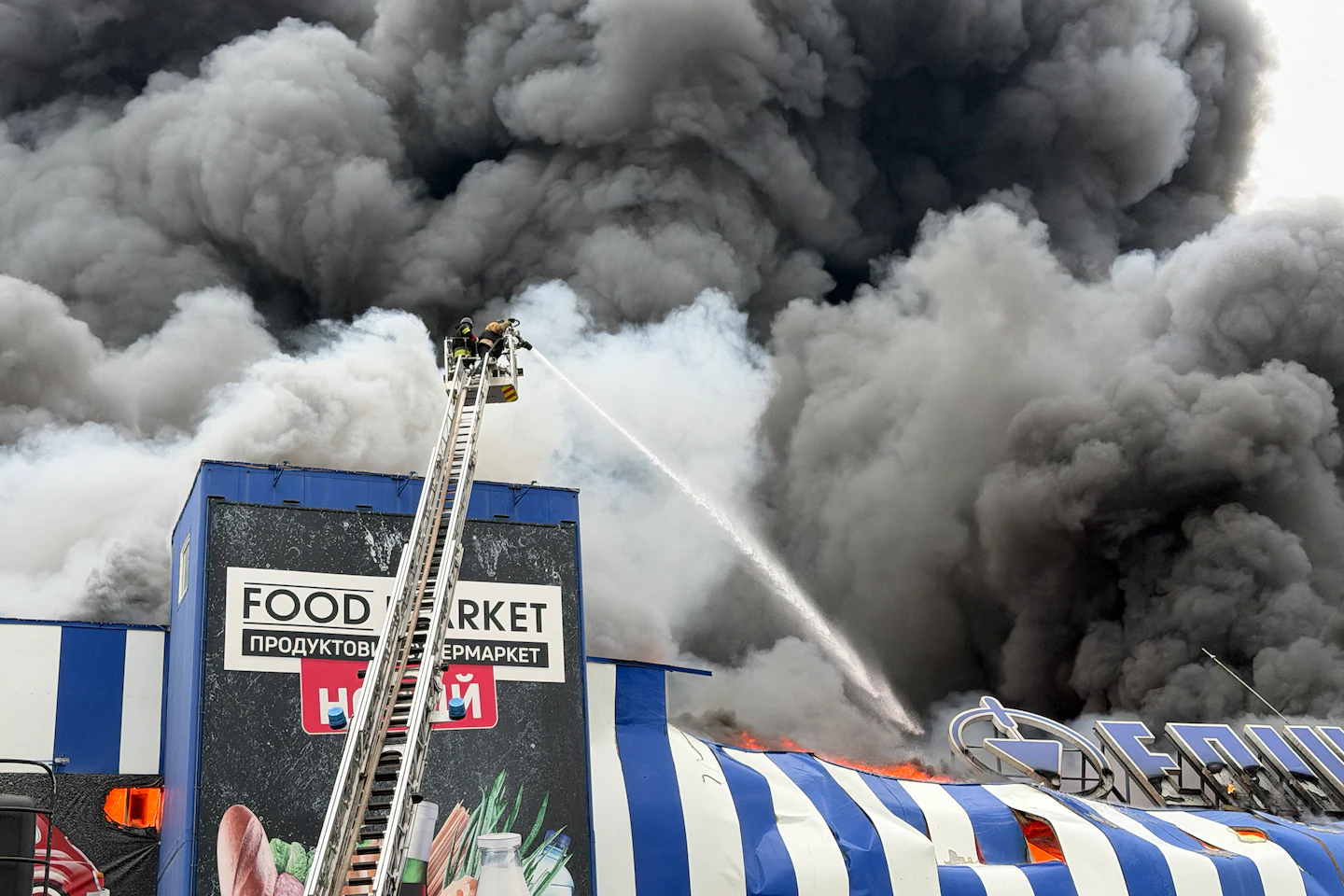
The damage was especially severe in the August 5 attack. Four Fozzy Group distribution centres supplying Silpo, Fora and Thrash! stores were hit, with six employees killed, while Novus said its logistics centre suffered multiple direct missile strikes and had to cease operations at the site.
The pattern did not end there. On August 20, a Fora distribution centre in Martusivka storing fresh products was damaged only about a week after the chain began using it following previous attacks. The company said it was once again rerouting deliveries and searching for alternatives.
According to Daycom’s analysis of verified public reporting, this is the distinction that matters most when discussing food shortages in Ukraine: Russia has inflicted extraordinary damage on the machinery of food distribution, but that is not the same as destroying the country’s ability to produce enough food. The crisis is primarily between the farm and the checkout.
The widely repeated figure of 90 percent illustrates why the distinction is necessary. Reuters reported Agriculture Minister Taras Vysotskyi as saying roughly 90 percent of food logistics operated by retail chains had been destroyed, while Ukrainian reporting described around 90 percent of modern warehouse or storage capacity for goods as lost.
Neither formulation means that 90 percent of Ukraine’s food has disappeared. It refers to logistics and storage infrastructure — the warehouses, distribution centres and systems that aggregate goods before sending them onward to shops. Vysotskyi explicitly said there was no expectation of famine or systemic physical food scarcity.
That explains why the effects are uneven. One supermarket may run short of sour cream, cheese, sugar or certain vegetables while another a few blocks away still has them. The product may exist elsewhere in the economy; what has failed temporarily is the route that was supposed to put it on a particular shelf at a particular time.
Fresh food is particularly vulnerable because its logistics cannot simply be improvised in any empty building. Dairy, produce and other perishable goods require refrigeration, temperature control, rapid sorting and predictable transport. Destroying a warehouse for those categories creates a more complicated recovery problem than losing storage for durable goods.
When a major distribution centre disappears, trucks cannot simply follow yesterday’s timetable from another address. A retailer has to locate replacement space, move surviving inventory, reconnect digital stock systems, reorganise picking operations and redesign delivery routes serving dozens or hundreds of stores.
Fora’s experience shows how quickly those contingency plans can themselves be disrupted. After its earlier losses, the chain began using a replacement warehouse in Martusivka. That facility was then struck as well, forcing the company to redesign logistics again rather than simply completing a one-time relocation.
On August 27, another Russian attack damaged a warehouse belonging to the KOLO supermarket chain. The company warned that deliveries of some products could be delayed, but said stores remained open and that alternative solutions were being arranged to minimise the effect on customers.
Four days later, Varus reported damage to one of its warehouses in Kyiv region. A significant quantity of stock was destroyed, the chain said, and some items could temporarily disappear from shelves. Yet all 119 supermarkets continued operating — an increasingly familiar combination of substantial damage and rapid adaptation.
This is why the emerging story is not one of supermarkets simply closing. It is one of progressively more expensive improvisation. Retail networks lose a central hub, redirect cargo elsewhere, create temporary routes and continue trading — only to face the possibility that the replacement infrastructure may itself become a target.
Russia’s recent attacks have also extended beyond grocery distribution. Reuters documented strikes affecting Nova Poshta sorting centres, shopping facilities, warehouses and other commercial infrastructure, alongside periodic shortages of fresh produce, milk and sugar in Kyiv.
Nova Poshta has responded by moving toward a more decentralised sorting model, creating backup processing capacity and alternative routes after central hubs were destroyed. Its experience offers a preview of what food retailers may increasingly have to do: sacrifice some efficiency in exchange for a system that can survive the loss of any single node.
That trade-off reverses decades of peacetime logistics thinking. Large central warehouses are efficient because they reduce duplication, concentrate technology and simplify inventory management. In wartime, the same concentration becomes a vulnerability: one successful strike can disrupt deliveries to hundreds of locations at once.
A more resilient network needs smaller stocks spread across more sites, several transport providers, backup cold-storage capacity and the ability to redirect deliveries on short notice. It is harder to destroy in one attack, but it requires more trucks, more staff, more leases and more working capital.
Some retailers are already shifting toward direct deliveries from suppliers to stores. Fora said after its earlier warehouse losses that it was diversifying logistics partly through more direct shipment arrangements and alternative storage. That keeps goods moving but removes some of the cost savings created by centralised distribution.
For consumers, that means the longer-term effect may appear in prices before it appears as genuine scarcity. Extra transport, replacement warehouses, insurance, security, duplicated equipment and lost inventory all add costs. Retailers and suppliers can absorb some of those losses, but not indefinitely.
The burden can be especially severe for smaller producers. A national supermarket chain may have enough balance-sheet capacity to lease additional storage or reroute hundreds of trucks. A small farm or food manufacturer that loses one large consignment can lose a significant share of the cash it needs for the next production cycle.
Ukraine nevertheless possesses an important source of resilience: supermarkets are not the only way food reaches consumers. Local markets, regional distributors, smaller shops and direct producer networks remain active, while locally made bread, meat and other short-chain products do not always depend on the same large warehouse system.
That is why some Kyiv residents interviewed by The Washington Post described adapting rather than going without food entirely. If one supermarket lacked an item, they tried another store or a farmers’ market. Such behaviour indicates serious logistical disruption, but not yet a classic food crisis in which essential goods cannot be found at all.
The distinction between logistical scarcity and physical scarcity is fundamental. A logistical shortage means a product exists but is temporarily in the wrong place. A physical shortage means national production and available stocks are insufficient even if transportation functions perfectly. Current evidence points much more strongly to the first problem.
There is, however, a dangerous cumulative effect. One destroyed warehouse can be replaced. A second can be replaced at greater cost. The system becomes genuinely vulnerable when replacement facilities are being hit faster than businesses can equip them and build new routes around them.
The repeated attacks on Fora are revealing precisely for that reason. One of its replacement sites had been operating only briefly before it was damaged. Another warehouse used by the chain was later reported hit after only several days of use, demonstrating how quickly a conventional backup plan can lose its value under repeated strikes.
Russia’s pressure on food logistics also overlaps with attacks on other systems. Railway infrastructure, postal networks, energy facilities, ports and commercial warehouses have all been struck. A food distributor may find a replacement warehouse only to discover that electricity, railway capacity or the road network serving it is also under pressure.
A modern food system depends on far more than the amount harvested. It requires refrigeration, packaging, electricity, trucks, drivers, warehouse workers, software, fuel and predictable delivery windows. Disrupt several of those components simultaneously and plentiful national food stocks can still produce empty local shelves.
The government also has to manage expectations carefully. Panic buying can create a shortage where none previously existed by emptying stores faster than damaged logistics can replenish them. For that reason, officials have stressed the seriousness of the warehouse losses while rejecting suggestions that Ukraine is approaching famine.
That message should not be confused with reassurance that everything is normal. The likely near-term reality is less dramatic but economically significant: narrower selections in some stores, goods arriving irregularly, temporary regional gaps and a higher cost of maintaining enough redundancy to keep the system functioning.
Today, the visible symptom may be a missing yoghurt or a reduced vegetable section. Over time, the same disruption may be felt as several additional percentage points in a household grocery bill — the accumulated price of replacing warehouses, lengthening routes and carrying more emergency capacity.
This is also why attacking a distribution centre differs from striking a farm or food factory. A warehouse attack may not eliminate national production, but it attacks predictability — the retailer’s assumption that tomorrow morning the right truck will arrive with precisely the stock that demand requires.
Modern supermarkets operate on that predictability. Cities do not store months of milk, vegetables and meat inside each shop. They depend on a continuous flow in which distribution centres calculate demand, consolidate goods and send fresh stock outward every day.
Russian attacks on warehouses are targeting that largely invisible layer of urban life. As long as Ukrainian retailers can rebuild routes faster than those routes are destroyed, consumers will mostly experience inconvenience, temporary shortages and higher costs rather than widespread hunger.
If destruction begins to outpace adaptation, the picture changes. Prices would rise faster, product ranges would shrink further and regional shortages could become more persistent. Retailers would also have to devote growing amounts of capital simply to duplicating infrastructure that once needed to exist only once.
The central question for Ukraine heading into autumn is therefore not whether the country has enough food. The available evidence indicates that it does. The question is how many warehouses, refrigerated sites, trucks, backup routes and additional hryvnias will be required to ensure that food continues reaching the cities where people expect to buy it.
That is how war has changed the meaning of food security. A harvest can be abundant, a producer’s cold store can be full and a supermarket shelf can still be empty. Between those points lies a logistics system that used to be almost invisible — and has now become another front in Russia’s air campaign against Ukraine.