






















Iran came to the BRICS meeting in New Delhi not merely with a diplomatic complaint, but with a demand for political judgment. Tehran wants the bloc to explicitly condemn the United States and Israel for a war it describes as illegal aggression. Yet that demand has exposed the weakness of the expanded BRICS format.
Iranian Foreign Minister Abbas Araghchi said Washington and Tel Aviv were violating international law, while Iran, though still open to diplomacy, was ready to defend itself by all available means. This was not the language of compromise. It was an attempt to force partners to choose sides.
The problem is that BRICS has become heavier after enlargement, but not necessarily more cohesive. The bloc now includes not only Brazil, Russia, India, China and South Africa, but also Egypt, Ethiopia, Indonesia, Iran and the United Arab Emirates. Its geopolitical weight has grown. So have its internal contradictions.
For Daycom, the meeting was revealing: BRICS increasingly claims the role of an alternative center of power, but in the crisis around Iran it is running into its own limits. When states with different security fears sit inside the same platform, consensus becomes a diplomatic trap.
Iran needs a clear formula. For Tehran, a BRICS condemnation of the United States and Israel would prove that the West no longer controls the language of international legitimacy. It would be more than a sentence in a final statement. It would be a symbol that a significant part of the non-Western world refuses to accept Washington’s framing of the war.
But for other members, such directness is dangerous. India, which chairs BRICS in 2026, is focused on the stability of energy routes and has no interest in turning the forum into an anti-American platform. China is also cautious: it criticizes unilateral pressure, but is reluctant to bear the costs of an open front.
The role of the UAE is especially complicated. For BRICS, it is a valuable financial and energy player. In the context of the war around Iran, it is also part of the regional field of tension. When Tehran and Abu Dhabi sit inside the same bloc, every sharp word in a joint statement becomes a problem.
BRICS operates by consensus, and that is what makes Iran’s request so difficult. One serious objection is enough to soften, blur or block a common position. Enlargement has given the bloc more voices, but it has taken away the simplicity of the older format.
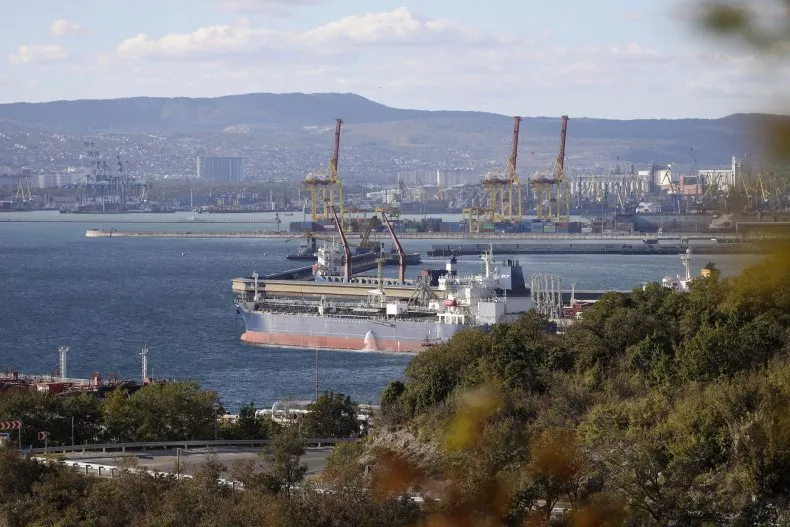
The war that began on February 28 has already moved far beyond a regional conflict. It has struck maritime trade, energy security and global inflation. The Strait of Hormuz, through which roughly one-fifth of global oil flows pass in normal times, has become the nervous center of the crisis.
For India, this is not an abstract issue. As a major energy-importing economy, it is highly exposed to any jump in oil prices, higher insurance costs and the risk of disrupted supplies. That is why New Delhi speaks less in the language of condemnation and more in the language of free navigation, stability and economic security.
The attack on an Indian-flagged vessel off the coast of Oman only sharpened that emphasis. The crew was safe, but the strike on commercial shipping showed how quickly the war can touch countries that do not want to become direct participants in it.
Subrahmanyam Jaishankar chose a cautious formula in New Delhi. He did not name culprits, but stressed the importance of open international waterways — Hormuz, the Red Sea and other routes on which the world economy depends. It was the position of a state trying to preserve room for maneuver.
At the same time, India did not abandon the traditional BRICS criticism of unilateral sanctions. For many members of the bloc, this is one of the few points of genuine agreement. Sanctions are seen not only as a legal instrument, but as a mechanism of power that disproportionately harms developing economies.
This is where Iran is trying to find common ground with its partners. Its argument is simple: pressure cannot replace diplomacy, and sanctions and military action undermine the international order. But when that general criticism turns into a demand to directly condemn the United States and Israel, the consensus begins to fall apart.
Russia and China may be closer to a harder anti-Western line, but India, the UAE, Brazil and Indonesia have more complex interests. They want a more multipolar world, but not necessarily at the price of rupture with Washington, energy panic or new risks for trade.
This is the central contradiction of BRICS. The bloc can oppose the Western monopoly over global rules, but it cannot always produce a common political will. Its members broadly dislike unilateral pressure, yet they differ sharply on what to do when a crisis demands a concrete choice.
Iran wanted to use New Delhi as a platform for diplomatic mobilization. Instead, the meeting showed that BRICS may become less a shield for Tehran than a mirror of its constraints. Support for general principles is not the same as willingness to share political responsibility for Iran’s position.
This does not mean BRICS has failed. On the contrary, the bloc is becoming more important precisely because different centers of power now meet within it. But its influence increasingly depends not on the number of members, but on its ability to turn divergence into action. In the war around Iran, that ability still looks limited.
New Delhi showed the hard reality of a multipolar world: it does not always mean unity against the West. More often, it is a space of careful calculations, where every state seeks its own security, energy, markets and political balance. Iran is asking BRICS to speak with one voice. The bloc itself increasingly sounds like a choir in which each member sings a different note.