


















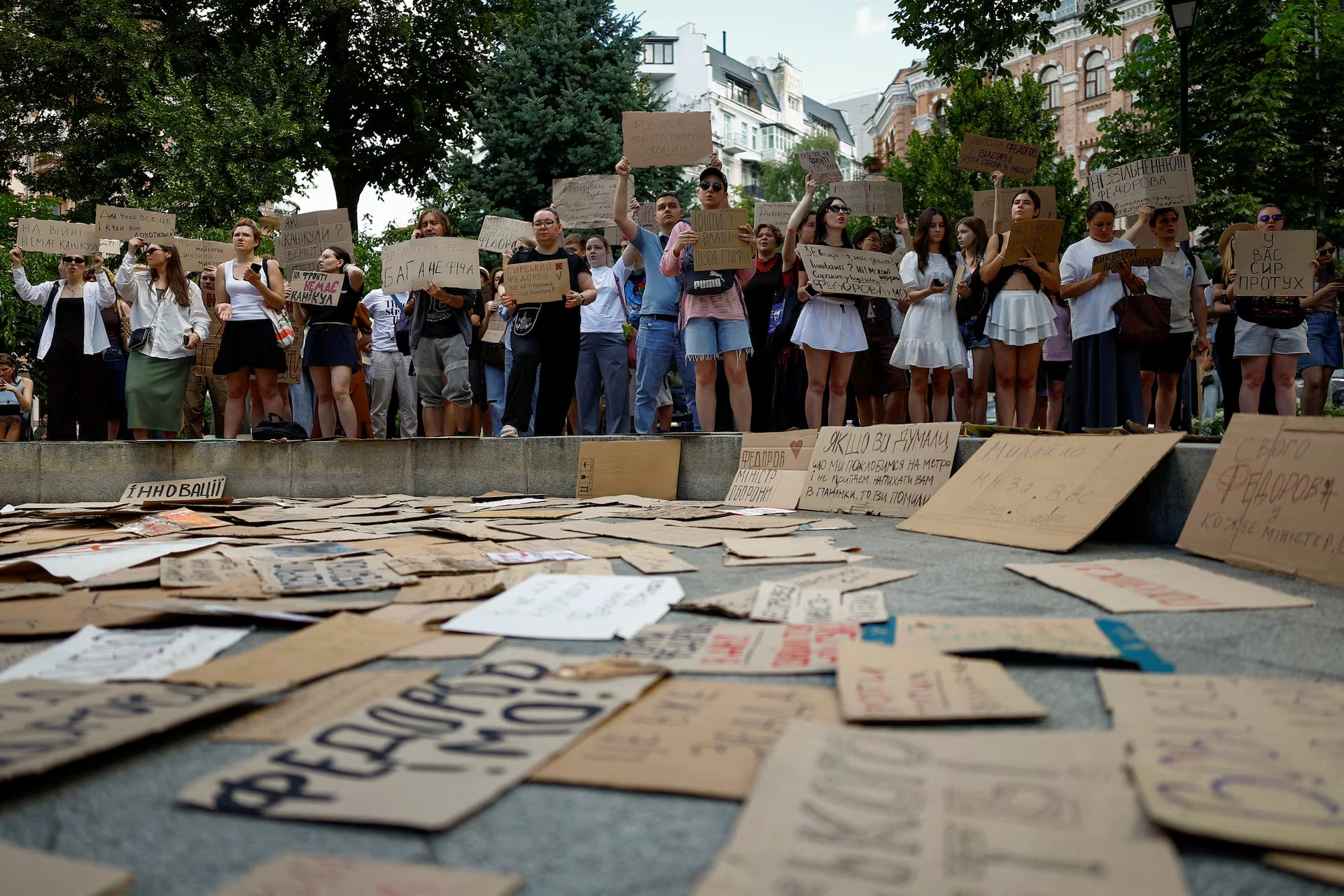
A few thousand people carrying handmade cardboard signs in central Kyiv have compelled the Ukrainian government to react faster than parliament, political parties or formal institutions could. The protest over the dismissal of Defense Minister Mykhailo Fedorov has become a test not only for Volodymyr Zelensky, but for Ukraine’s entire wartime system of government.
At first, demonstrators demanded Fedorov’s return. Their focus then shifted toward Gen. Oleksandr Syrskyi, the commander in chief of the Armed Forces, whose confrontation with the former minister exposed deep disagreements over weapons procurement, battlefield priorities and the pace of Ukraine’s transition toward drone and robotic warfare.
The Office of the President did not dismiss the rallies as untimely, dangerous or helpful to the enemy. Kyrylo Budanov, Zelensky’s chief of staff, acknowledged that society’s position had been heard. Zelensky, meanwhile, began a series of consultations with corps commanders and senior military officials, signaling that the earlier decision might not be final.
As Daycom has previously argued, this response belongs to a durable Ukrainian political tradition: when official institutions lose public trust or fail to react quickly enough, the street becomes an informal mechanism for correcting power. A president may resist allies, generals and lawmakers. Ignoring public anger is far more difficult.
The current demonstrations are much smaller than the mass movements of 2004 or 2013–14. They have no central headquarters, party structure or recognized leader able to negotiate on behalf of the crowd. Yet this absence of organization is precisely what makes them difficult for the government to contain.
There is no single figure to persuade, isolate or co-opt. The protest is held together by a shared conviction rather than a formal program. Its demands can therefore change rapidly, absorbing grievances that extend far beyond the original dispute.
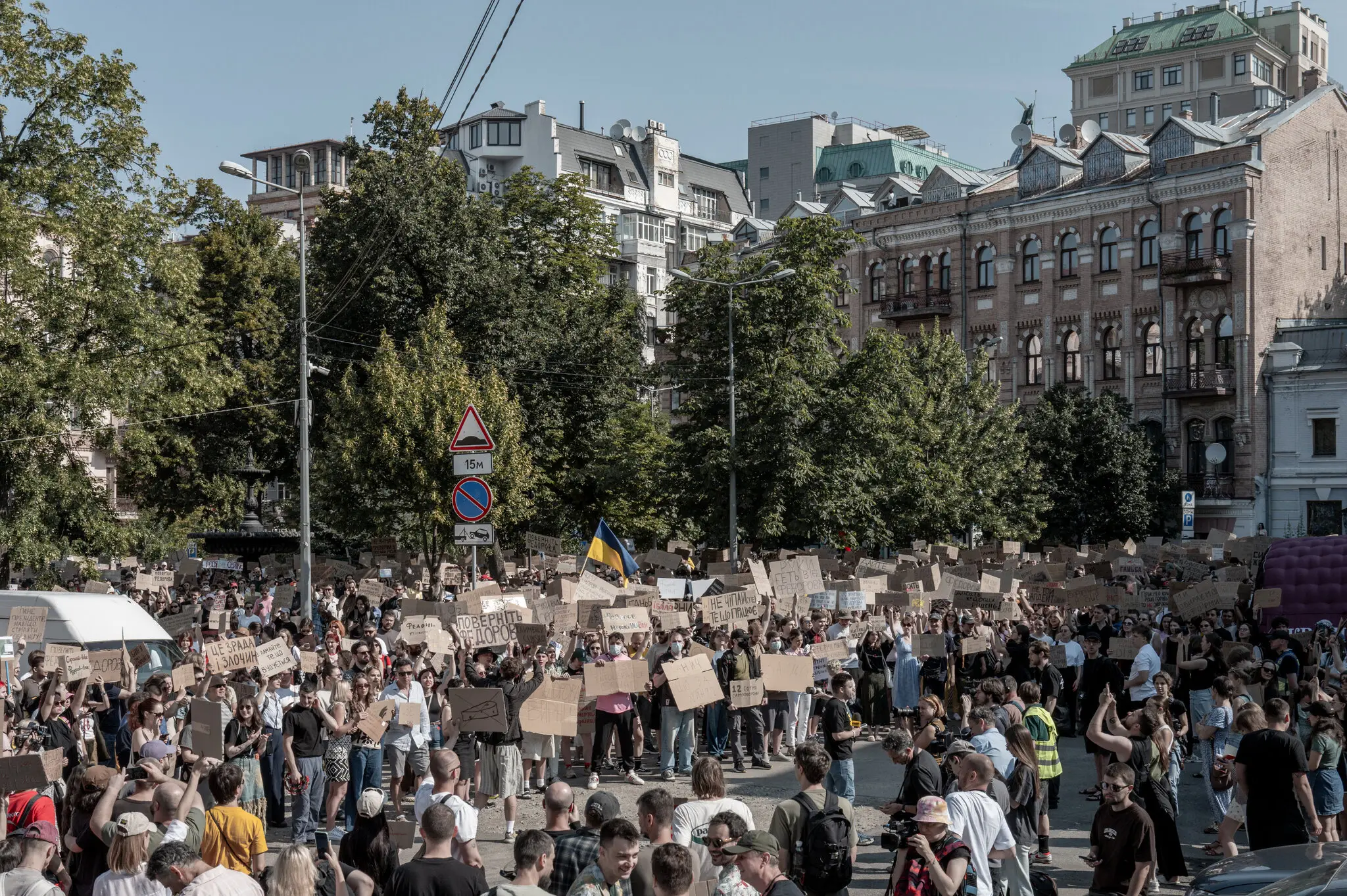 Протест у Києві в четвер — Єнджей Новіцький
The rallies emerged from social media posts and quickly spread beyond Kyiv. Fedorov has not appeared before his supporters or attempted to lead them. An open political rebellion during wartime would expose him to accusations of undermining unity and turning a military disagreement into a personal campaign.
In his absence, the protesters created a symbol. A cardboard cutout of the former minister drew cheers whenever it appeared above the crowd. The image captured the movement’s character: people were defending less a particular official than an idea of Ukraine as a state capable of learning, adapting and moving faster than its enemy.
Fedorov came to embody defense technology, digitized government, large-scale drone production and efforts to shorten the distance between private developers, military procurement and front-line units. To many Ukrainians, his removal did not look like an ordinary cabinet reshuffle. It looked like a possible return to a slower and more closed military bureaucracy.
That is why the dispute between Fedorov and Syrskyi grew beyond personal rivalry. It placed two competing models of warfare against each other.
The first relies on a strict chain of command, centralized allocation of resources, heavy artillery and the authority of the General Staff. The second emphasizes unmanned systems, ground robots, greater autonomy for combat units and the rapid expansion of technologies developed outside the traditional defense establishment.
Fedorov accused the military leadership of delaying initiatives, obstructing procurement and favoring some commanders over others in the distribution of weapons. One of the sharpest disputes concerned budget priorities: Syrskyi pressed for more artillery ammunition, while the minister sought to direct additional resources toward drones and robotic platforms.
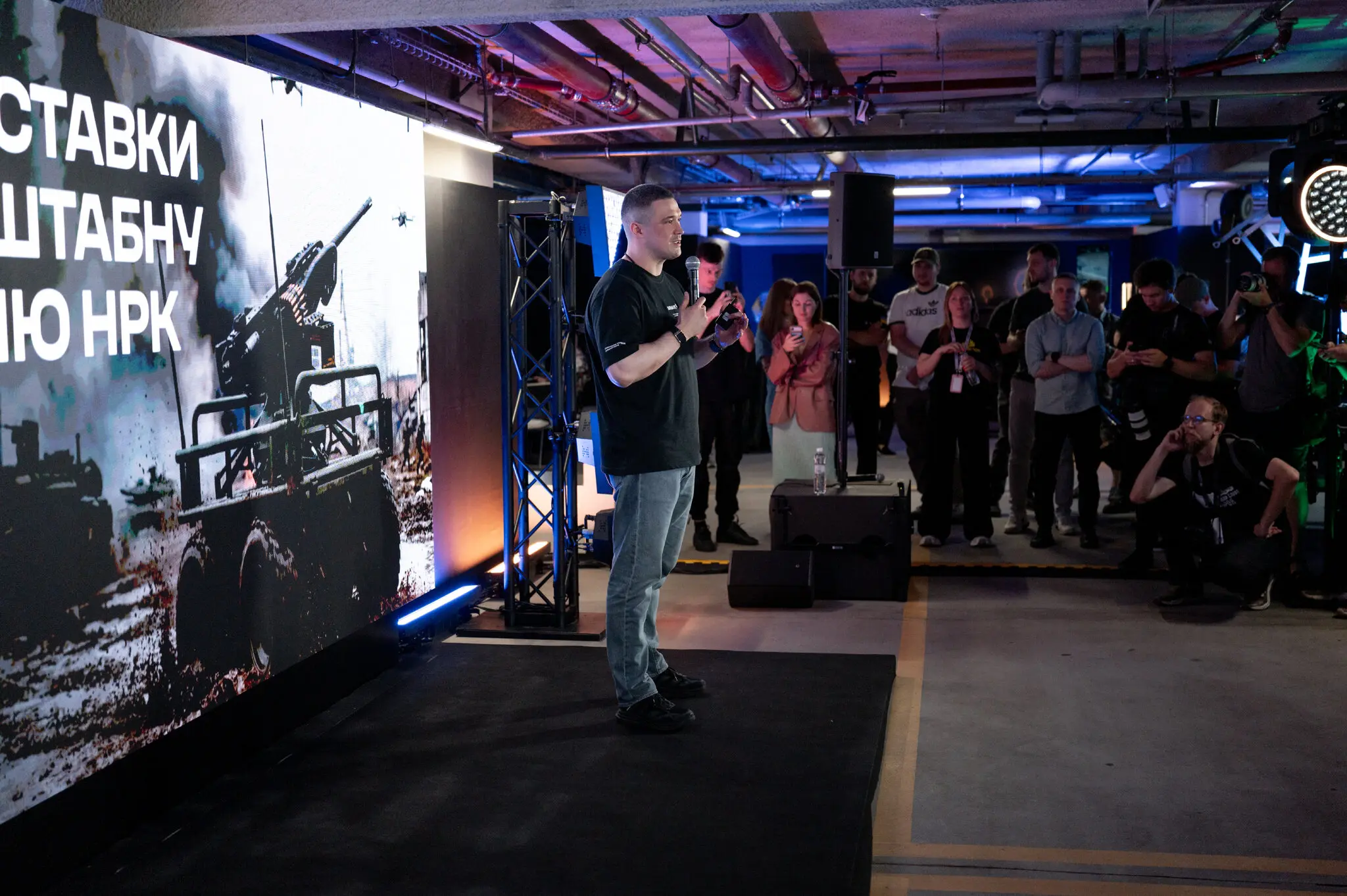
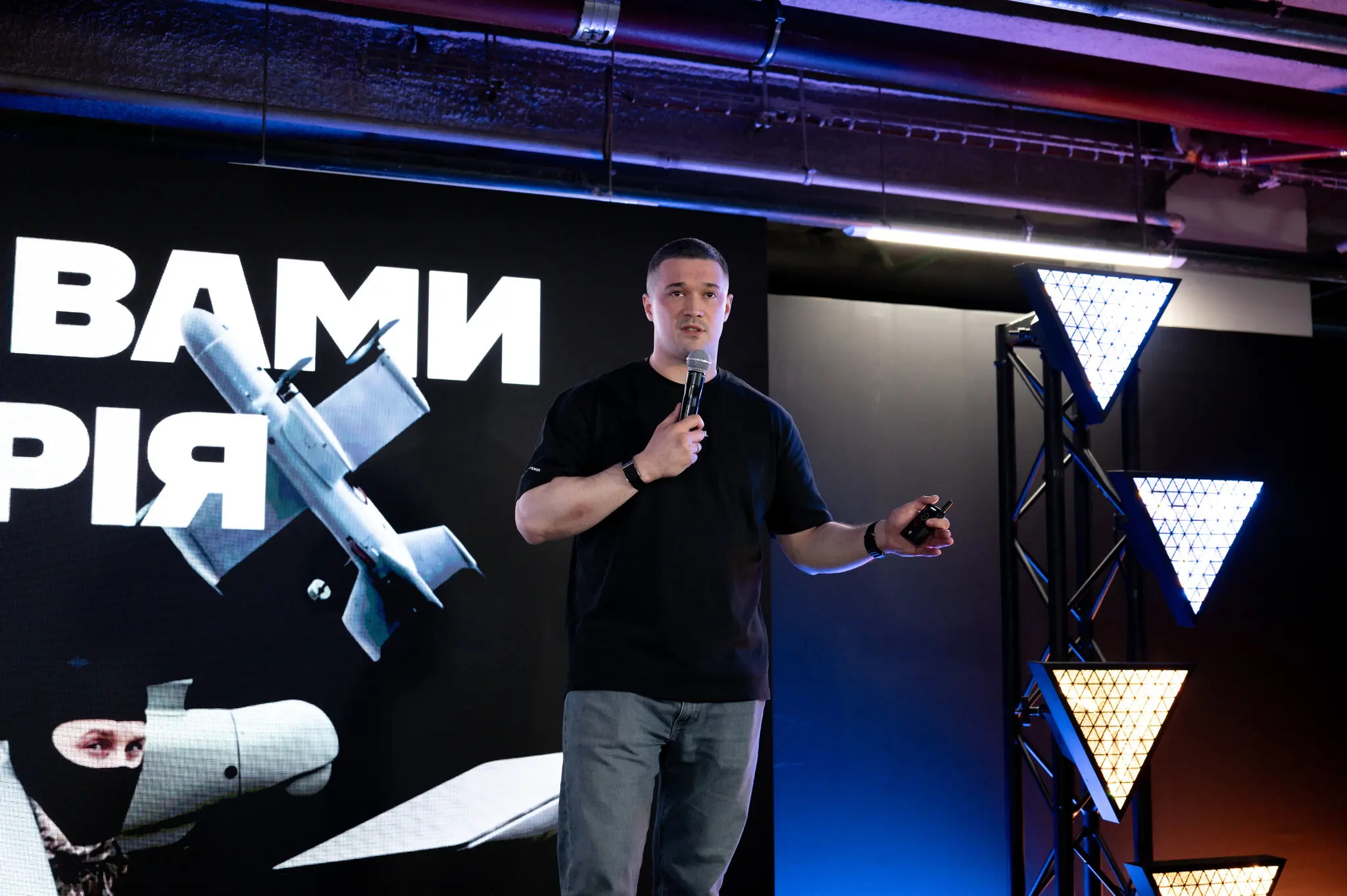 Колишній міністр оборони України Михайло Федоров у Києві у четвер. Він був обличчям української технологічної війни — Єнджей Новіцький
For an army fighting a larger adversary, this is not an abstract argument. Every hryvnia spent on shells is unavailable to a drone manufacturer. Every month lost to approvals can erase a technological advantage, particularly as Russia accelerates its own battlefield adaptation.
Yet the choice between artillery and drones is also misleading. Unmanned systems do not eliminate the need for infantry, fortifications, ammunition or discipline. At the same time, conventional weapons without modern reconnaissance, automation and robotic support are becoming increasingly expensive, especially in human lives.
Fedorov’s dismissal was therefore interpreted as a possible victory of inertia over adaptation. Ukrainian society has spent years raising money for drones, funding volunteer networks, supporting military technology and watching the battlefield change almost in real time. For many citizens, technological warfare is no longer a specialist policy. It is a matter of survival.
Syrskyi attempted to reduce the tension with a public apology to Fedorov. He also emphasized the need to expand the use of drones and robotic systems around Kostiantynivka, one of the most heavily pressured sectors of the front.
Formally, these statements addressed the military. Politically, they were also directed at the people gathered in Kyiv.
The apology, however, did not resolve the deeper issue. The protesters were not merely asking two powerful men to reconcile. They wanted evidence that decisions about military leadership were based on performance rather than personal access to the president, institutional influence or success in bureaucratic competition.
Zelensky responded in a manner that has become characteristic of his presidency. Instead of immediately restoring Fedorov or dismissing Syrskyi, he made the consultation process visible.
A succession of conversations with corps commanders served several purposes at once. They allowed the president to assess the military hierarchy, hear complaints from below and test the views of officers who might eventually be considered for more senior roles.
The consultations also gave Zelensky access to information that had not been filtered through the General Staff. To the public, they demonstrated that the president had not closed the discussion. To ambitious commanders, they created an opportunity to define their positions without the government formally announcing a search for Syrskyi’s replacement.
One of the most closely watched figures was Gen. Mykhailo Drapatyi, commander of the Joint Forces. He supported Fedorov’s technological agenda and did not conceal his disagreements with the senior command.
Under different political circumstances, such independence might have ended his career. Once protesters entered the streets, punishing him became significantly more costly.
For Zelensky, this is familiar terrain. From the beginning, his authority has rested on intensely personalized communication: short videos, emotional directness and the image of a president who speaks in the language of ordinary citizens rather than institutions.
That model gives him unusual political flexibility. It also creates a particular vulnerability. A leader who derives legitimacy from proximity to the public cannot easily appear indifferent when that public turns against one of his decisions.
Zelensky remained in office after his five-year term ended in 2024 under the constitutional framework that preserves presidential continuity during martial law. The legal basis of his authority is clear. Political legitimacy, however, requires constant renewal.
With elections suspended during the war, public trust has become the presidency’s most important informal resource. Even a relatively small protest can therefore matter if it channels a broader anger that has not yet found organized political expression.
A handwritten sign can identify a shift in public mood before a poll does.
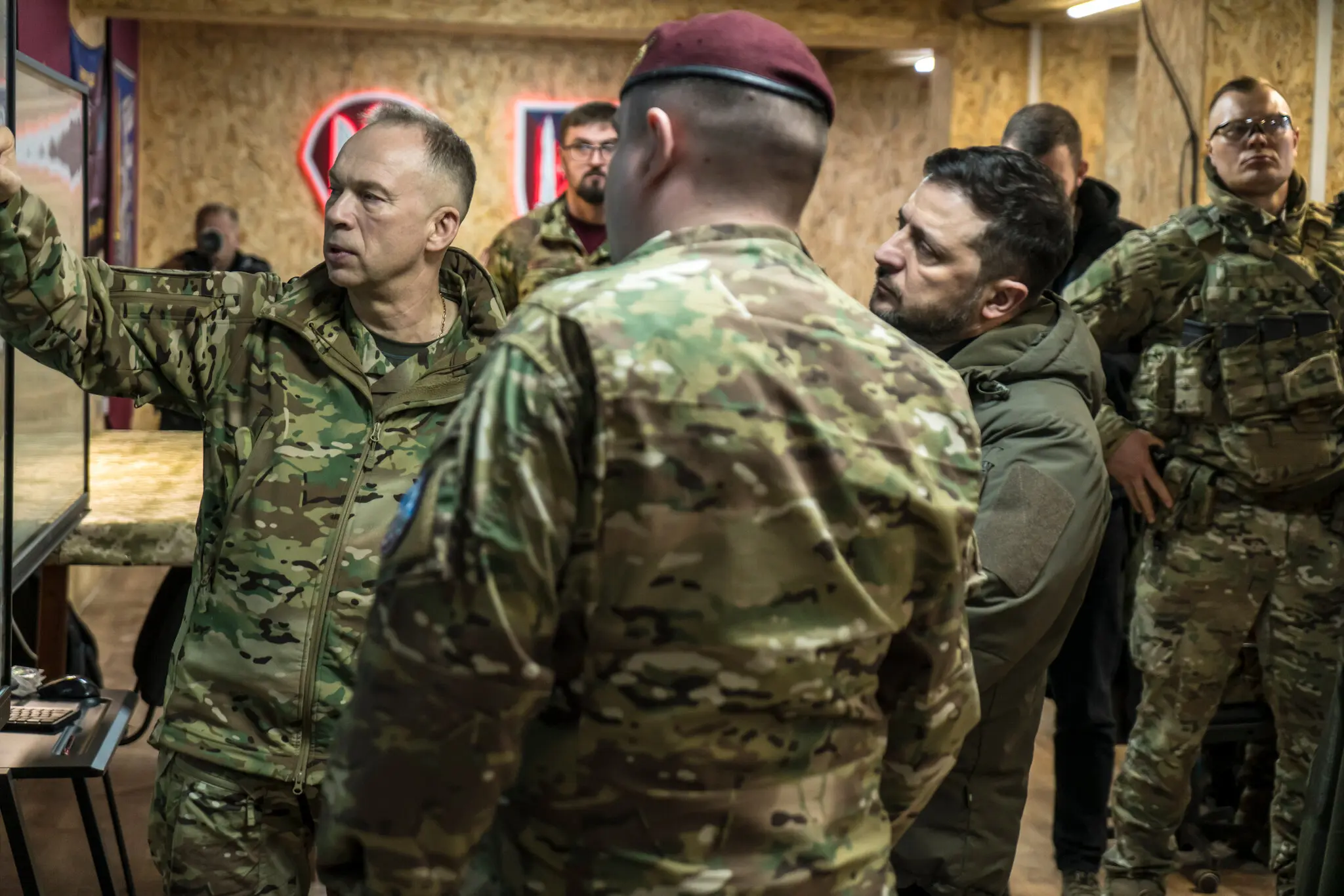 Генерал Олександр Сирський (ліворуч) із паном Зеленським у Донецькій області у березні — Брендан Гоффман
Ukraine’s leaders understand the force of such signals. Mass mobilization helped drive the country toward independence in 1991. In 2004, street protests forced a new round of voting after a fraudulent presidential election. In 2014, demonstrations brought down a government that tried to alter the country’s strategic direction through coercion and violence.
The lesson from those moments is not that the street is always right. It is that Ukrainian power cannot treat the street as irrelevant.
Zelensky has already adjusted major decisions under public pressure. In 2019, demonstrations against concessions to Russia narrowed his room for compromise in early peace negotiations. Later, anger over efforts to weaken anti-corruption institutions forced the government to retreat and restore their independence.
This does not mean that the president automatically yields to every protest. He has resisted foreign governments for months, challenged allied leaders and demanded weapons even when doing so strained diplomatic relationships.
The decisive difference lies in the source of the pressure.
A confrontation with a foreign power can strengthen Zelensky at home by allowing him to act as the defender of national interests. A confrontation with Ukrainian society threatens the foundation of his personalized political authority.
That danger is especially acute when the dispute concerns the army, mobilization, battlefield losses and the state’s ability to wage war effectively.
The current crisis also intersects with grievances that had been accumulating long before Fedorov’s dismissal. Public frustration has grown over the aggressive methods used by some military recruitment officials, corruption scandals, opaque decision-making and a persistent sense that the burden of war is not shared equally.
Fedorov’s removal was the trigger, but it was not the entire cause.
The rallies brought together fears of technological stagnation, distrust of secretive appointments, anger at military bureaucracy and a demand for clearer responsibility when front-line decisions fail.
As long as the demonstrators direct most of their anger at Syrskyi, Zelensky can still present himself as the arbiter. He remains the official expected to correct the mistake rather than the person blamed for creating it.
That position will not last indefinitely.
If he postpones a decision for too long, or reduces the dispute to a misunderstanding between two officials, the protest may acquire a new target. Zelensky could then cease to be the figure from whom protesters expect a solution and become part of the problem they are trying to solve.
For the Office of the President, that is the most dangerous scenario. A demonstration over one personnel decision could widen into a larger argument about the quality of wartime government, the concentration of power and the absence of meaningful institutional accountability.
Restoring Fedorov to the Defense Ministry could quickly reduce tension, but it would also amount to a public acknowledgment that the president had made a mistake.
Removing Syrskyi would satisfy another part of the protest movement, yet changing the military command during intense fighting would create operational uncertainty and could deepen divisions within the armed forces.
A compromise might involve giving Fedorov a new position with expanded authority over defense innovation while gradually restructuring the military hierarchy. Such an arrangement would allow Zelensky to avoid an abrupt reversal.
It might also fail.
A ceremonial position without control over budgets, procurement or implementation would not satisfy those who see Fedorov as a vehicle for reform. The protesters are not demanding an honorary title. They are demanding the continuation of a program: more drones, faster production, greater use of robots and a procurement system capable of responding to battlefield change.
In the longer term, the significance of the crisis extends well beyond Fedorov and Syrskyi. Ukraine must decide who is responsible for shaping its model of modern warfare.
Is it the General Staff, which commands military operations? The Defense Ministry, which controls procurement? The presidential office, which arbitrates between them? Front-line commanders, who understand immediate battlefield needs? Or the network of manufacturers, engineers, volunteers and technology teams that has become indispensable to the war effort?
Without a clear division of authority, similar conflicts will recur.
A ministry may control purchases without controlling how weapons are used. The General Staff may define military needs without fully understanding the pace of technological development. The president may intervene in every major dispute, but a system governed through constant personal arbitration gradually erodes institutional responsibility.
War requires discipline, but discipline is not the same as silence.
Centralization can accelerate the transmission of orders, yet slow the adoption of new ideas. Decentralization gives commanders room to innovate, but without coordination it can produce duplication, rivalry and unequal access to resources.
Ukraine’s most important advantages have often emerged where the state, the military, business and civil society functioned as parts of a single adaptive network. The present protest is, at its core, a demand not to sever that connection for the administrative convenience of a rigid chain of command.
The people on the square are defending more than their right to influence a cabinet appointment. They are asserting a claim over how the country fights, which technologies it develops and what kind of political system it will remain after the war.
For them, the dispute between Fedorov and Syrskyi is ultimately a dispute over whether the state can still hear the society that sustains it.
Zelensky may still dismiss the commander in chief, restore the former minister or construct a more complicated system of authority. But one crucial decision has already been made: the government has acknowledged that it cannot simply wait for public anger to disappear.
The statement that society has been heard has become a political obligation. What matters now is not the speed of the response but its substance.
If the words are not followed by visible change, the protests will gain a new argument. Their agenda may then expand far beyond the personnel dispute that first brought people into the streets.
The Ukrainian street does not always possess a detailed plan, and it is not immune to error. Its power lies elsewhere: in its ability to establish the point at which government stops explaining its decisions and begins demanding obedience.
This time, that boundary was marked by a piece of cardboard raised in wartime Kyiv.
For a president who has learned to withstand pressure from the Kremlin, Washington and Europe’s capitals, the most difficult pressure still comes from the people in whose name he speaks.
Zelensky can argue with the street. He can delay its demands and search for compromise. He cannot afford not to hear it.