

















The Venezuela oil deal announced by Donald Trump in late August is far more unusual than a conventional agreement between a government and an energy company. Washington plans to rely heavily on NABEP, a private Venezuelan producer linked to businessman Alejandro Betancourt, as it attempts to reshape the country’s oil industry.
The agreement covers 17 oil fields associated with more than 65 billion barrels of proven reserves. Trump has described the arrangement as giving the United States “majority control,” while Venezuelan President Delcy Rodríguez insists that legal ownership of the oil and sovereignty over the country’s subsoil remain with Caracas.
Rodríguez says the bilateral programme will run for 25 years and is intended to raise production from the fields included in the agreement to more than 1.5 million barrels a day. A further eight blocks are expected to be developed separately and are not yet included in that initial production target.
That would make the project one of the most significant attempts in decades to redistribute economic control over Venezuela’s oil industry. Yet the central question remains unresolved: Washington and Caracas are still describing “control” in different ways when it comes to ownership, financing and physical production.
Daycom’s analysis indicates that the U.S.-Venezuela oil deal is less a simple purchase of crude than an experiment in state-backed private control of a strategic resource. Washington wants substantial economic rights without formally owning Venezuela’s oil fields or placing the full financial risk on the U.S. government.
That is why North American Blue Energy Partners, or NABEP, is so important to the arrangement. The company is registered in Barbados, maintains operations in Venezuela and already works across exploration, development and production in one of the world’s most politically complicated energy markets.
NABEP is currently estimated to produce roughly 200,000 barrels a day. That makes it one of Venezuela’s largest private oil producers and an unusual player in an industry that for decades has revolved around state-owned PDVSA and joint ventures in which the government retains a dominant role.
The company’s ambitions are far larger. Its plans envision raising production to as much as one million barrels a day within roughly five years. To finance that expansion, NABEP is considering up to $5 billion in debt, illustrating the enormous capital requirements involved even before Venezuela approaches its historic output levels.
The U.S. government’s proposed participation remains more complicated. Early descriptions suggested that Washington would effectively receive 55% of the venture’s output. A more detailed version later emerged involving roughly a 35% passive economic interest in NABEP and preferential access to another 20% of production at cost.
Those figures may explain where the 55% number comes from, but they are not legally equivalent. An equity interest gives the holder a share in the economic performance of a company. A right to purchase crude at cost is a commercial entitlement to the commodity. Until the contracts are final, the distinction matters.
The Pentagon’s role introduces another layer of uncertainty. Discussions have involved the Office of Strategic Capital, a Defense Department body designed to mobilize private investment into strategically important industries and supply chains.
Its existing authorities, however, are primarily structured around loans, loan guarantees and related financial assistance. That creates questions about how a federal defence entity could acquire a direct economic stake in a private oil company without a different statutory mechanism.
One proposal under discussion involves warrants — instruments giving their holder the right to purchase shares at a predetermined price. In some structures, such warrants can be issued at a very low exercise price, allowing the holder to benefit substantially if the company’s value later rises.
A warrant is not the same thing as an ordinary share. It gives the holder the future right to acquire equity, potentially allowing the government to participate in the upside of a successful project without immediately committing billions of dollars in direct capital.
But Pentagon officials have stressed that the Office of Strategic Capital does not simply possess unrestricted authority to buy private-company shares. That means the final structure may have to rely on loans and guarantees, while any equity-like economic rights are handled through another federal vehicle.
The distance between the political announcement and a fully executable legal structure is therefore significant. The project could still be redesigned before major financing is committed, particularly if lawyers conclude that the mechanism initially discussed exceeds the Pentagon office’s authority.
For Trump, the corporate architecture is ultimately secondary to the strategic objective: privileged access to Venezuelan crude. His administration wants a long-term source of heavy oil in the Western Hemisphere that can reduce U.S. exposure to instability in the Middle East.
That calculation has become more important after the escalation involving Iran and disruption around the Persian Gulf. Venezuela is geographically much closer to the United States, while Gulf Coast refineries have historically been well suited to processing the country’s heavy crude.
The difficulty is that enormous reserves do not translate into enormous immediate production. Venezuela has roughly 303 billion barrels of proven oil reserves, around 17% of the global total, but much of that resource consists of extra-heavy crude in the Orinoco Belt.
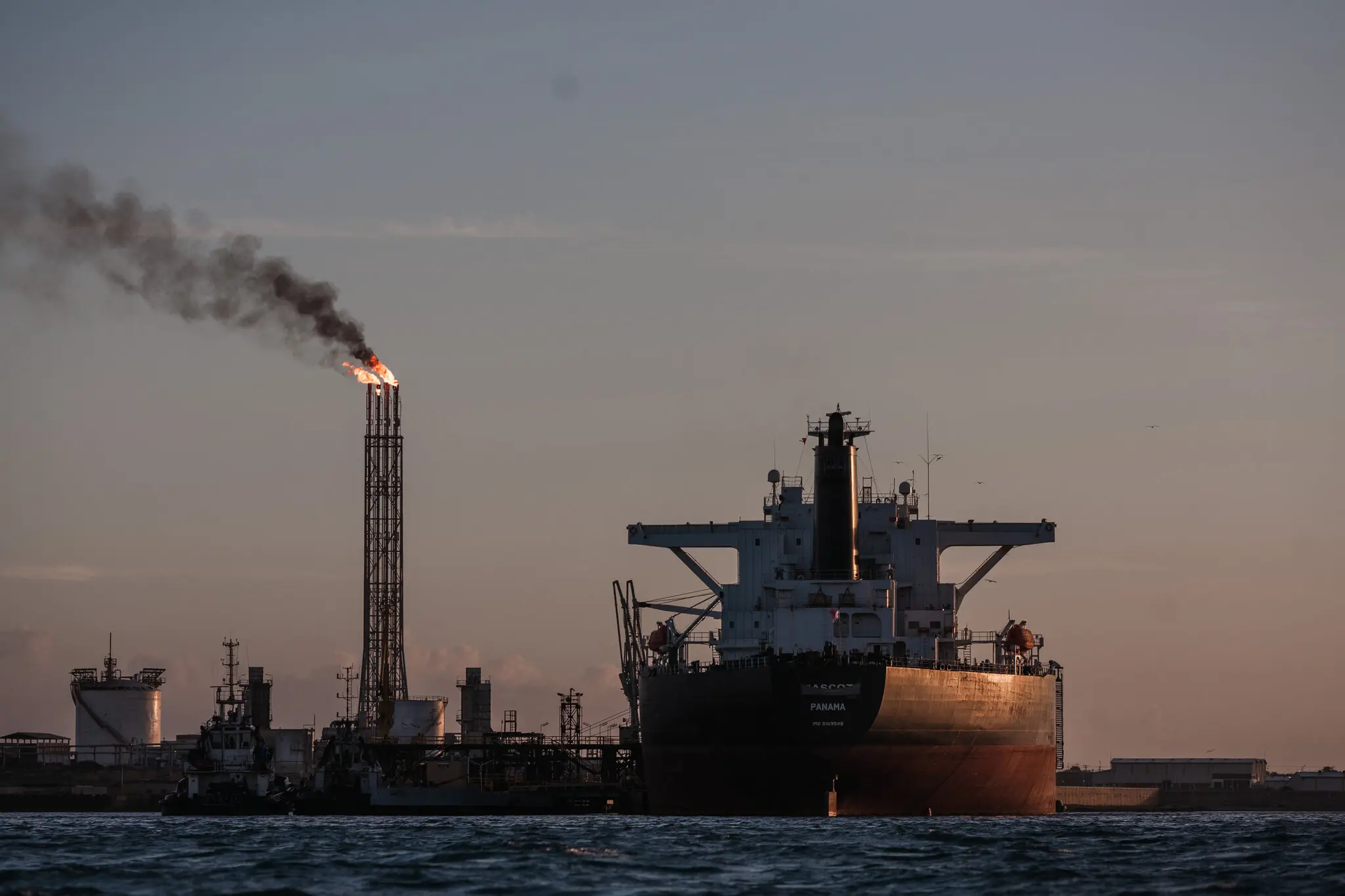
That oil requires specialized extraction, upgrading, blending and transport infrastructure. It often needs lighter hydrocarbons or condensate to make it sufficiently fluid for movement and processing. Restoring production therefore means rebuilding an entire industrial chain, not simply reopening wells.
At present, Venezuela produces only a little more than one million barrels a day, far below its historic peaks and a modest share of world supply. Years of underinvestment, infrastructure deterioration, management failures, loss of skilled personnel and sanctions have all reduced capacity.
That is why the deal cannot quickly lower U.S. gasoline prices. Even mature oil fields require repairs to wells, pumps, pipelines, power systems, storage facilities and export terminals. New blocks require exploration, drilling and development cycles that can take years.
In this context, U.S. government backing may prove more important than the precise size of Washington’s stake in NABEP. Federal guarantees and financing could lower risk for banks, equipment suppliers and service companies that would otherwise demand exceptionally high returns to operate in Venezuela.
For private investors, the country’s greatest risk has long been political rather than geological. Contracts have been rewritten, assets nationalized, payments delayed and sanctions have restricted access to the dollar system. A rich oil field can remain commercially unattractive if the legal framework is unstable.
Direct U.S. government involvement changes that calculation. It does not merely provide financing; it creates political protection around the contract. A future Venezuelan government would face far greater diplomatic costs if it moved against a project backed directly by Washington.
That is also what makes Alejandro Betancourt such a divisive choice. His business career was built inside the Venezuelan political economy that U.S. governments spent years criticizing for corruption, opaque public contracts and unusually close ties between private fortunes and political power.
Betancourt, now 46, rose to prominence in the 2010s after companies linked to his circle received major contracts to build power plants. The young businessmen associated with those deals became known in Venezuela as the “bolichicos,” or “Bolivarian boys,” for the fortunes they accumulated during the Chávez era.
He later moved deeper into oil, acquiring an interest in Petrozamora, which operated mature fields around Lake Maracaibo. Those assets became part of the foundation for NABEP’s expansion as the company increased production and gained new operating opportunities from 2024 onward.
Betancourt’s financial activities have been scrutinized for years by Swiss prosecutors. He has not, however, been formally charged with a criminal offence in Switzerland. NABEP’s legal team has emphasized that he has not been charged with a crime in any jurisdiction.
That produces the central political paradox of the deal. Washington spent years arguing that Venezuela’s economy had been distorted by business groups enriched through proximity to the state. It may now depend on one of the businessmen who emerged from that system to execute its new oil strategy.
The administration’s logic appears pragmatic. Rapidly increasing output requires a partner with personnel, wells, contracts, political relationships and practical experience operating alongside PDVSA. NABEP has achieved a rare record of production growth in modern Venezuela, making it operationally attractive.
The company itself remains cautious about defining its future role. NABEP has said it is prepared to work with the United States on rebuilding Venezuela’s energy sector but has indicated that the precise structure of its participation is still premature to describe.
Washington is also expanding its presence through established operators. Chevron has been increasing its role in Venezuelan projects and securing additional opportunities in the Orinoco Belt, giving the United States another route for bringing American capital back into the sector.
Taken together, Chevron, NABEP and U.S. state financing suggest a broader model. Instead of restoring the old PDVSA-dominated system intact, Venezuela may move toward an industry in which private operators, foreign capital and agreements backed by powerful external governments play a much larger role.
Caracas has its own reasons to support the arrangement. Rodríguez has estimated that the project could generate more than $200 billion in government revenue over its lifespan, based on expected production, taxation and the state’s share of the value created.
Those numbers are forecasts, not guaranteed receipts. They depend on actual output, global crude prices, operating costs, financing conditions, transport expenses and whether the deal survives future political changes in both Venezuela and the United States.
The same caution applies to projections of almost $100 billion in private investment. It remains unclear which companies have made binding commitments, how much financing will depend on U.S. guarantees and how quickly investors will be willing to deploy capital.
Venezuela has experienced similar cycles before: vast reserves generate expectations of an investment boom, only for political instability to undermine the commercial model. The challenge facing this project is not finding oil. The challenge is establishing rules that investors believe will survive for decades.
Sovereignty will also become a domestic political issue. Trump speaks of American control, while Rodríguez emphasizes Venezuela’s continuing ownership of its natural resources. Legally, the two positions can coexist if Caracas owns the subsoil while foreign partners receive long-term production and purchasing rights.
Politically, however, the distinction is far more sensitive. Oil has been a symbol of Venezuelan sovereignty for generations. Even a commercially advantageous agreement could face opposition if it is perceived domestically as transferring a strategic national resource to a foreign power.
Trump’s argument runs in the opposite direction. He wants a major resource base in the Western Hemisphere, preferential access for U.S.-aligned companies and eventually more barrels entering the global market. In theory, that could reduce the pricing power of Middle Eastern producers.
But “eventually” is the crucial word. Oil markets respond to barrels that are actually being produced today, not to tens of billions sitting underground. Even a successful Venezuelan expansion would require years before it materially changes the global supply balance.
For now, the U.S.-Venezuela oil deal therefore matters more geopolitically than it does for prices. Washington is attempting to rewrite access to the world’s largest proven oil resource while creating a structure in which the U.S. government, a private operator and Caracas share risk and reward.
The biggest uncertainty remains the meaning of “control.” If the United States ends up with a substantial economic interest, privileged access to additional production and federal financing rights, it would represent an extraordinary fusion of foreign policy, strategic capital and commercial oil interests.
If the legal limits surrounding the Office of Strategic Capital prevent the proposed structure, the agreement will have to be redesigned before the first major financing package is completed. The celebrated oil deal would then face a basic test: whether it can actually be built in the form the administration has described.
That is why Betancourt matters almost as much as Trump or Rodríguez. He combines precisely the qualities Washington long treated with suspicion: proximity to Venezuela’s governing system, the ability to work inside it and, now, a willingness to partner directly with the United States.
That combination may prove useful if the goal is to increase production rapidly in one of the world’s most difficult political economies. But it also creates the project’s central risk: a strategy presented as a new foundation for U.S. energy security may depend on one of the most controversial products of Venezuela’s old system.