









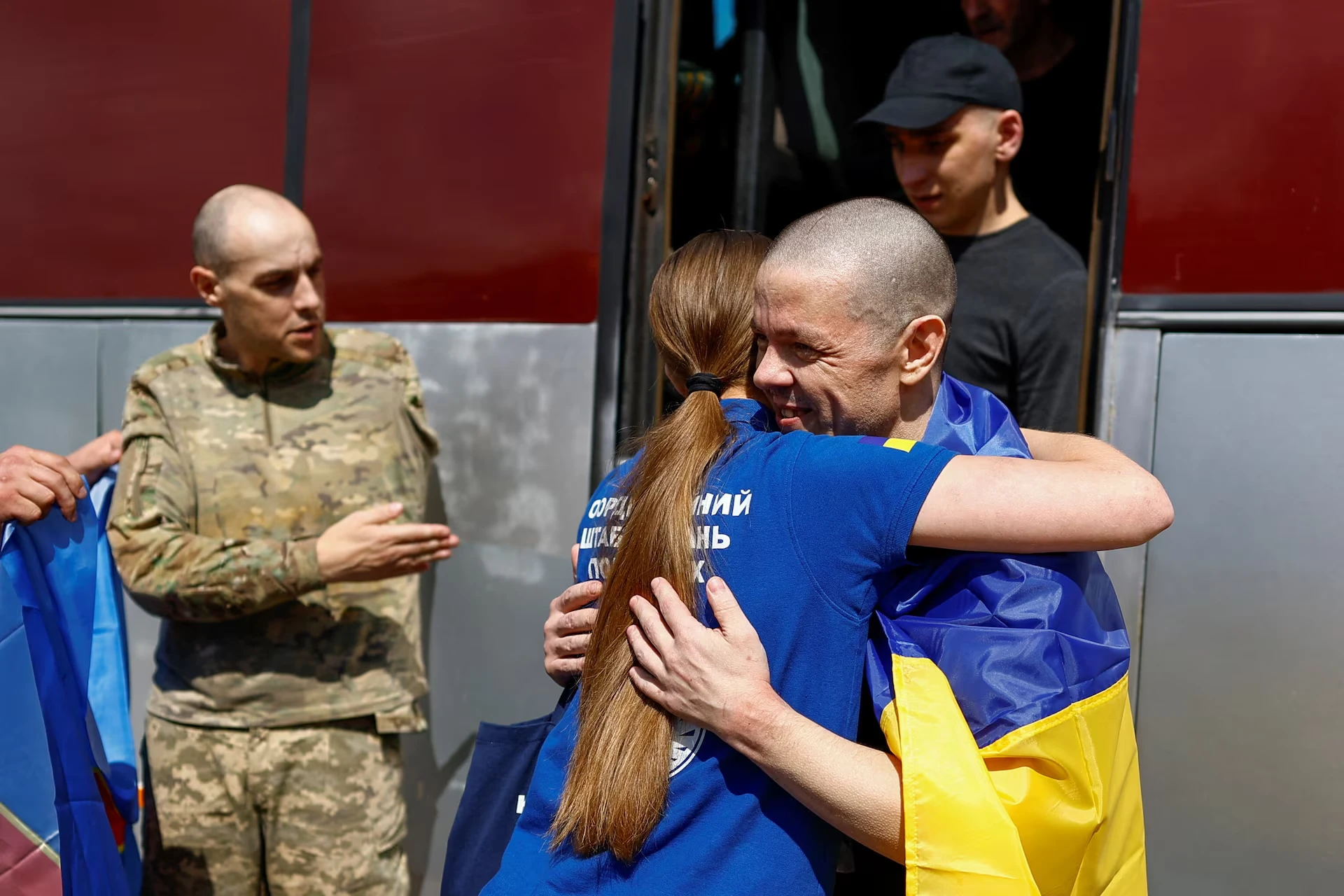





Ukraine brought 103 servicemen home from Russian captivity on August 19 in the latest Ukraine-Russia prisoner exchange. The Coordination Headquarters for the Treatment of Prisoners of War described the operation as the first stage of another exchange process. Russia also received 103 of its servicemen.
The Ukrainians released included members of the Armed Forces, Navy, Territorial Defence Forces, National Guard and State Border Guard Service. The group included soldiers and non-commissioned officers as well as several officers, reflecting the range of units whose personnel remain in Russian captivity.
Most of those returned have wounds or serious medical conditions, according to Ukrainian officials. They are expected to undergo medical examinations, physical and psychological rehabilitation and receive state support. For many, returning home marks the beginning of a separate and potentially lengthy process of recovery.
The freed servicemen had fought on the Luhansk, Donetsk, Kharkiv, Zaporizhzhia, Kherson, Dnipropetrovsk and Sumy fronts. The youngest member of the group was born in 2000, while the oldest was 59, underscoring how broadly the war has drawn Ukrainians of different ages into military service and captivity.
Daycom’s analysis indicates that the significance of this Ukraine-Russia prisoner exchange goes beyond the number of people returned. Kyiv’s description of the operation as a “first stage” suggests that the humanitarian negotiating channel remains active even as the two countries remain far apart on the broader terms of ending the war.
Oleh Ivashchenko, head of Ukraine’s Coordination Headquarters and chief of military intelligence, personally met the released servicemen after their return. Ukrainian officials said negotiations were continuing and that government agencies were already working on preparations for further exchanges.
Ivashchenko told Reuters that another exchange was expected before the end of August. He said Ukraine hoped the next group would include defenders who have spent a particularly long time in captivity, among them servicemen who took part in the defence of Mariupol during the opening months of the full-scale invasion.
Ukraine’s official Coordination Headquarters has not announced a precise date for the next exchange, confirming only that preparations are continuing. The distinction matters: expected timing remains part of a sensitive negotiating process and can change depending on agreements reached between the two sides.
Particular attention continues to focus on Ukrainian servicemen captured during the earliest and most intense phases of the full-scale war. Among them are defenders of Mariupol and the Azovstal steelworks, whose return has remained one of the most prominent demands of prisoners’ families and a stated priority for Ukrainian negotiators.
The human cost of captivity was visible in the accounts of those released on August 19. Reuters spoke with 29-year-old Dmytro, who had spent three years as a prisoner of war. After returning home, he urged the families of those still being held not to lose hope that their relatives could also come back.
Another released serviceman, 43-year-old Anton Tymofiienko, had spent 28 months in captivity. He said letters from relatives were among the few connections prisoners had with the outside world and that they otherwise received very little information about events beyond the places where they were being held.
Such accounts help explain why a prisoner exchange does not end when a serviceman physically returns to Ukrainian-controlled territory. Long-term isolation, poor health, uncertainty about relatives and the experience of captivity can leave consequences requiring sustained medical, psychological and social assistance.
The Coordination Headquarters has said the released Ukrainians will receive comprehensive support and reintegration services. For those held for years rather than months, readjustment may be particularly difficult after prolonged separation from families, ordinary civilian life and the rapidly changing reality of a country still at war.
Prisoner exchanges have continued even while Ukraine and Russia remain deeply divided over the conditions for any settlement of the war. That makes the humanitarian track distinct from broader diplomatic negotiations: limited agreements on the return of captives can still be reached without agreement on territory, security guarantees or a ceasefire.
In March 2026, President Volodymyr Zelenskyy said 8,669 military personnel and civilians had been returned from Russian captivity during four years of work by the Coordination Headquarters. By late June, he said the overall number brought home since the full-scale invasion had exceeded 9,500.
The exchange mechanism itself is neither automatic nor predictable. Ukrainian authorities continuously collect and update information on prisoners and missing persons, while the names included in individual exchanges become the subject of negotiations. Families therefore often have no certainty that a relative will appear on the next list.
Ukrainian officials also thanked the United States and the United Arab Emirates for assisting with the August 19 exchange. International mediation remains significant where direct Ukrainian-Russian contacts are limited and where arrangements over prisoners require additional channels to facilitate agreements between the sides.
The continuation of prisoner exchanges should not be interpreted as evidence that a broader peace settlement is close. Rather, it demonstrates that humanitarian arrangements can operate separately from negotiations over the fundamental political and military questions that continue to divide Kyiv and Moscow.
Ukraine has not publicly disclosed a complete list of those it hopes to bring home in the next stage. Ivashchenko’s reference to long-held prisoners and defenders of Mariupol nevertheless identifies one of Kyiv’s priorities if another exchange takes place before the end of August as expected.
For the 103 Ukrainian servicemen released on August 19, months or years of captivity have now ended with a return home. For the many others who remain in Russian custody, the latest Ukraine-Russia prisoner exchange carries a different meaning: the mechanism is still functioning, and negotiations over further returns are continuing.