




















On September 1, children at Sichovyi Collegium in Zaporizhzhia arrived wearing embroidered shirts, carrying flowers for their teachers and sharing the ordinary nervous excitement of a new school year. But after the opening ceremony, they did not head upstairs. Their classrooms lie below ground, protected by layers of concrete and soil.
During breaks, pupils sit beside ventilation systems, talk in reinforced corridors and play in spaces that, in a peacetime city, would have been schoolyards and sports grounds. They are allowed outside only when there is no air-raid alert. When the siren sounds, everyone remains below ground.
For parents, such a school does not feel dystopian. It means several hours in which they do not have to watch their phones and wonder whether their child reached a shelter in time. Yulia Barabash, whose son Damir is in eighth grade, describes the relief simply: once she brings him to school, she does not spend the day worrying about his safety.
Zaporizhzhia has turned underground education into a permanent part of its urban infrastructure. By the end of the previous academic year, the city had ten municipally run underground schools and two more under regional authority, while almost all city schools were operating either in person or through a hybrid format.
Daycom’s analysis indicates that underground schools in Ukraine solve a problem ordinary shelters cannot: they protect not only children during an air raid, but the learning process itself. In a frontline city, a safe classroom increasingly means one that never has to be evacuated in the first place.
 Першого дня студенти одягли традиційні вишиті сорочки — Єнджей Новіцький
That transformation is accelerating across Zaporizhzhia region. By the end of the 2025–2026 school year, 19 underground schools were operating there. More facilities were being prepared for September, and several opened at the start of the new academic year. Regional authorities plan to expand the network further by the end of 2026.
Officials estimate that, operating in shifts, the underground-school system will allow tens of thousands of children to return to face-to-face education. In a region where the security situation can change within hours, the model is no longer an experiment. It is becoming a way to bring pupils back from years of remote learning.
Nearly 90,000 schoolchildren began the new academic year across Zaporizhzhia region, including several thousand first-graders. Some are entering school life in a reality where the phrase “safe school” is associated from the beginning with reinforced ceilings, filtration systems and backup power.
Sichovyi Collegium illustrates why many parents accept that reality. Its underground space was designed not simply as somewhere to wait out an alert, but as a place where children can study, take breaks and remain for hours. The school has powerful ventilation and emergency electricity, allowing lessons to continue when sirens sound.
Students had already described how returning to a physical classroom after years of online education changed more than their grades. Some teenagers who had spent long periods studying remotely had to relearn the basic rhythms of daily interaction with classmates.
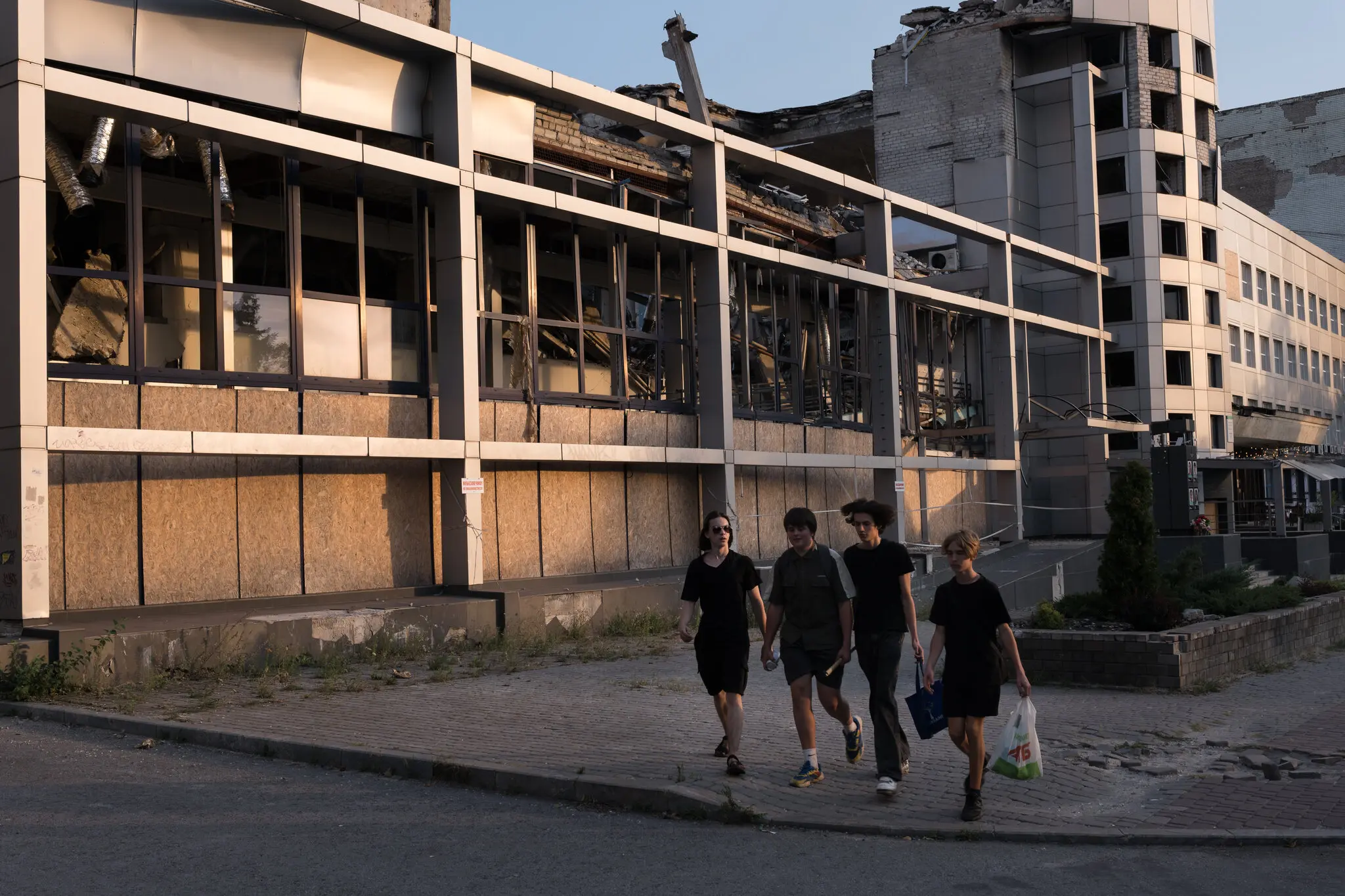 Підлітки проходять повз зруйновану будівлю в Запоріжжі у вівторок. Місто розташоване недалеко від лінії фронту — Єнджей Новіцький
Studying underground also has limits. Some lessons are shorter than the traditional 45 minutes, while additional material is completed through digital platforms. The result is a hybrid model in which the physical school protects children from attack and online tools compensate for the constraints of the underground environment.
For Damir, who also studied underground last year, the main frustration is simpler: he would like to spend more time outside and play football. When there is no alert, children may occasionally go up for fresh air. When the sirens return, even an ordinary school break moves back under concrete.
Inside the collegium, there is another reminder of the world above: a memorial to former students and a teacher who died in the war. For the children, these realities now exist side by side — homework, friends and football, and a war that shapes even the architecture of the place where they learn.
The father of one eighth-grader, Dmytro Sizhykh, is serving in the military. For him, the underground school means being able to do his job without constantly wondering whether his son is safe. Under current conditions, he says, he would not send the boy to an ordinary above-ground school.
That paradox has become one of the most striking consequences of the war. Children in frontline Zaporizhzhia can sometimes have a more stable in-person school day than pupils in cities much farther from the front. The reason is not lower danger, but infrastructure designed on the assumption that attacks are part of everyday life.
 Січовий колегіум — один із 74 навчальних закладів України, які працюють повністю підпільно — Єнджей Новіцький
In an ordinary Ukrainian school, an air-raid alert means stopping the lesson and moving children into a shelter. If that shelter is unsuitable for teaching, dozens of minutes or even hours of instruction disappear. In an underground school, the siren changes the rules for going outside but does not necessarily interrupt mathematics or English.
At the start of the new school year, that distinction affects millions of children. Ukraine has nearly 12,000 schools serving more than 3.5 million pupils. Most operate either in person or through mixed formats, while a significant number remain fully online.
Most schools that provide face-to-face learning have access to their own shelter or another equipped protective space. The state continues to spend billions of hryvnias on school shelters. But having a shelter does not automatically mean classes can continue inside it.
That is why official counts of “underground schools” can vary. Some estimates include only fully subterranean educational facilities, while others also count reinforced shelters designed for sustained teaching during alerts. The difference is largely about definitions.
The government continues to expand the network. Funding is being directed toward new protective school infrastructure, with priority given to regions facing the highest security risks. Some of these sites function in practice as full schools built below ground.
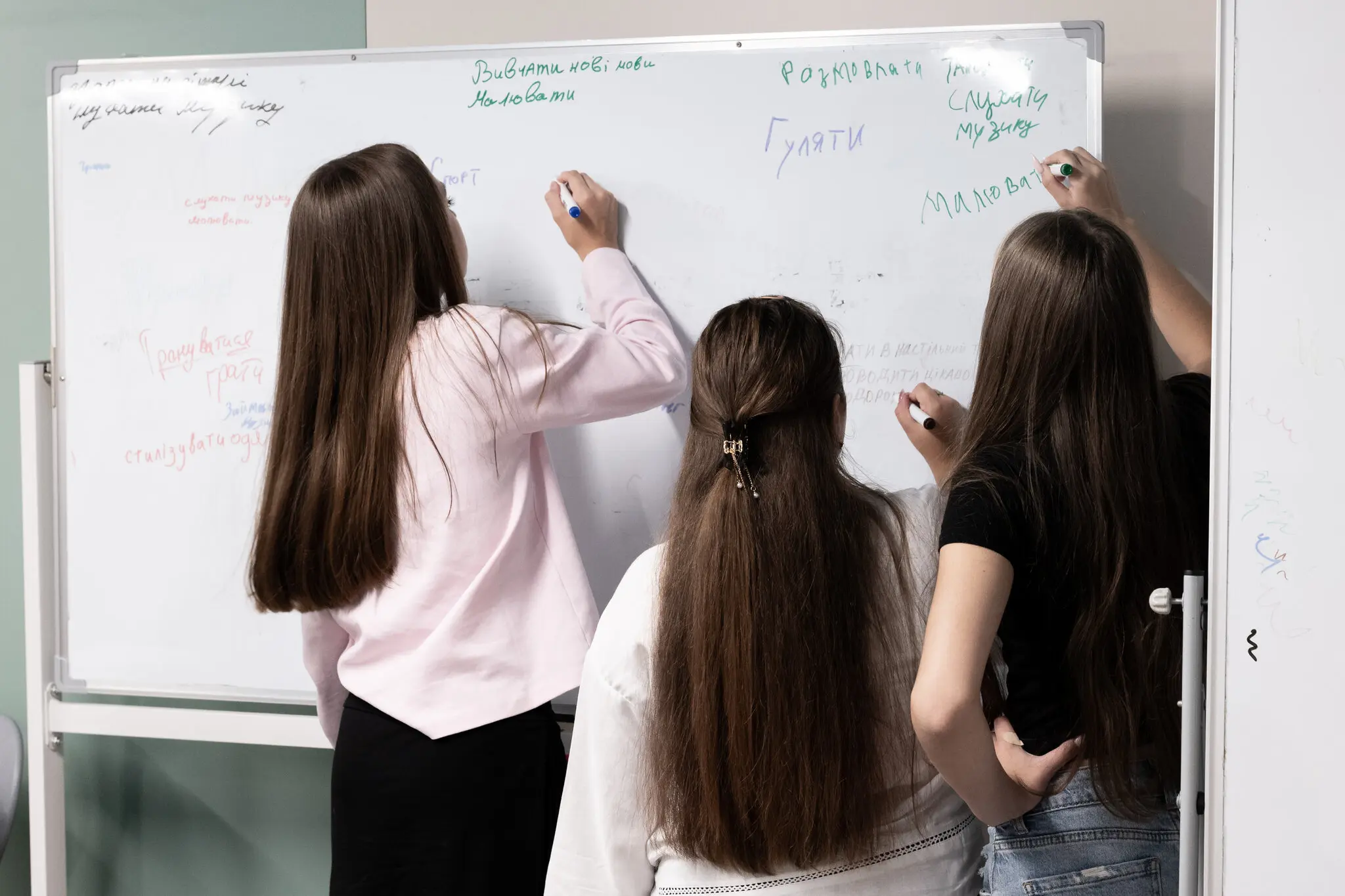 Запис сподівань на наступний рік на дошці — Єнджей Новіцький
Authorities are also allowing schools to create specially protected learning spaces in areas where constructing a major shelter is not immediately possible. The aim is to reduce long-term remote education without waiting for every expensive capital project to be completed.
Underground schools are costly, but remote education carries costs that are harder to see in a budget. Ukrainian children moved almost directly from the disruption of the COVID-19 pandemic into years of full-scale war, producing two long periods in which normal school life was repeatedly interrupted.
Education researchers have documented more than gaps in academic knowledge. The war has reduced access to schooling, deepened inequalities between regions and families, and harmed the emotional wellbeing of both students and teachers. The effects are particularly severe for children who have spent years learning mainly online.
Even before the current school year, a substantial share of Ukrainian pupils were not studying full-time in classrooms, while some remained entirely remote. International child-protection organisations increasingly describe the problem not simply as lost instructional hours, but as a broader crisis of development, socialisation and mental health.
For teenagers in frontline regions, the consequences are especially visible. Long school closures deprive them of daily contact with peers, while the constant threat of attacks creates background anxiety that interferes with concentration. An underground school restores at least part of an ordinary routine — a timetable, a teacher, friends and a break between lessons.
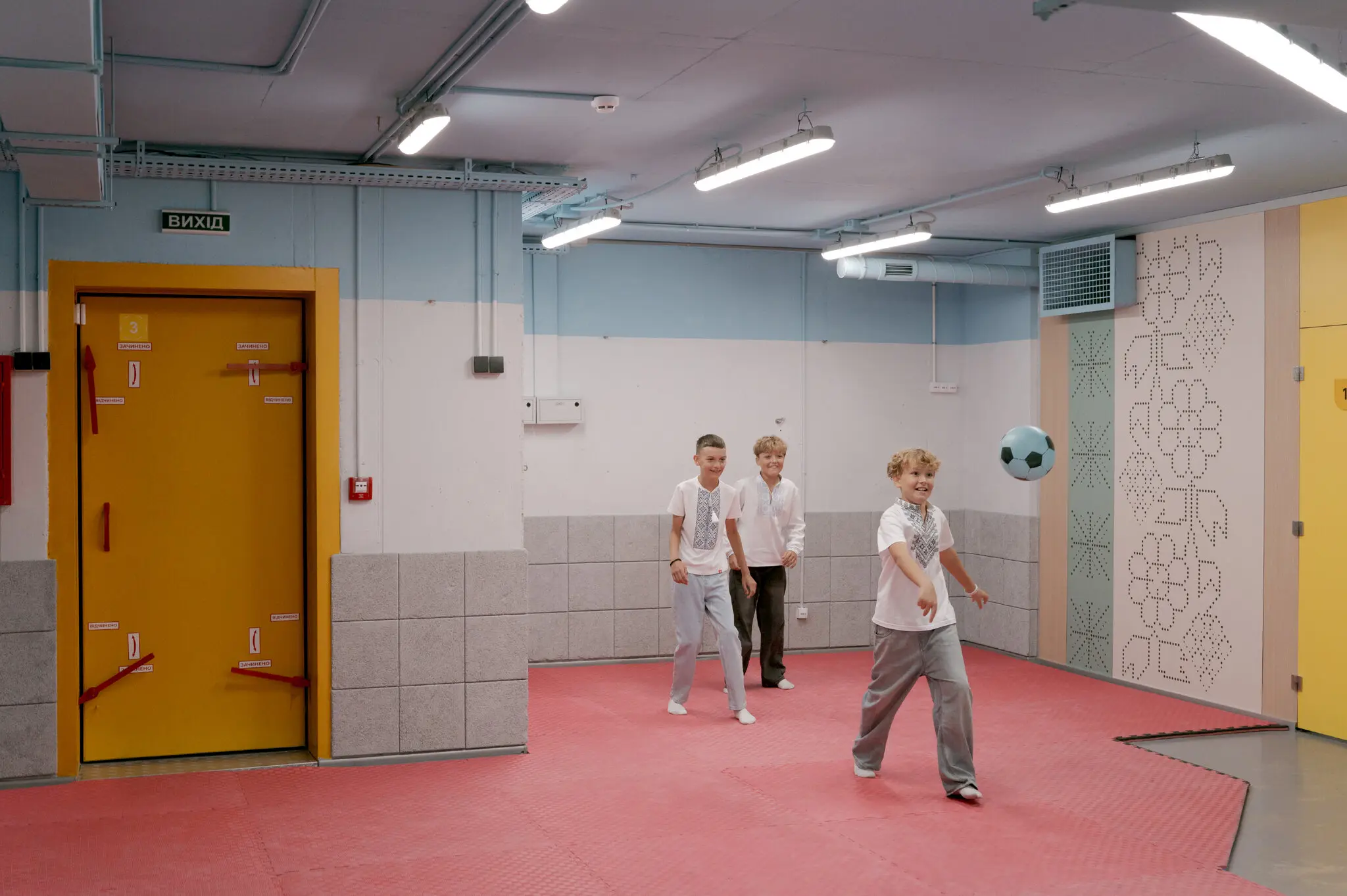 Гра у футбол під землею. Діти можуть виходити на поверхню лише тоді, коли не діє повітряна тривога — Єнджей Новіцький
During the first years of the full-scale invasion, children in some frontline areas spent thousands of hours in shelters. That amounted to months of life underground, with ordinary school days repeatedly broken apart by alarms.
An underground school changes the meaning of those hours. A child is still below ground because of the threat of attack, but the time is no longer simply spent waiting for an all-clear. That is the central difference between a bunker classroom and a basement shelter.
The adaptation should not obscure the reason it became necessary. Direct damage to Ukraine’s education sector is measured in billions of dollars, while reconstruction needs run into the tens of billions. Zaporizhzhia region is among the areas most heavily affected.
Thousands of educational facilities have been damaged or destroyed during the war. The real number may be higher because not every case can be independently verified quickly, particularly near the front line and in occupied territories.
An underground school is therefore both an achievement in adaptation and evidence of how deeply ordinary life has been altered. It brings a child back to a desk, but only by radically changing what a school building means: windows, sunlight and a courtyard become optional extras rather than everyday features.
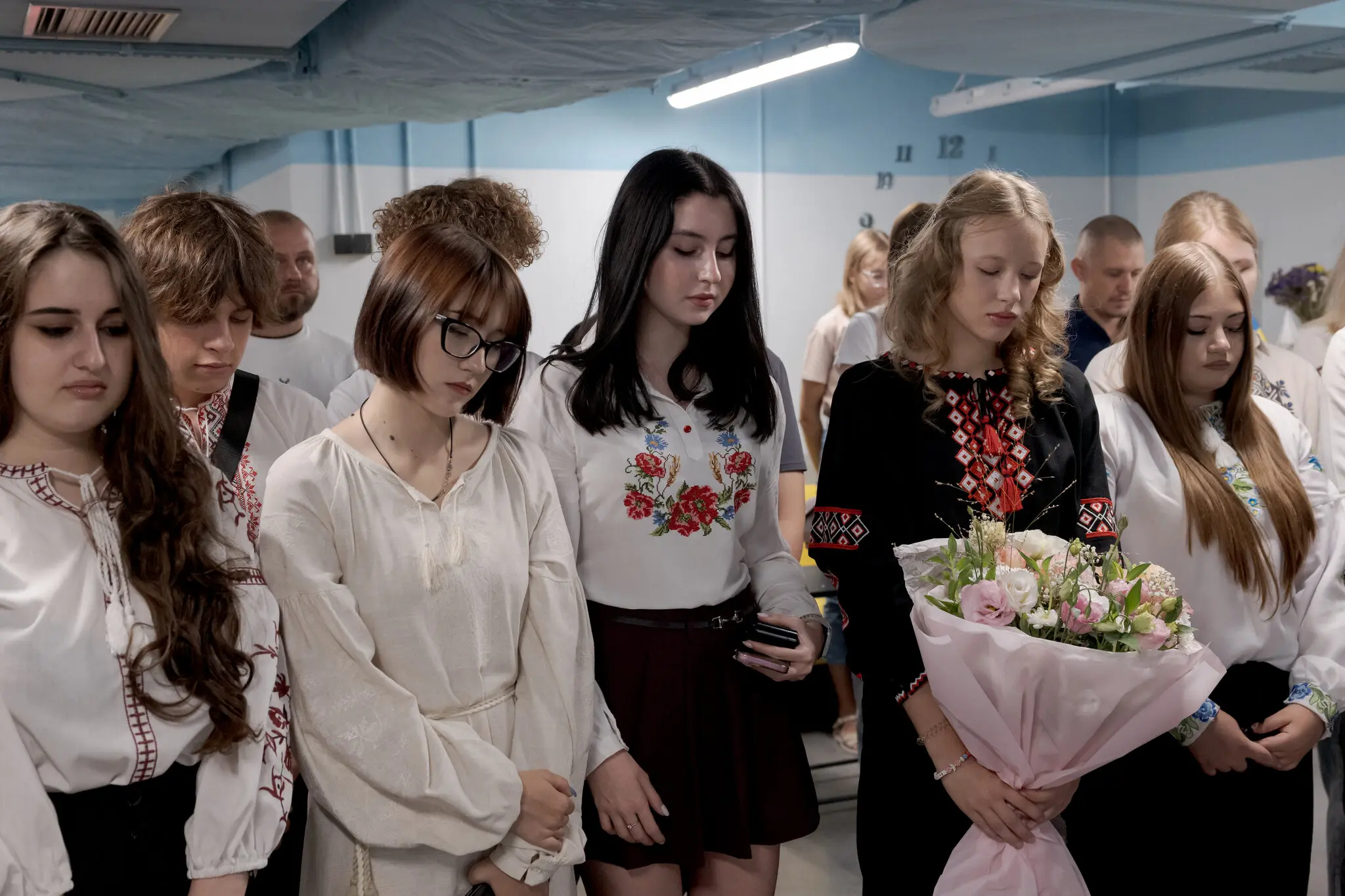 Дотримання щоденної хвилини мовчання — Єнджей Новіцький
Halyna Volkova, the principal of Sichovyi Collegium, does not describe this reality as apocalyptic. For her pupils, it is simply school — a place to study, take exams, make friends and think about the future. Even under these conditions, students are still capable of achieving the highest scores on national tests.
That normality may be the most extraordinary part of the story. Children play football underground, complain about lessons, study English and wait for the next break. A few metres above them, sirens may be sounding, but the school day continues.
For the Ukrainian state, underground schools are gradually shifting from an emergency measure to a long-term infrastructure policy. Zaporizhzhia region is planning dozens of such facilities, while the government continues to finance protected learning spaces across the country. The implication is clear: a rapid return to the prewar model of schooling is not expected.
For parents in Zaporizhzhia, the conclusion is much simpler. They do not need a school as a symbol of resilience or as an architectural answer to modern warfare. They need a place where they can leave their child in the morning and spend a few hours without fearing that the next missile or drone will interrupt the lesson.
The central paradox of Ukrainian education in the fifth year of full-scale war is that some of the safest children are learning in places where they cannot see the sky. Underground schools do not give them back a peaceful childhood. They create a space where the war, at least, does not take away the lesson as well.