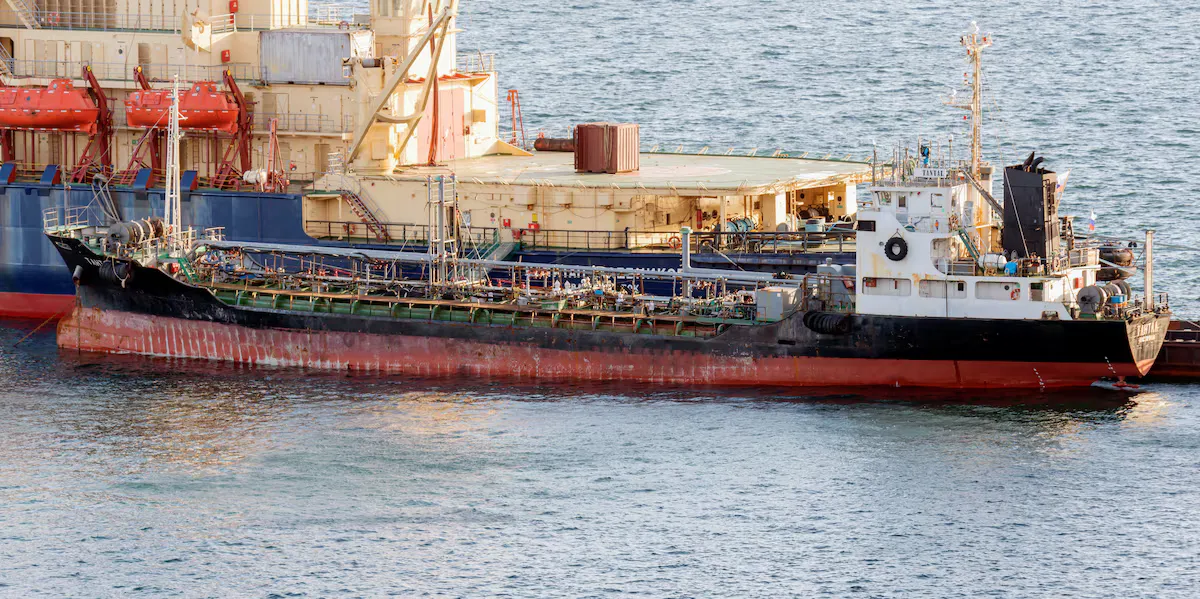






















Tankers and bulk carriers entering the Bosphorus are beginning to look like improvised warships. Tyres hang from hulls, water-filled containers surround vulnerable sterns and steel netting rises above superstructures — crude attempts to protect civilian vessels from a threat commercial shipping was never built to confront.
The damaged vessels arriving near Istanbul show why crews are experimenting. The Russian-flagged Omskiy-107, its command deck burned out, was abandoned and drifted from Russian waters toward the Turkish coast. Other ships have reached the Bosphorus bearing visible damage and escorted by coast guard boats.
The escalation has accelerated since July. Russia intensified attacks on Ukraine’s main grain-export hubs at Odesa, Chornomorsk and Pivdennyi, while Ukraine expanded strikes against ships and infrastructure supporting Russian oil and grain exports. Commercial navigation increasingly sits between those two campaigns.
One response has been strikingly low-tech. The Sierra Leone-flagged tanker Caruzo crossed the Bosphorus with water tanks hanging around its stern, while the Russian tanker Khrizopraz appeared with tyres suspended along its hull. Other tankers have installed protective netting over exposed sections.
According to Daycom’s analysis of verified public reporting, Black Sea drone attacks are now altering more than battlefield tactics. They are changing the economics of merchant shipping itself, forcing shipowners to price in physical protection, higher insurance, delays and the possibility that an ordinary voyage may suddenly become a combat-zone transit.
The logic behind the improvised barriers is simple. A net may catch or detonate a small aerial drone before it reaches the bridge. Water-filled containers can absorb part of a blast, while tyres may provide an additional buffer. These measures borrow directly from adaptations first seen on military vehicles and installations.
Their effectiveness, however, has hard limits. Corey Ranslem, chief executive of maritime security firm Dryad Global, told Reuters that such defences may help against some smaller drones but can offer little protection against larger military systems carrying substantially heavier explosive payloads.
The challenge is even greater when the attacker approaches from the sea. Fast, remotely controlled naval drones can carry large explosive charges and strike near the waterline or engine room. Nets draped above a bridge or tyres along a hull are unlikely to stop a powerful surface drone making direct contact.
For commercial vessels, there is no easy substitute. A naval warship can combine radar, electronic warfare, armed watch teams and dedicated interception systems. A grain carrier or oil tanker is designed to move cargo efficiently, not to identify and destroy small high-speed targets approaching through the air or across the water.
That explains the improvised appearance of the new defences. Shipowners face a choice between avoiding dangerous routes, paying for expensive specialised systems or using inexpensive physical barriers that might reduce damage in some scenarios. None offers the certainty that civilian shipping once expected from established trade lanes.
Arming thousands of merchant ships would create additional legal and operational problems. Electronic jamming can interfere with navigation and communications, while weapons aboard civilian vessels alter security requirements and raise questions about crews, port access and the status of ships operating close to a war zone.
The sight of tyres and cages on large tankers therefore represents vulnerability rather than confidence. A vessel worth tens of millions of dollars, carrying a cargo potentially worth even more, may now depend partly on a barrier costing a tiny fraction of that amount to reduce the impact of an inexpensive drone.
Turkey is particularly exposed to the consequences. The Bosphorus is the only maritime gateway between the Black Sea and the Mediterranean, and Turkish commercial vessels have themselves faced repeated danger. Ankara recently summoned Ukraine’s ambassador after attacks on two ships near the Russian port of Tuapse.
A serious casualty near the strait could become far more than a bilateral wartime incident. A disabled tanker, major fire or uncontrolled vessel near the Bosphorus could disrupt one of the world’s most strategically important shipping corridors and produce environmental as well as commercial consequences.
President Recep Tayyip Erdogan has increasingly framed the issue in terms of food security. He warned that renewed attacks in the Black Sea were contributing to grain shortages, with African countries particularly vulnerable to disruptions in supplies from two of the world’s major agricultural exporters.
Ankara is again trying to mediate. Foreign Minister Hakan Fidan said Turkey had prepared a plan to restore safer passage for grain shipments and was discussing it with both Russia and Ukraine. The initiative seeks to recreate at least part of the stability achieved during the earlier Black Sea grain arrangement.
That agreement, brokered by Turkey and the United Nations in 2022, allowed nearly 33 million metric tons of Ukrainian grain to leave Black Sea ports before Russia withdrew in 2023. For a time, it demonstrated that limited rules for commercial navigation could survive even during a major interstate war.
Moscow now says it sees no grounds for reviving the old arrangement. Russia has continued to argue that restrictions affecting its own food and fertiliser trade were not adequately addressed, while Turkish officials want a narrower maritime solution before any wider settlement of the war becomes possible.
That disagreement goes to the heart of the present crisis. Turkey wants to separate food exports and civilian navigation from the broader conflict. Russia and Ukraine both have powerful reasons to treat maritime infrastructure as part of the economic machinery sustaining the other side’s ability to fight.
For Kyiv, Russian oil and grain exports generate foreign currency and public revenue. Ports, tankers and export infrastructure can therefore be viewed as parts of a wider wartime economic system rather than isolated commercial assets. Attacking them allows Ukraine to impose costs far behind the land front.
Moscow applies a similar logic to Ukraine. Russian attacks against Black Sea and Danube ports target a sector essential to Ukrainian export earnings. Damaging grain terminals and transport infrastructure places pressure not only on individual companies but on the country’s wider ability to finance itself during war.
The result is a maritime war of attrition in which civilian shipping becomes increasingly entangled with strategic economic targets. A vessel does not have to carry military cargo to face danger; its route, ownership, destination or proximity to infrastructure may be enough to place it inside a contested commercial network.
Ukraine’s reliance on alternative routes has already increased as attacks disrupt its main Black Sea ports. By late August, around 80 ships were reportedly waiting for access to Ukrainian Danube ports through the Sulina Canal, illustrating how quickly pressure on one transport corridor can create congestion elsewhere.
That congestion has economic consequences long before a drone actually hits a ship. Vessels waiting for access continue to incur operating costs, exporters face delays and port capacity becomes harder to schedule. Air-raid alerts and inspection bottlenecks further slow cargo movements even when terminals remain physically intact.
Insurance is another immediate transmission mechanism. As the probability of attack rises, war-risk premiums increase. A shipowner may therefore face a substantially more expensive voyage even if the vessel itself never encounters a drone, because insurers are pricing the probability of a catastrophic loss across the entire route.
Higher insurance is then added to freight rates, delays and the cost of defensive measures. A few water tanks or rolls of netting may be cheap, but they are merely the most visible part of a much larger bill being transferred from the battlefield into global shipping and ultimately to exporters and consumers.
Food markets are particularly sensitive to that chain. Russia and Ukraine remain major grain suppliers, and a sustained increase in Black Sea transport costs can spread rapidly into import prices. The effect is most painful in countries where food already absorbs a large share of household income and governments have limited fiscal room.
That is why Turkey’s emphasis on Africa is economically credible. For wealthy importing states, a modest increase in freight costs may be manageable. For lower-income countries already facing currency weakness, fuel costs and climate-related pressure, another rise in grain prices can quickly become a fiscal and social problem.
The new threat also challenges traditional assumptions about civilian status at sea. Merchant ships have long operated through regions affected by conflict, but widespread access to cheap, precise unmanned systems allows combatants to create risk at far greater distances and with much lower costs than conventional naval forces.
The economic asymmetry is stark. A drone may cost a fraction of the value of the tanker it threatens, while a single successful strike can produce repairs, lost cargo, environmental damage, insurance claims and weeks of interrupted operations. The defender must protect every voyage; the attacker needs only occasional success.
That means maritime coercion can work even without sinking many ships. If operators become convinced that losses are plausible, some will withdraw, others will demand higher freight rates and insurers will increase premiums. The expectation of violence begins producing economic effects before additional weapons are launched.
Recent arrivals at the Bosphorus have made that risk tangible. The Liberian-flagged Anna S passed through with visible deck damage, while other heavily damaged commercial vessels have required Turkish escorts. Each becomes another data point for companies deciding whether the next Black Sea voyage remains commercially acceptable.
For crews, the transformation is more personal. Merchant sailors accustomed to planning for storms, mechanical failure and fire must now consider blast damage, drone approach vectors and the most vulnerable parts of the ship. The psychological boundary between seafarer and participant in a conflict zone is narrowing.
More sophisticated commercial counter-drone technology will almost certainly follow. Sensors capable of detecting small airborne or surface targets, improved fire suppression and protected bridge structures may become more common. But retrofitting large sections of the world merchant fleet would require major investment and regulatory changes.
For now, improvisation remains easier. Even an imperfect barrier may divert a small drone, limit fragmentation or provide enough protection to prevent a fire from reaching critical machinery. The fact that crews consider such marginal advantages worthwhile shows how seriously the danger is already being treated.
The underlying problem, however, cannot be engineered away ship by ship. A safe corridor in 2026 would need more than geographic coordinates. It would probably require understandings covering ports, anchored vessels, grain and oil terminals, approaches to harbours and procedures for investigating disputed attacks.
That is considerably harder than the challenge negotiators faced in 2022. Both sides now possess more capable long-range drones, naval unmanned systems have become routine weapons and economic infrastructure far from the land front is increasingly treated as a legitimate means of weakening the opponent.
The incentives also work against restraint. Russia sees pressure on Ukrainian ports as leverage over Kyiv’s economy. Ukraine sees attacks on Russian export infrastructure as one of the few tools capable of imposing substantial material costs inside Russia without having to break through heavily defended land positions.
Neither side is therefore likely to abandon maritime strikes merely because commercial shipping would benefit. A durable arrangement would require each to receive something it values more than the freedom to keep attacking the other’s economic networks — precisely why security experts increasingly connect maritime stability to broader peace efforts.
Until that changes, the Black Sea will remain a place where global commerce adapts to warfare in real time. Nets, tyres and water tanks may look primitive beside autonomous weapons, satellites and modern navigation systems, but they capture the central reality better than any technical briefing.
Black Sea drone attacks have made attacking cheaper than guaranteeing defence. As long as that imbalance persists, shipowners will keep experimenting, insurers will keep repricing danger and importing countries will keep absorbing costs generated hundreds or thousands of kilometres from their own shores.
The most important development is therefore not that tankers have begun hanging tyres from their hulls. It is that major civilian vessels now prepare for a possible attack as part of an ordinary commercial voyage. The Black Sea has crossed the line at which merchant shipping can still regard the war as something happening around it.
Turkey may yet rebuild a protected grain mechanism, but physical barriers cannot substitute for political rules accepted by both combatants. Until such rules return, commercial ships will keep navigating between Russian and Ukrainian campaigns with whatever protection they can improvise — and the cost of that insecurity will travel with every cargo.