













Ukraine’s new defence minister, Yevhenii Khmara, is preparing to tell allies not merely how much money the country needs, but what it intends to achieve with it. Kyiv is trying to close a military funding gap of roughly $27 billion and wants part of its European financing released earlier than originally planned.
The central proposal is to bring forward some of the €45 billion currently scheduled for 2027. At the same time, the Defence Ministry wants larger contributions from existing partners and hopes to draw in countries that have so far played only a limited role in financing Ukraine’s defence.
Khmara has framed the new approach around four questions: what tasks the Defence Forces must accomplish, what projects are needed to carry them out, what results those projects should produce and within what timeframe. In practical terms, Kyiv is trying to move from asking for “more money” to financing defined military capabilities.
The need has become more urgent because expenditure in the first half of the year ran substantially above expectations. President Volodymyr Zelenskyy had already warned in August that the military budget faced a significant shortfall and that additional funding would be required for the autumn and winter period.
Daycom’s analysis indicates that Ukraine’s military budget problem is no longer simply a question of securing more aid. Kyiv must convince its partners that additional billions will translate into measurable results — more interceptions, more strikes, more drones, safer logistics and fewer Ukrainian troops exposed to unnecessary risk.
A European financial structure already exists to support that effort. Earlier this year, the European Union finalized a €90 billion loan programme for Ukraine covering 2026 and 2027. Roughly €60 billion is intended for defence requirements and procurement, with the rest supporting the wider state budget and macroeconomic stability.
Ukraine has access to about €45 billion under the 2026 allocation. A substantial share is directed toward defence-industrial capacity, while the remainder supports broader financial needs. Kyiv’s current request is therefore less about creating an entirely new package than about changing the timetable of money already agreed.
That distinction matters. Ukraine is not asking Europe to produce the full $27 billion gap from scratch. It wants to cover part of the shortfall by accelerating funds that would otherwise arrive next year. But doing so immediately raises another question: what will finance the needs of 2027?
Simply pulling money forward does not solve the problem in full. It buys time over the coming months while reducing the financial buffer available next year. Kyiv therefore needs earlier disbursements, new contributors and a larger defence-industrial base capable of converting additional money into equipment quickly.
The European Union has already begun releasing money under the new framework, with a significant portion of the initial funding directed toward defence procurement. The broader mechanism relies on borrowing by the EU on capital markets and financial guarantees backed by the Union’s budget.
The money is not an unrestricted cheque. European support is tied to governance and anti-corruption requirements, while defence spending follows specific procurement rules. Ukrainian, European and selected partner-country manufacturers receive preferential treatment within the system.
That means Khmara’s war plan will also function as a financial document. Partners need to see not only a list of needs but a credible production chain: who will manufacture a system, how quickly it can be delivered, how many units can be produced and what battlefield effect they are expected to generate.
The approach fits Khmara’s background. Before becoming defence minister, he led the Security Service’s elite Alpha special-operations centre and was closely associated with technology-driven and long-range operations. Parliament approved him as defence minister in August.
Even before his appointment was finalized, Khmara described asymmetric warfare as one of the central principles of Ukraine’s strategy: spend less than the value of the damage imposed on Russia. He identified military industry, transport networks and fuel infrastructure among the priority categories for such pressure.
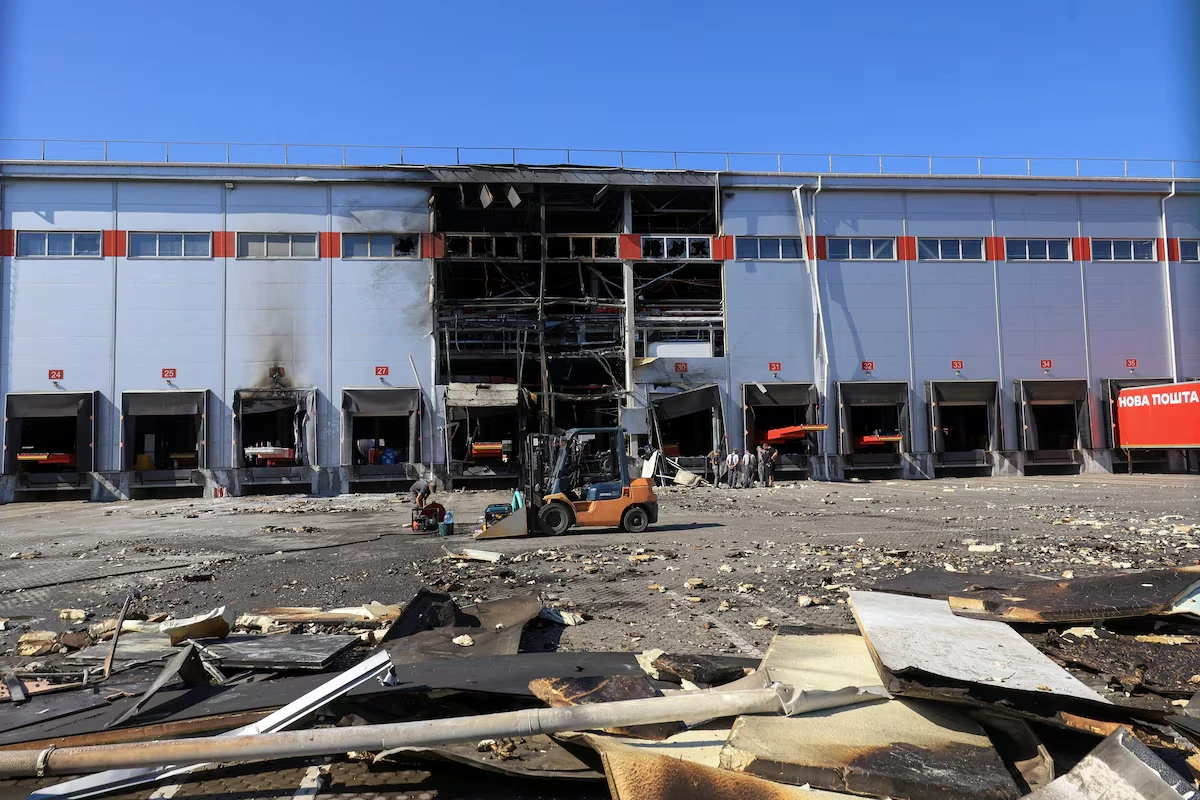
That logic is already visible in Ukraine’s long-range campaign against Russian refineries, warehouses, logistics centres and defence-related facilities. Kyiv cannot match Moscow symmetrically in aircraft, missiles or manpower, so technological asymmetry is becoming one of the main ways it tries to offset the resource imbalance.
But the funding requirement is not limited to offensive systems. Air defence remains one of Ukraine’s most acute shortages. Russia is launching thousands of drones and missiles each month, forcing Kyiv to consume expensive interceptors while simultaneously expanding cheaper layers of defence.
Fast jet-powered drones have become a particular challenge. Khmara has said Ukraine has tested four potential interceptor systems designed to engage such targets. The next step is to identify models that can move beyond successful trials and be manufactured in the thousands.
That is a fundamentally different air-defence economy. Using an expensive surface-to-air missile against a relatively cheap drone may be unavoidable in an emergency, but it is not a sustainable model for a long war. Ukraine needs a lower-cost interception layer that can be used at scale without exhausting strategic missile stocks.
Part of that production base is already being created. Ukraine has ordered thousands of domestically produced interceptor drones intended to counter Shahed-type aircraft and similar threats, spreading contracts across multiple manufacturers to increase volume and reduce dependence on a single supplier.
Jet-powered systems are more difficult because their higher speed leaves defenders less time to detect, classify and engage them. That is why Ukraine’s military leadership is pushing for faster development and mass production of new defensive systems, including higher-speed interceptors.
If one or two of the tested designs can be converted into a reliable mass-produced weapon, it would provide a clear example of what Khmara wants to present to partners: not abstract support for air defence, but a defined amount of funding for factories, components and thousands of interceptors delivered on a fixed schedule.
The Defence Ministry is using the same model in discussions over reconnaissance and strike drones, air-defence systems, unmanned ground vehicles and fibre-optic drones. These categories are increasingly being presented as production programmes rather than one-off aid packages.
The $27 billion shortfall, however, cannot be reduced to technology alone. Ukraine is entering another phase of the war with a severe manpower problem, a difficult mobilization system and the continuing need to reinforce units that have spent years in combat. Money can improve equipment, but it cannot by itself create infantry.
Khmara has therefore placed particular emphasis on preserving soldiers’ lives. He has argued that the health and survival of service members must be a priority for every commander and that the Defence Ministry must be responsible not only for supplying the front, but also for treatment, rehabilitation and return to service.
That links financing to a broader objective: reducing the human cost of holding the line. If an additional drone, ground robot or automated system allows a soldier to avoid a dangerous resupply route, its value is measured in more than the price of enemy equipment it may destroy.
Khmara is also trying to shorten the distance between the ministry and combat units. Since taking office, he has visited command posts and frontline formations to gather information directly from commanders and troops about what is working, what is failing and what must change.
He is building the new management structure alongside Commander-in-Chief Mykhailo Drapatyi and Chief of the General Staff Ihor Skybiuk. The political requirement from Kyiv is clear: the Defence Ministry and military command must operate with greater unity and react much faster to changes in the war.
That is not a bureaucratic detail. A technology that works on the battlefield today may lose much of its effectiveness within months. The army cannot afford a year-long cycle between identifying a problem and signing a contract. Requirements must move quickly from the front to manufacturers and solutions back to units.
This is where Khmara’s promise of a “clear plan” will face its most important test. An ally can allocate €1 billion, but if procurement is slow, components are unavailable or the system does not match the enemy’s actual tactics, a formally funded capability does not become battlefield effect.
Financing Ukrainian production also gives partners a specific advantage. Money is being spent inside an ecosystem where weapons are tested under real combat conditions and where manufacturers can modify designs on the basis of frontline feedback without waiting through years-long modernization programmes.
The European loan effectively reinforces that model. A large part of the defence component is intended for production capacity and procurement, with Ukrainian companies participating alongside European suppliers. The arrangement is therefore both support for Ukraine and an investment in a broader European defence-industrial base.
The largest risk is that the urgency of 2026 begins consuming resources intended for 2027 faster than new funding sources appear. An accelerated European tranche can close today’s gap, but it does not eliminate future salaries, ammunition bills, equipment repairs and manufacturing contracts.
Khmara’s presentation to partners will therefore amount to an attempt to sell a strategy rather than a budget. Allies are being asked to finance a specific model of war: technologically driven Defence Forces, long-range asymmetric strikes, cheaper anti-drone air defence and a faster cycle linking soldiers, procurement officials and factories.
For Kyiv, this is also a way to address growing fatigue among partners over repeated funding requests. The longer the war continues, the harder it becomes to persuade governments with another headline deficit alone. A model in which every €100 million is tied to a defined number of systems, a delivery date and an expected effect is easier to defend politically.
No financial document, however, removes the fundamental constraint that Russia is adapting too. Moscow is expanding production, changing technologies and altering tactics. A Ukrainian “war plan” therefore cannot be a fixed annual spending sheet; it must allow money to move quickly toward whatever new threat emerges.
That is the central challenge facing the new defence minister. Khmara has to find roughly $27 billion, persuade partners to accelerate financing, turn that money into production and prove to frontline units that the new management system can respond faster than the one it replaces.
If that succeeds, early European financing could become more than a temporary patch for a budget hole. It could fund a different model of Ukrainian defence. If it fails, bringing forward money from 2027 will merely postpone the same problem by several months — in a war where time is becoming almost as scarce as money.