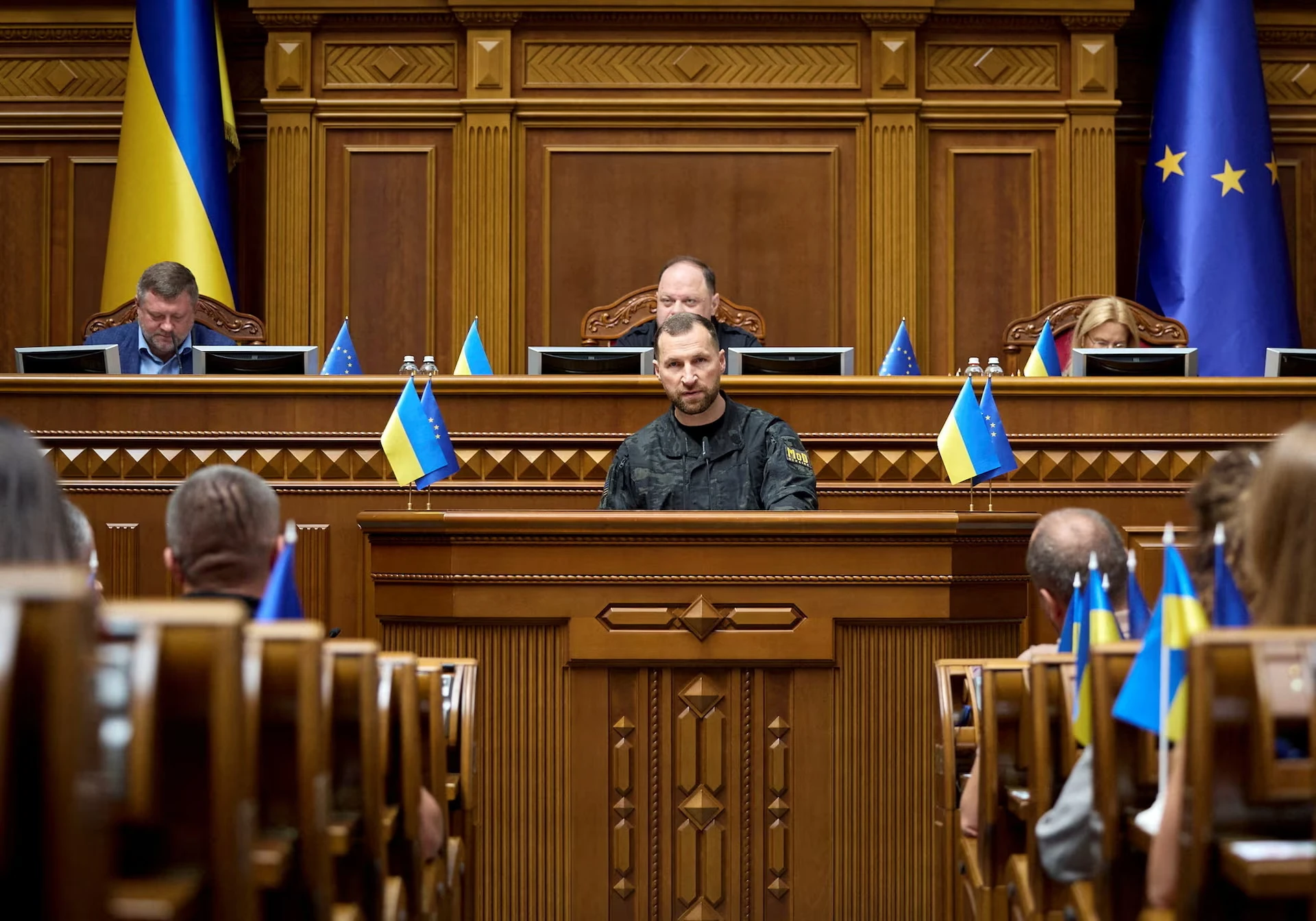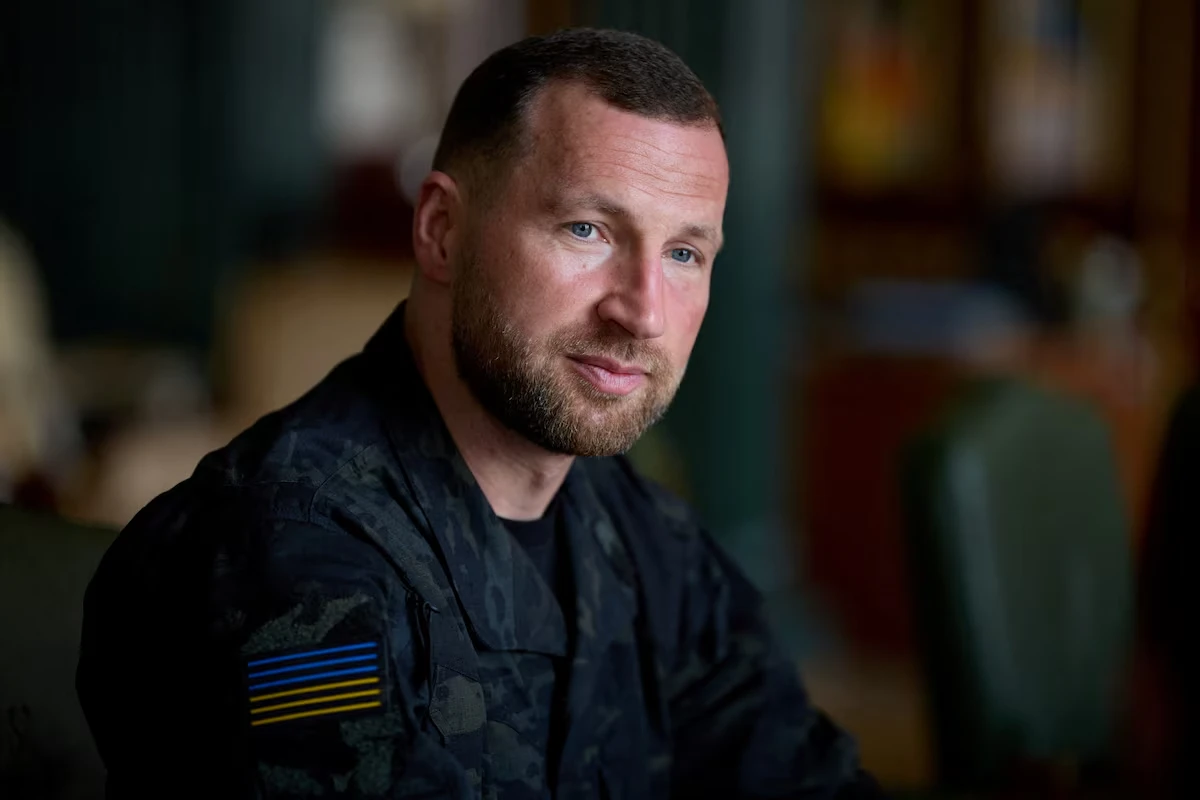


















Yevhenii Khmara has become Ukraine’s new defence minister after winning the support of 312 lawmakers. The former special operations commander takes over at a moment when Kyiv needs less institutional disruption, faster technological scaling and a defence system capable of sustaining the war without another prolonged reset.
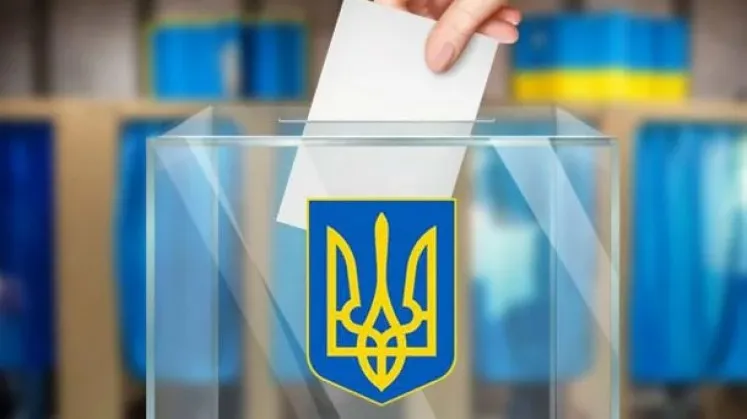
Ukraine’s parliament formally approved Yevhenii Khmara as defence minister on August 19, backing his appointment with 312 votes, comfortably above the 226 required. The decision ended the interim period in which Khmara had already been running the ministry in an acting capacity.
The size of the parliamentary majority removes at least one immediate problem: uncertainty at the top of the country’s most important wartime ministry. Ukraine now has a permanent defence chief overseeing procurement, international military cooperation and a growing share of the technological transformation of the armed forces.
But the appointment follows an unusually turbulent month. The dismissal of former minister Mykhailo Fedorov triggered protests and a wider argument over the direction of defence reform. Khmara therefore inherits not only a vast bureaucracy, but also the burden of proving that another leadership change will not produce another institutional break.
His professional background is markedly different from that of his predecessor. Khmara emerged from inside the security establishment, led the Security Service’s elite Alpha special operations unit and later served in senior positions within the country’s security apparatus. Much of his reputation is tied to high-risk operations and wartime command.
Daycom’s preliminary analysis suggests that the central significance of Khmara’s appointment lies in an effort to bring political leadership at the Defence Ministry closer to the kind of war Ukraine is increasingly fighting — one shaped by drones, long-range strikes, special operations and shorter cycles between intelligence, decision and attack.
That matters because Ukraine cannot afford to compete with Russia symmetrically in every category. Moscow still possesses greater manpower reserves and a large defence-industrial base. Kyiv’s answer has increasingly been to use technology, precision and speed to offset disadvantages in scale.
Khmara has already signalled support for that logic. The objective is not necessarily to match Russia platform for platform or shell for shell, but to find ways in which a less expensive system can impose disproportionately greater costs on the enemy.
Long-range drones are the clearest example. Ukrainian strikes increasingly reach military, logistical, fuel and other infrastructure far beyond the front. Sustaining such a campaign requires more than airframes: it depends on intelligence, mission planning, production capacity and the ability to replenish stocks after large-scale operations.
The new minister also faces the continuing challenge of protecting Ukraine from Russian air attacks. Ballistic missiles, attack drones and aviation-launched weapons remain among the country’s most severe vulnerabilities, making domestic production and foreign air-defence support equally important.
Khmara’s relationship with the military command will be another major test. Friction between civilian defence leadership and the armed forces hierarchy helped drive the previous political crisis. Disagreement is inevitable in wartime, but prolonged public conflict can slow decisions that need to move rapidly from headquarters to the front.
That means Khmara must now prove himself as more than an experienced security operator. A defence ministry is not a special mission or a single command chain. It is a massive administrative system managing budgets, weapons contracts, industrial policy, international partners and the requirements of hundreds of thousands of service members.
This may be the hardest transition of his career. In a special operation, success can depend on a handful of correct decisions made quickly. At ministry level, a procurement mistake or delayed contract may not become visible until months later, when the consequence appears as a shortage on the battlefield.
Rapid turnover at the top of the Defence Ministry therefore represents a risk in itself. If every new minister redesigns the system around a personal vision, the bureaucracy spends precious time reorganising instead of executing existing programmes. In a long war, management continuity becomes part of military capability.
Khmara inherits a substantial reform agenda. It includes greater digitalisation, expansion of unmanned systems, changes to defence procurement and the wider use of battlefield data in decision-making. The relevant question is no longer who introduced each initiative, but which of them actually delivers measurable value to combat units.
A wholesale dismantling of his predecessor’s system would be as risky as preserving every policy unchanged. Khmara will need to conduct his own audit: keep what works, correct what does not and abandon programmes that generate more bureaucratic activity than battlefield effect.
The technological contest is also moving too quickly for static policy. Russia is adapting to Ukrainian drones, expanding electronic warfare, altering supply routes and hardening key facilities. Systems that provided an advantage six months ago may now require major modification or replacement.
That forces the ministry to work with the defence industry differently from an ordinary government buyer. Manufacturers need predictable demand and fast contracting mechanisms. Soldiers need a way to report quickly which systems perform under combat conditions and which are already becoming obsolete.
Air defence will remain one of Khmara’s most urgent responsibilities. Ukraine must continue expanding domestic interceptor production while preserving access to Western systems, ammunition and technologies. At present, neither domestic output nor foreign support alone can fully cover the country’s needs.
The diplomatic role of the defence minister is therefore as important as the technological one. Negotiations over air defence, missiles, artillery ammunition, joint production and long-term financing require continuity and trust. The reliability of the person sitting across the table can have direct consequences for battlefield supply.
The 312 votes give Khmara a strong political starting point, but they do not guarantee a successful tenure. His formal legitimacy is unlikely to be questioned in the immediate term. The harder issue will be whether he can build confidence through results.
For frontline units, those results are concrete. Will urgently needed drones arrive faster? Will the time between a battlefield request and a signed contract shrink? Will repairs move more quickly? Will Ukraine increase its stocks of long-range systems and air-defence interceptors?
Transparency in defence spending will be another measure of his performance. Wartime budgets create enormous corruption risks, and faster procurement cannot become an excuse for weaker oversight. Money lost through opaque contracts translates directly into fewer resources available to the military.
The appointment is also a test of government communication. The previous political crisis demonstrated how damaging a major personnel decision can become when the public sees the explanation as incomplete or unconvincing. In a prolonged war, even justified changes require a clear account of why they are necessary.
Khmara will need to balance military secrecy with public accountability. A defence minister cannot disclose operational plans or sensitive production details, but he can explain strategic priorities, reform criteria and the logic behind major institutional decisions.
The August 19 vote therefore closed only the procedural phase of the transition. The substance begins now, with decisions on budgets, contracts, manufacturers, command relationships and which technological programmes will receive priority over the coming months.
For Khmara personally, this is a move from an environment where a mission may turn on several precise decisions to one where success depends on thousands of processes functioning at the same time. At the scale of a defence ministry, personal reputation quickly gives way to the quality of institutional management.
Ukraine has appointed a new defence minister not during a strategic pause, but in the middle of an accelerating technological race. Khmara will not have the luxury of a conventional hundred-day settling-in period. The front, procurement system, air-defence network and long-range campaign already require decisions.
That is why the significance of the 312 votes goes beyond parliamentary arithmetic. They gave Yevhenii Khmara a full political mandate and removed the word “acting” from his title. The central question now is whether he can translate a background in special operations into a stable system for managing the defence of an entire country.